
Trunk comparison: BMW i4 vs Durchschnitt Compact SUV

Key Differences
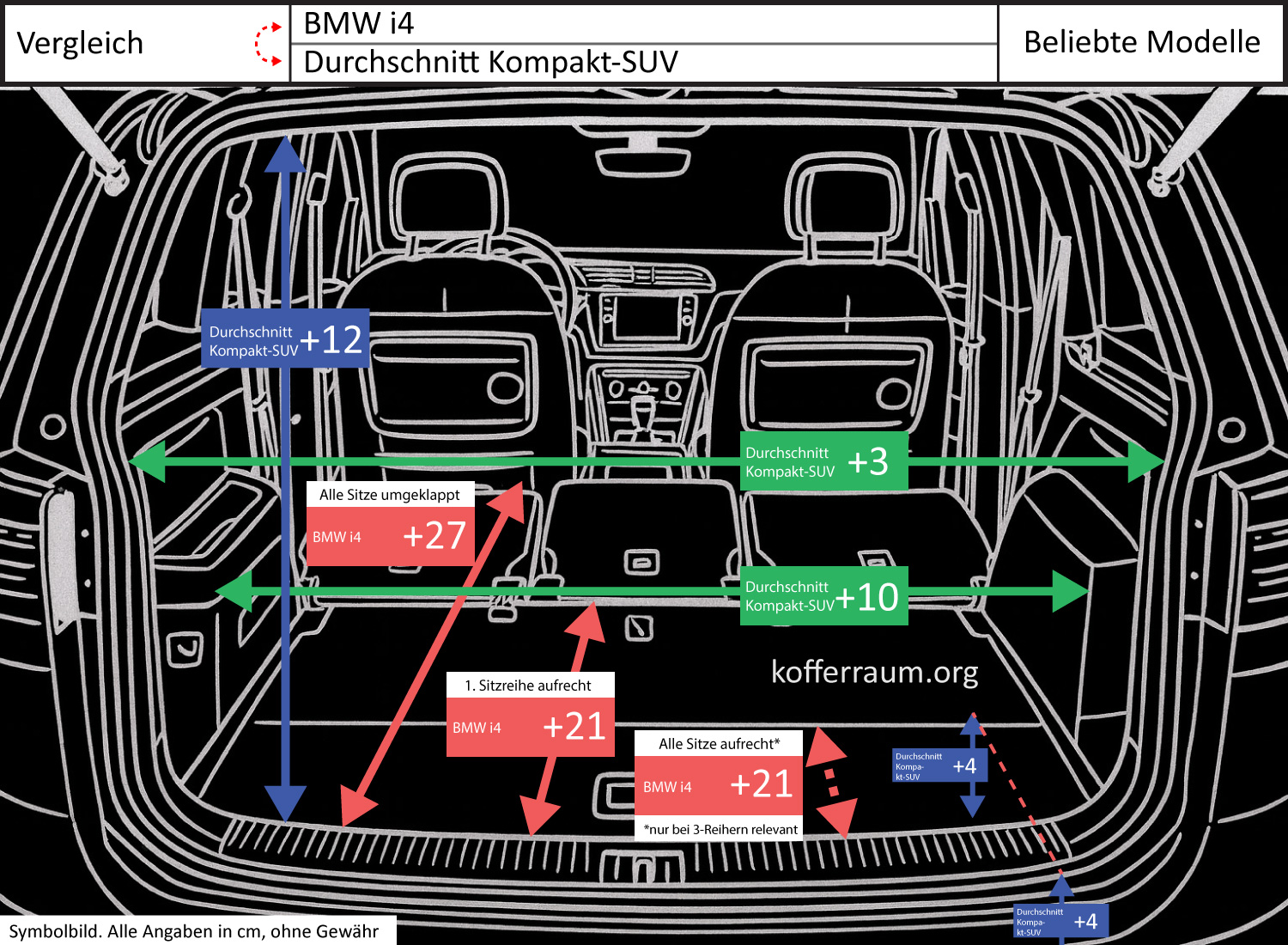
The BMW i4 offers significantly more loading length: with the rear seats folded down, the trunk is
longer, and with the front row upright,
longer compared to the average compact SUV. In contrast, the compact SUV has practical advantages in height and depth: the height of the trunk opening is
greater on the SUV, and the depth from the loading edge seat to the trunk floor is even
greater on the SUV. Additionally, the narrowest width in the trunk is
greater on the SUV. Smaller differences — such as a 1.6 in higher loading edge (+6%) or a 1.2 in wider opening width (+3%) — are comparatively insignificant.
What does this mean for usability?
The greater loading length of the BMW i4 makes it better suited for long, flat items (e.g., skis, laminate packages, long furniture parts) — especially when the rear seats are folded down or bulky items are loaded lengthwise. Those who often transport long but not very tall or wide cargo benefit from this length. The compact SUV is more practical for bulky or bulky cargo: the higher trunk opening facilitates loading tall items, the greater depth means more usable space behind the loading edge, and the greater narrowest width allows wider goods to be loaded crosswise. Overall, the SUV is more flexible for bulky, tall, or wide cargo and for everyday use with variable loading. In brief: BMW i4 = advantage in length and transporting elongated items; compact SUV = advantage in height, depth, and width for bulky or wide cargo. Smaller differences like the slightly higher loading edge on the SUV (≈+1.6 in, 6%) hardly affect practical use but can slightly complicate lifting very heavy loads.