
Trunk comparison: BMW i4 vs Ford S-MAX
Main Differences (Trunk)
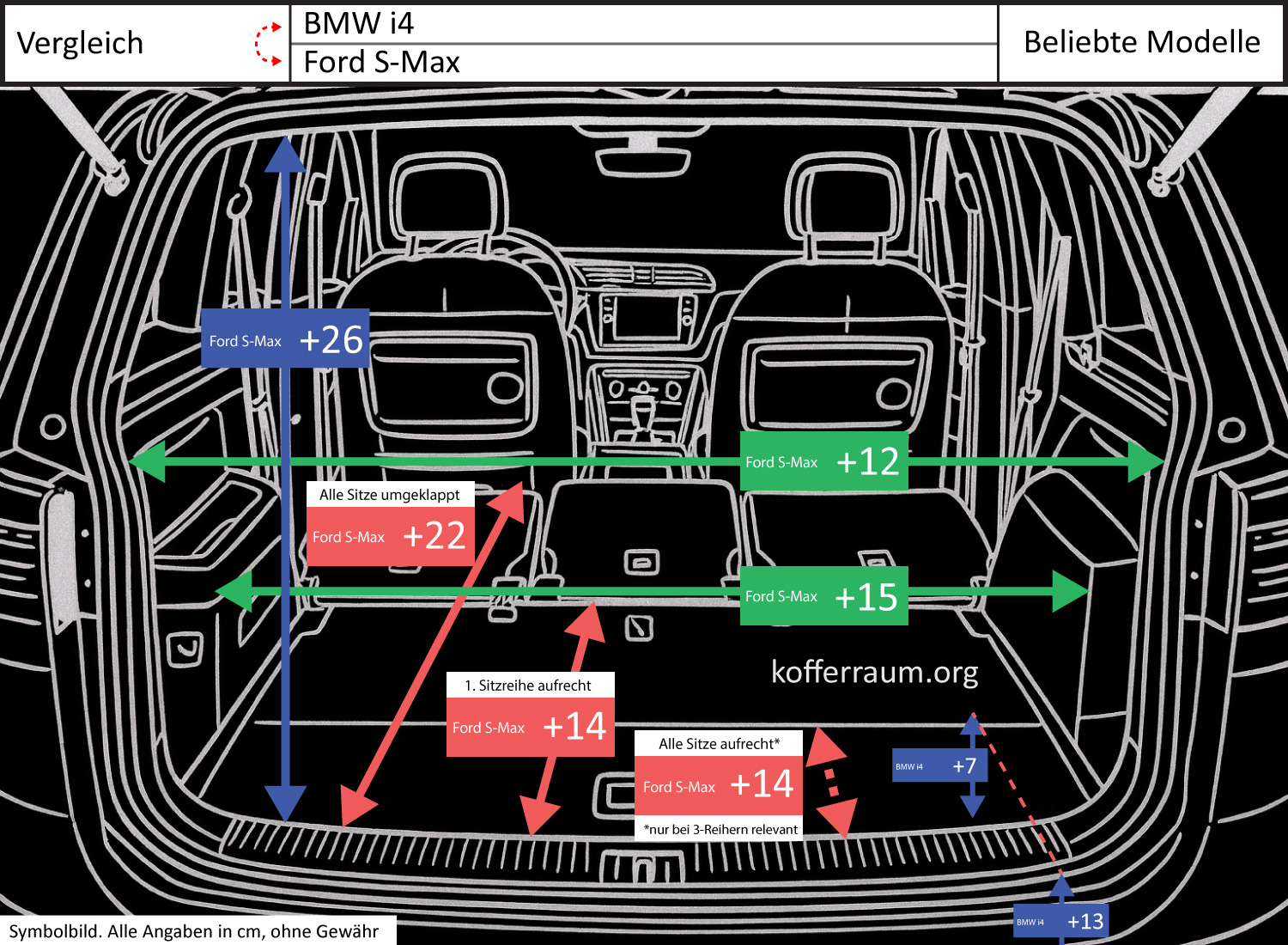
The Ford S-Max offers significantly more usable cargo space in width, length, and opening height: with seats folded down, the trunk of the S-Max is +8.7 in (13%) longer, and with the first row of seats upright, it is +5.5 in (14%) longer.
The trunk opening of the S-Max is +10.2 in (39%) higher, the narrowest point of the trunk is +5.9 in (17%) wider, and the opening width of the trunk is +4.7 in (13%) larger than that of the BMW i4. In contrast, the BMW i4 has a significantly greater depth between the loading edge and the trunk floor (+2.8 in, 233% compared) and a higher loading edge above the road (+5.1 in, 23%).
Impact on Usability
For transporting long or bulky items, the S-Max is more practical: the greater interior length with and without folded seats, the wider narrowest point, and the wider opening make it easier to load suitcases, furniture parts, strollers, or longer items.
The significantly higher opening height of the S-Max makes loading tall items (e.g., boxes, larger equipment) easier.
The BMW i4 brings two practical but limiting features: the greater depth below the loading edge means items can "sink" deeper into the trunk well, which limits stacking higher loads in the visible area but can help prevent shifting.
The higher loading edge of the i4 (compared to the S-Max) makes lifting heavy items into the vehicle more strenuous and less practical for frequent loading and unloading.
In summary: If you regularly transport long, wide, or tall items or frequently load/unload with minimal effort (family use, transport tasks), the Ford S-Max is clearly more advantageous due to its larger opening, width, and length.
If you rarely carry bulky loads and prefer a deeper cargo floor profile (e.g., to store small items deeper), the BMW i4 may suffice — but the higher loading edge and narrower opening significantly limit everyday practicality for larger loads.