
Trunk comparison: BMW i4 vs Hyundai IONIQ
Key Differences
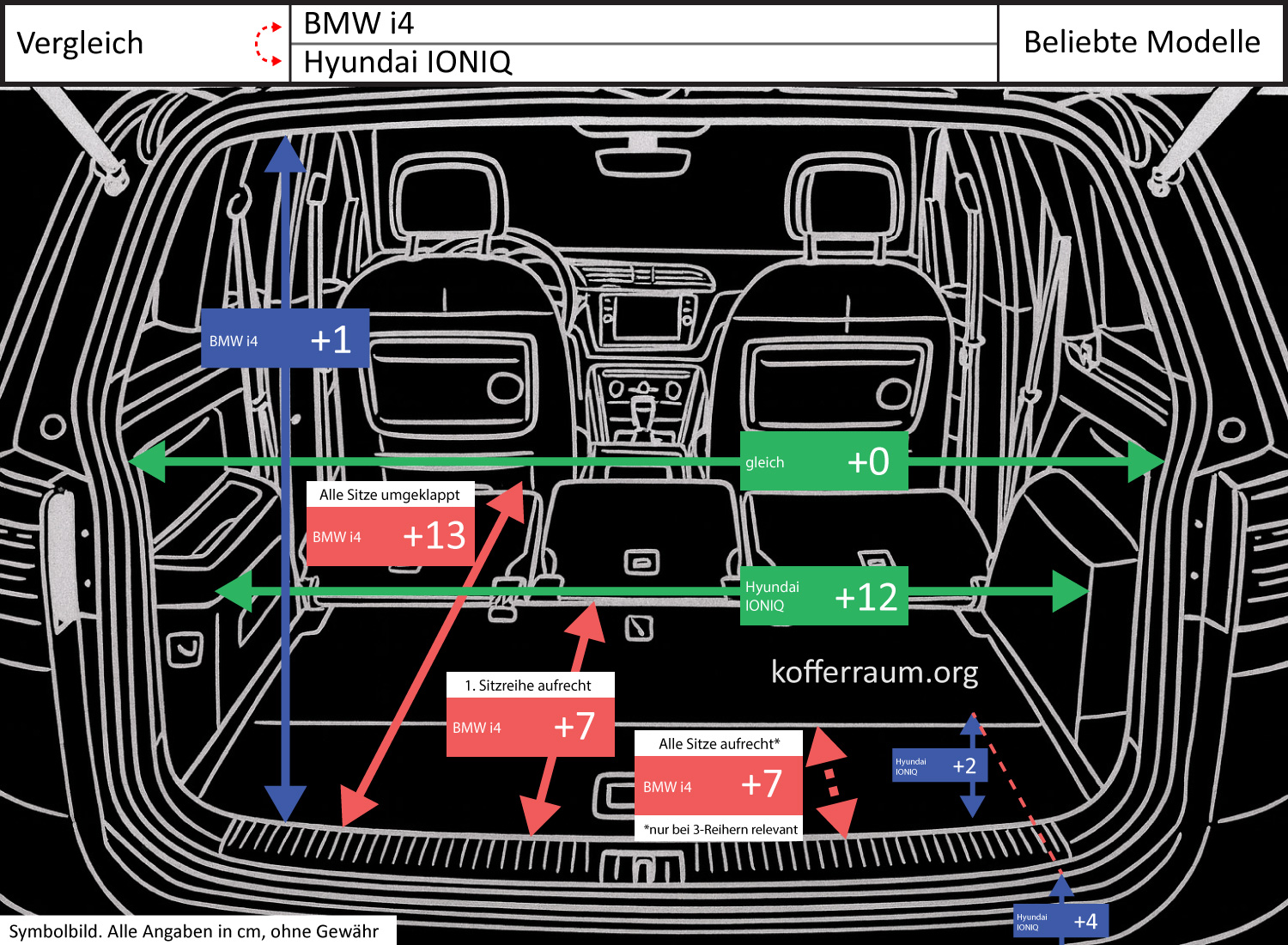
The biggest differences concern the depth and the narrowest width of the trunk: The Hyundai IONIQ has a 0.8 in (≈20%) greater depth from the loading edge to the trunk floor and at the narrowest point a 4.7 in (≈14%) greater width than the BMW i4. All other values differ only slightly: The BMW i4 offers about +5.1 in (≈8%) more loading length with the seats folded down and +2.8 in (≈8%) more length with the front seats upright; the trunk opening height is +0.4 in (≈2%) larger on the BMW, the loading edge of the IONIQ is +1.6 in (≈6%) higher above the road, and the width of the trunk opening is the same on both.
Impact on Usability
The greater depth and wider narrow point of the IONIQ make it more practical for bulky or wide items: wide boxes, strollers, larger trolleys, or bulky cushions can be more easily loaded or slid through since the narrowest point offers more room and the loading floor is somewhat "deeper." The additional depth volume also helps when stacking deeper cargo.
The BMW i4 scores with somewhat more cargo length, especially when seats are folded down — this makes it advantageous for long items like slats, skis, or longer furniture parts that need to be loaded lengthwise.
The approximately 1.6 in lower loading edge of the BMW also makes lifting heavy items into the vehicle easier.
In practice, this means: If you frequently transport wide or bulky items that might cause problems at the narrowest point, the Hyundai IONIQ is better suited due to the larger narrow width and depth.
If, on the other hand, you transport longer items or often need to lift heavy loads, the BMW i4 offers practical advantages through the greater loading length and lower loading edge.