
Trunk comparison: BMW i4 vs Hyundai Kona
Key Differences
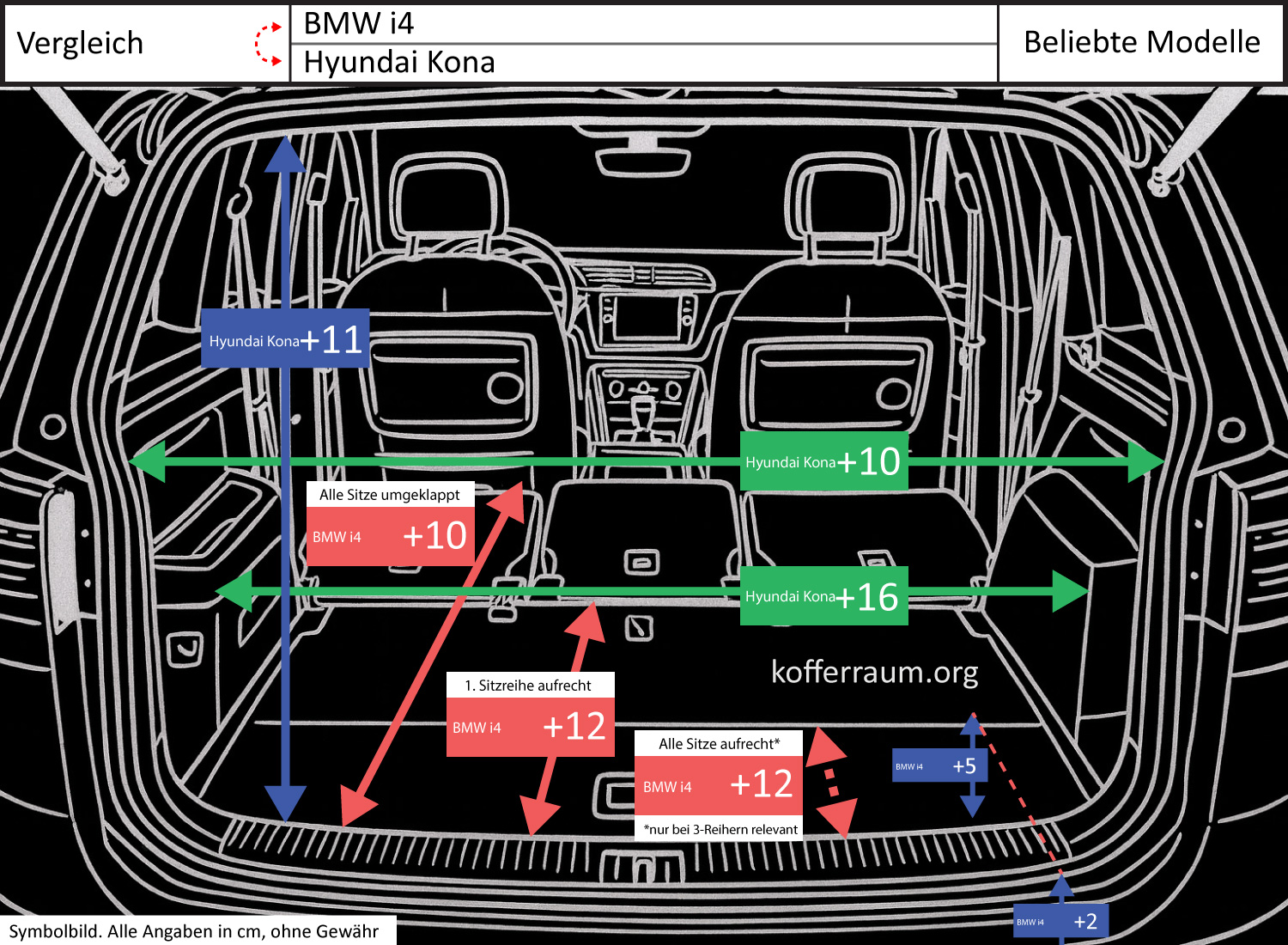
The comparison reveals several relevant differences. The BMW i4 has only a slightly longer cargo space with the rear seats folded down (+6%), but with the front seats upright, the i4 is significantly longer (+4.7 in / 14%).
The trunk opening of the Kona is higher (+4.3 in / 16%) and at the narrowest point as well as in opening width, the Kona is wider: narrowest point +6.3 in (18%), opening width +3.9 in (11%).
Also notable is the depth of the BMW i4's trunk (loading edge to trunk floor), which is significantly larger at +2 in or +100%. Smaller differences: the i4's loading edge is only +0.8 in (3%) higher above the ground.
Impact on Usability
In summary, this results in practical differences in everyday usability: Due to the greater depth and longer loading surface with the front seats upright, the BMW i4 is better suited for long or deep items (e.g., long packages, skis, or longer furniture parts), and it also offers more usable volume for stackable luggage with lowered floor surfaces.
However, the significantly greater trunk depth can make lifting heavy items into the cargo area somewhat more difficult because more lift is required.
The Hyundai Kona scores with bulky, wide, or tall loads: wider narrow points and a larger opening width (+11%) as well as a higher trunk opening (+16%) make it easier to fit and maneuver wide furniture, strollers, toolboxes, or large boxes inside.
The slightly lower loading edge of the Kona also makes lifting heavy loads minimally easier.
Practical rule of thumb: For regularly carrying long or deep loads, the BMW i4 is more advantageous; for frequent loading of bulky, wide, or tall items, the Hyundai Kona is the more practical choice.