
Trunk comparison: BMW i4 vs Mazda Mazda CX-60
Key Differences
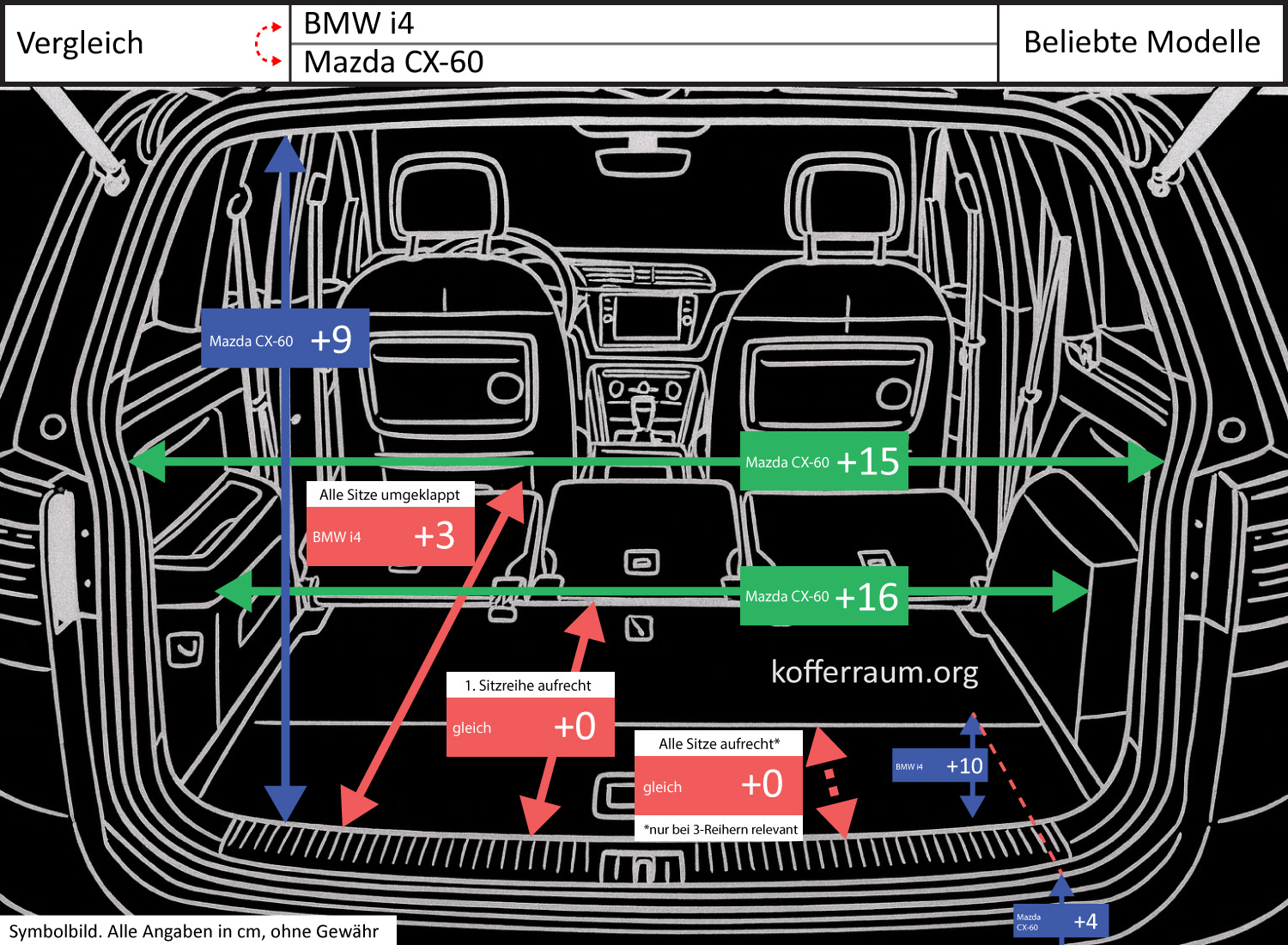
With the front seats upright, the lengths of both trunks are the same; with the seats folded down, the BMW i4 is only slightly longer (+1.2 in / 2%). The most significant differences, however, concern width, opening height, and interior depth:
The height of the trunk opening is +3.5 in (13%) higher on the Mazda CX-60, allowing more vertical clearance through the opening and making it easier to load tall items (e.g., crates, tall boxes). The width at the narrowest point is +6.3 in (18%) greater on the Mazda and the width of the opening is +5.9 in (16%) larger than on the BMW — this makes loading wider or irregularly shaped cargo significantly easier.
The depth of the trunk (loading edge to trunk floor) is +3.9 in (900%) greater on the BMW i4.
This means a deeper cargo area in the BMW, providing more vertical interior space below the loading edge: good for stacking or for lower-lying cargo, but it can make reaching in and retrieving small items more difficult since they lie further down.
Other values with less than 10% difference: the loading edge height is +1.6 in (6%) higher above the ground on the Mazda — this makes loading heavy items somewhat easier in the BMW because the loading edge is lower.
Implications for Usability
For bulky, wide, or tall items (e.g., furniture parts, wide boxes, bulky sports equipment), the Mazda CX-60 has the advantage: larger opening and greater minimum width make loading more straightforward. Those who frequently transport wide or voluminous cargo will find the Mazda more practical.
The BMW i4 scores with significantly greater installation depth and a lower loading edge: this results in more usable vertical interior space and facilitates sliding in heavy items. For heavier or deeper-stowed cargo as well as for easier access to the loading area, the BMW is more advantageous.
Conclusion: With the same trunk length in the normal state, the shape of the space is decisive: Mazda = better for wide/tall single loads and easier maneuvering through the opening; BMW = deeper cargo area and lower loading edge, better for lower-lying or heavier cargo.