
Trunk comparison: BMW i4 vs Mercedes Benz GLE

Key Differences
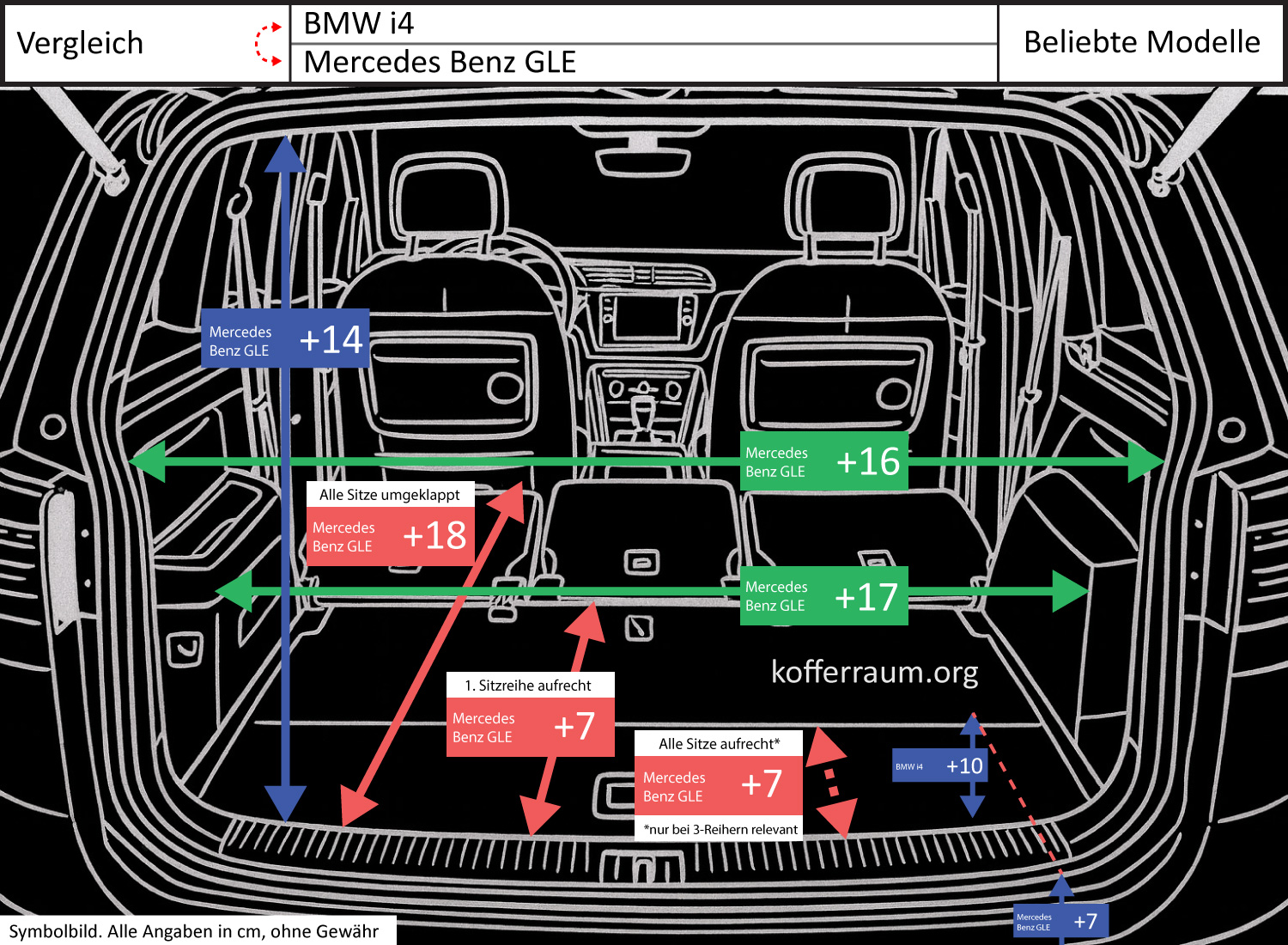
The Mercedes‑Benz GLE offers noticeable advantages over the BMW i4 in several dimensions: the height of the trunk opening is +5.5 in (21%) larger, the width at the narrowest point is +6.7 in (19%) wider, and the width of the trunk opening is +6.3 in (17%) greater.
These differences in favor of the GLE make loading wide or bulky items significantly easier. The overall length with folded seats is +7.1 in (10%) longer in the GLE, and with the front row upright, +2.8 in (7%) longer — these two differences are smaller or exactly 10% and therefore less pronounced.
The BMW i4 stands out with the depth of the trunk (loading edge to trunk floor): it is +3.9 in (900%) greater than in the GLE, meaning the i4 has a significantly deeper loading floor compared to the GLE.
The loading edge of the GLE is +2.8 in (10%) higher above the ground than the i4, which makes lifting heavy loads somewhat less convenient in the GLE (this value is 10% and thus not highlighted).
Impact on Usability
Practically, this means: The GLE is better suited for wide, bulky, or tall cargo — due to the greater width at the narrowest point and the wider and higher opening, furniture parts, strollers, or large boxes can be loaded and maneuvered more easily.
Loading longer items also benefits from the slightly greater overall length with folded seats.
The BMW i4, on the other hand, scores with handling-relevant details: the significantly greater trunk depth creates more usable volume in the cargo area and prevents items from shifting as easily; at the same time, the loading edge is lower, making it easier to lift heavy luggage.
However, the narrower opening width and lower opening height limit the loading of very wide or tall items — such cargo is easier to accommodate in the GLE.
In summary: For frequent transport of wide/bulky or tall items, the GLE is more practical. For easier lifting of heavy loads, more usable depth volume, and everyday luggage, the i4 is advantageous.