
Trunk comparison: BMW i4 vs Peugeot 308 SW 3-row
Key Differences
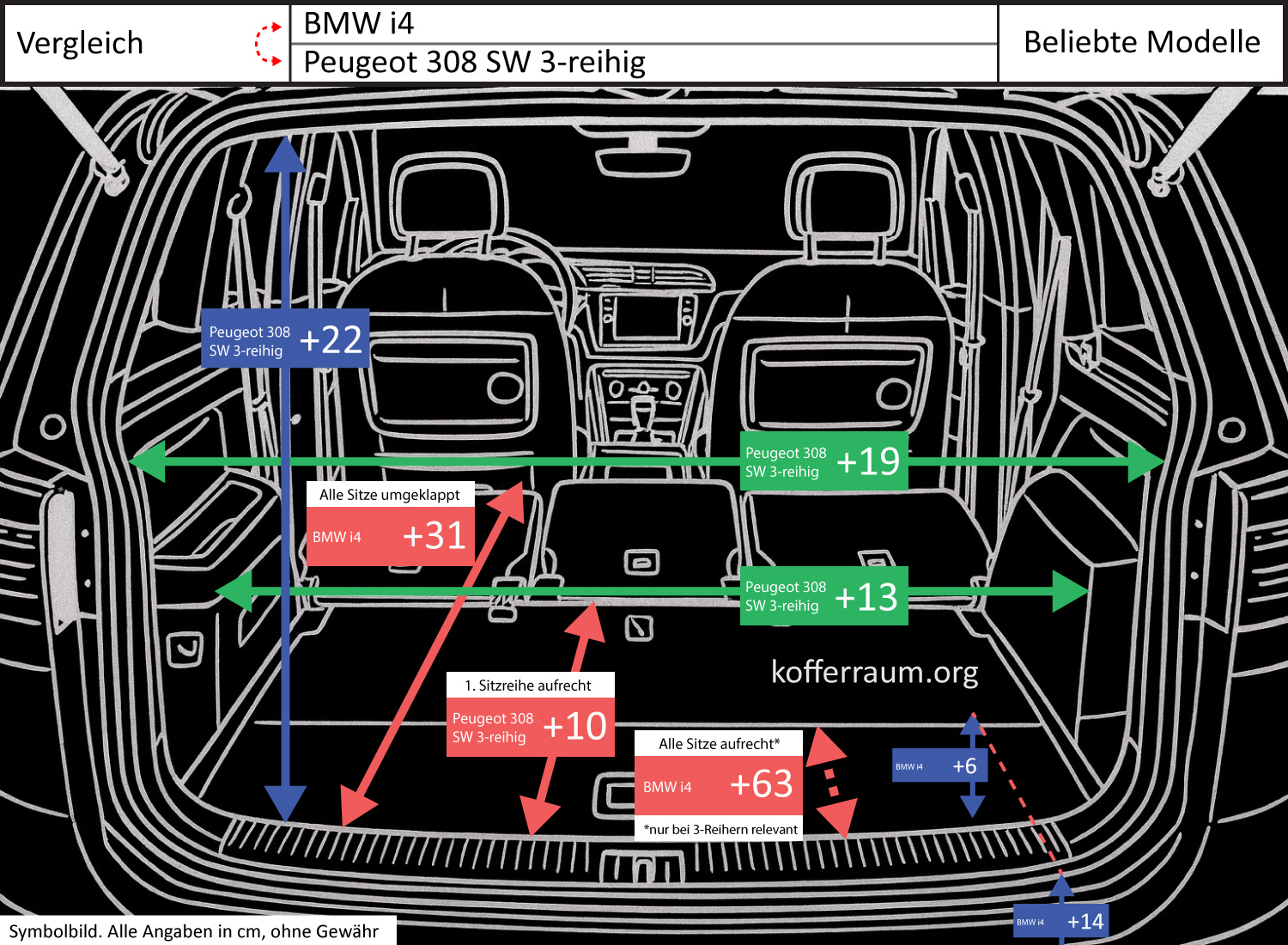
The BMW i4 offers a 12.2 in (21%) longer cargo space with the seats folded down than the Peugeot. With seats upright, the advantage of the BMW is even more pronounced: the trunk is 24.8 in (180%) longer. The trunk opening of the Peugeot, on the other hand, is 8.7 in (33%) higher than that of the BMW.
Regarding the depth from the loading edge to the trunk floor, the BMW is 2.4 in (150%) deeper (more usable vertical depth), while at the same time the loading edge of the BMW sits 5.5 in (25%) higher above the road.
In width, the Peugeot scores: at the narrowest point it is 5.1 in (15%) wider and the opening width is 7.5 in (20%) larger than the BMW. A smaller difference (not highlighted) is that the Peugeot offers 10% more trunk length with the first row of seats upright.
Impact on Usability
For long items and larger cargo volumes with normal seating positions, the BMW i4 is clearly advantageous: the significantly longer loading area with and without folded seats makes it more practical when transporting bulky or long pieces.
The greater depth from the loading edge to the floor in the BMW creates more interior height under the loading edge but the higher loading edge above the road can make lifting heavy loads more difficult.
The Peugeot 308 SW is more practical for wider, taller, or bulkier cargo: the significantly larger opening height and width as well as the greater minimum width in the cargo area make loading bulky, wide, or tall items easier.
The lower loading edge makes handling heavy loads simpler and easier on the back. However, the available cargo space in length, especially with upright seating, is smaller than in the BMW.
Conclusion: BMW i4 = better solution for longer payloads and more cargo volume with upright seating; Peugeot 308 SW = better suited for wider, taller, and easier-to-handle cargo thanks to larger opening and lower loading edge.