
Trunk comparison: BMW i4 vs Seat Tarraco

Key Differences (Summary)
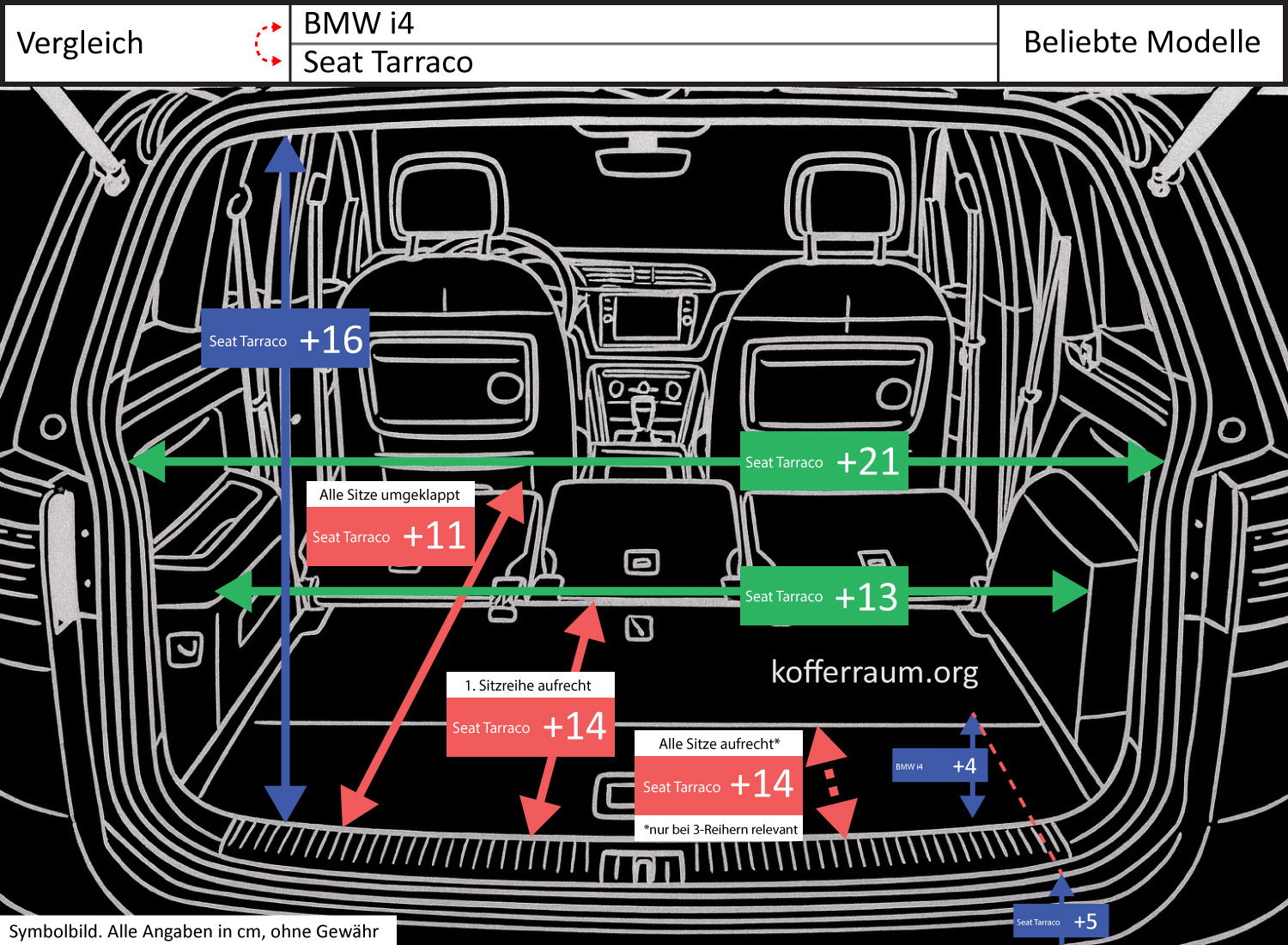
The clearest advantages of the SEAT Tarraco lie in width, opening, and usable length with the first row of seats upright: the width at the narrowest point is +5.1 in (15%) larger and the width of the trunk opening is +8.3 in (22%) larger than in the BMW i4. The height of the Tarraco's trunk opening is +6.3 in (24%) higher, and with the first row of seats upright, the trunk is +5.5 in (14%) longer.
In contrast, the BMW i4 has a greater trunk depth (loading edge to trunk floor) of +1.6 in (67%) compared to the Tarraco. Smaller differences are: with fully folded seats, the Tarraco is only +4.3 in (6%) longer, and the Tarraco's loading edge is +2 in (7%) higher above the road.
What impact do these differences have on usability?
The greater widths and significantly larger opening of the SEAT Tarraco make loading and unloading wider or bulky items (e.g., furniture parts, strollers, bulky boxes) easier.
The higher opening height improves sliding in tall cargo and reduces the risk of hitting the edge. The longer usable area with the first row of seats upright makes the Tarraco more practical for longer items without folding the seats down.
The BMW i4 scores with a deeper cargo floor (greater distance from loading edge to trunk floor). This creates a somewhat "deeper" cargo well that better holds smaller items back and can make stacking easier.
Additionally, the i4's loading edge is slightly lower (difference of 2 in), which makes lifting heavy items over the edge somewhat easier—a practical advantage when frequently loading heavy loads.
Overall, this means: For regularly transporting wide, tall, or bulky items, the SEAT Tarraco is the more practical choice.
For everyday usability with easier lifting and a deeper cargo well that better secures small loads, the BMW i4 is advantageous. With fully folded seats, the models are largely equal in length (only ~6% difference).