
Trunk comparison: BMW i4 vs Tesla Model 3
Key Differences
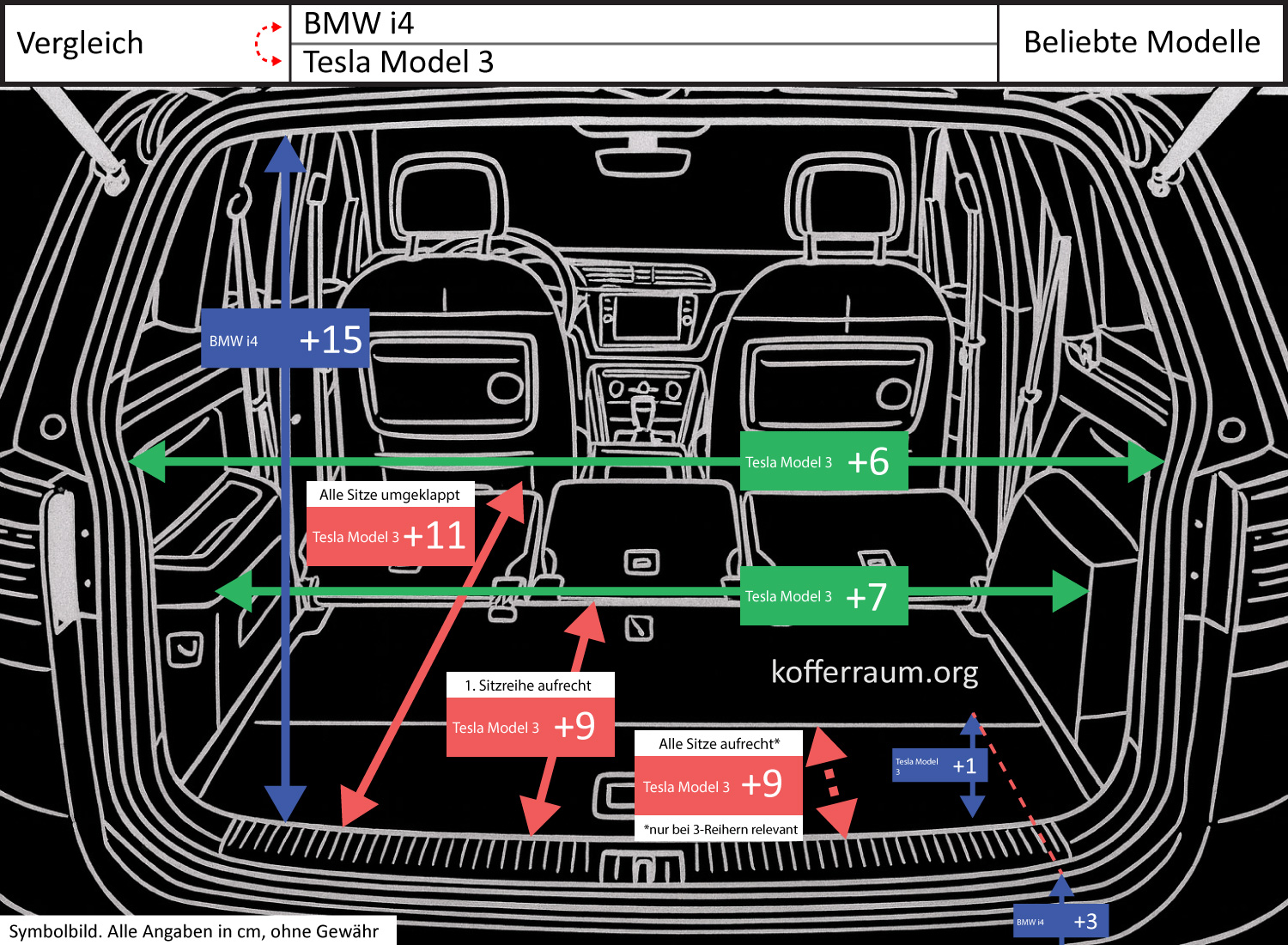
The Tesla Model 3 offers more length and width in the trunk: with the seats folded down, it has +4.3 in (6%) longer cargo space and with the front seats upright, +3.5 in (9%) more length than the BMW i4. At the narrowest point, the Tesla is +2.8 in (8%) wider, the trunk opening width is +2.4 in (6%) greater, and the trunk depth (loading edge to floor) is +0.4 in (10%) larger in the Tesla.
However, the loading edge of the BMW i4 is +1.2 in (4%) higher above the road. It is particularly noteworthy that the trunk opening of the BMW i4 is +5.9 in (29%) higher than that of the Tesla Model 3.
Impact on Usability
The significantly higher trunk opening of the BMW i4 makes loading tall or bulky items easier, as more vertical space is available and many items can be loaded upright without needing to tilt them significantly.
Conversely, the higher opening may make reaching in more difficult for shorter individuals. However, the BMW has a slightly higher loading edge (+1.2 in), which makes lifting heavy loads somewhat more strenuous.
The Tesla scores with slightly more length and width as well as a lower loading edge, which facilitates storing long items (e.g., slats, skis) and handling heavy suitcases or groceries.
Since these advantages are mostly in the single-digit percentage range, they are rather gradual: the Tesla is overall more practical for elongated or wide cargo, while the BMW is better for tall, upright items.
Conclusion: Those who often transport tall items benefit from the BMW i4 due to the significantly higher opening. Those who regularly carry long or wide cargo and prefer the lowest possible loading edge are better off with the Tesla Model 3.