
Trunk comparison: BMW i4 vs Volvo XC40

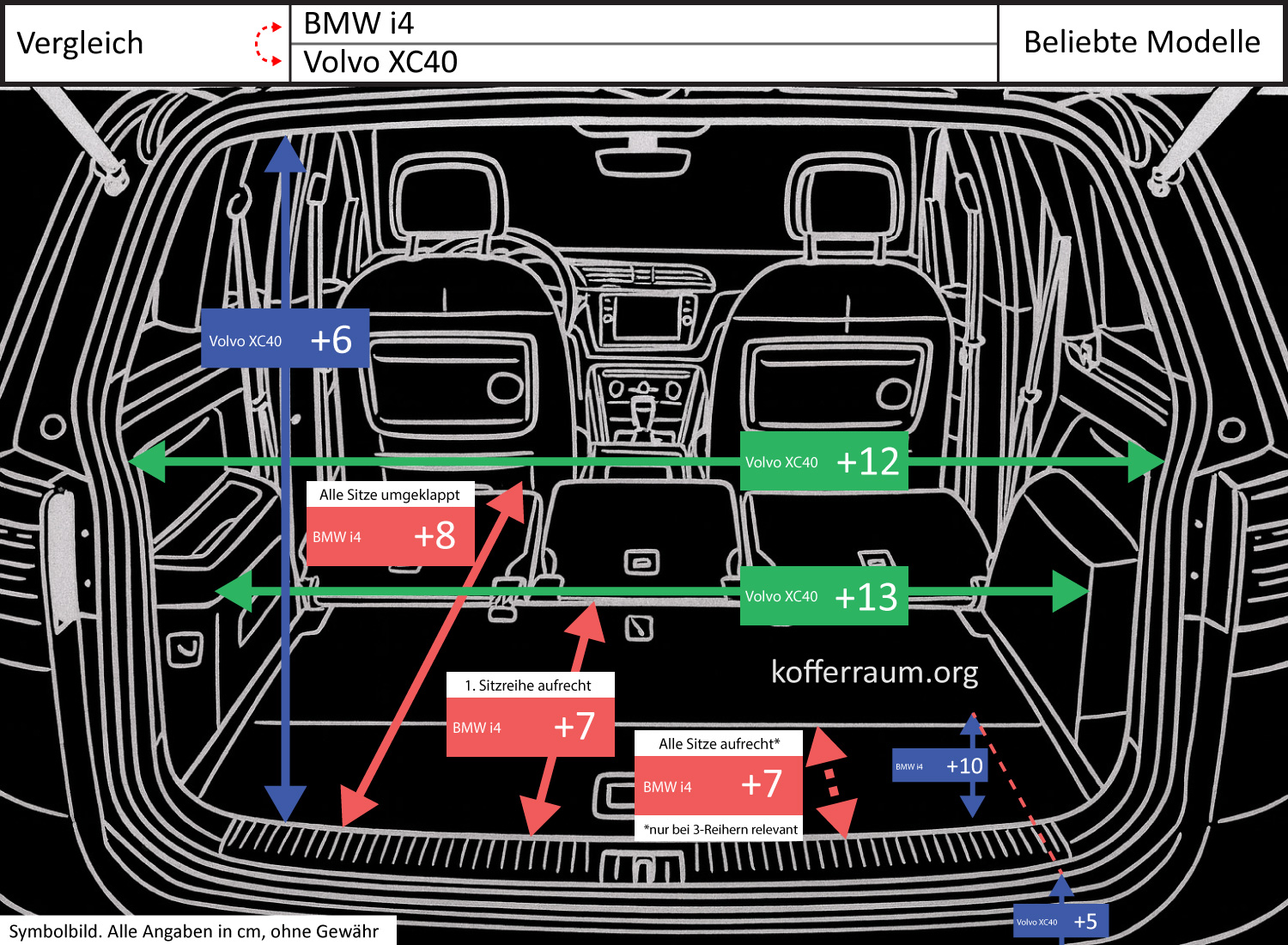
Key Differences (highlighted)
Three differences stand out clearly from the data:
- Trunk depth (loading edge → trunk floor): BMW i4 is 3.9 in or 900% larger than the Volvo XC40.
- Width at the narrowest point: Volvo XC40 is 5.1 in or 15% wider than the BMW i4.
- Width of the trunk opening: Volvo XC40 is 4.7 in or 13% wider than the BMW i4.
What impact do these differences have on usability?
The combination of values results in clear practical consequences:
- Width and opening: The Volvo XC40 offers noticeably more space at the narrow point and in the opening. This makes the vehicle clearly more practical for wide or bulky items (e.g., large suitcases, wide strollers, furniture/packages) — less hassle when sliding items in and less frequent rearranging of the cargo.
- Trunk depth in the BMW i4: The significantly greater vertical distance between the loading edge and trunk floor in the BMW indicates a deeper cargo well. This increases usable interior height or capacity for irregularly shaped or stackable cargo; items can be further "sunk" in. However, a deep load floor level can make lifting very heavy items somewhat less practical if leverage is unfavorable.
- Practical compromise: For wide, flat items and those that must be loaded across the full opening width, the Volvo XC40 is better suited. For bulky, stackable, or "sinkable" cargo, the BMW i4 offers advantages due to the greater depth.
Conclusion
The Volvo XC40 scores with width and accessibility of the opening — better for wide/bulky items. The BMW i4 offers more usable interior height and volume for low-lying or stackable cargo thanks to the significantly greater trunk depth.
The choice depends on typical loading profile: wide, bulky goods → XC40; lots of stackable or sinkable cargo → i4.