Trunk comparison: BMW i4 vs VW ID.3
Key Differences
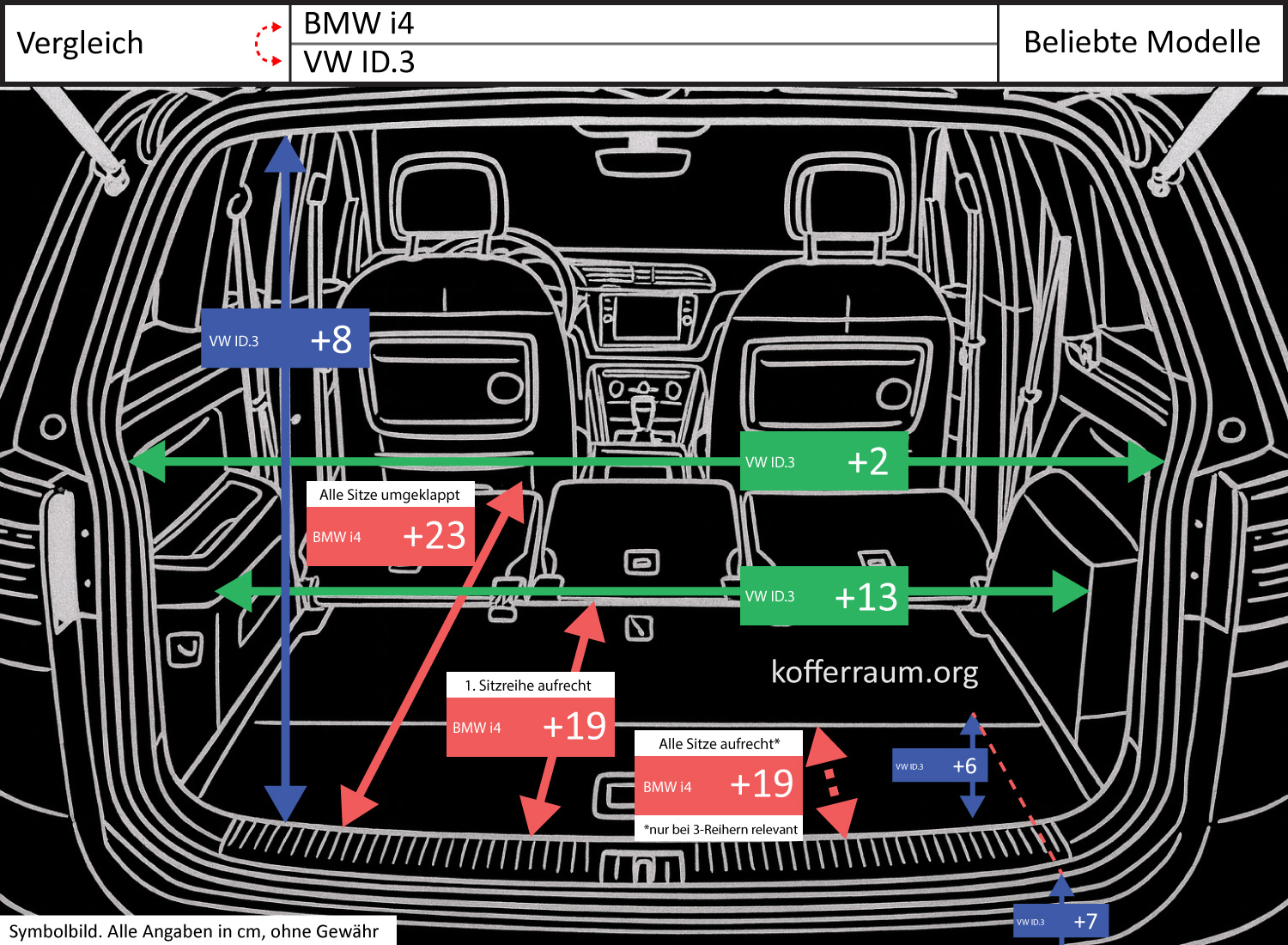
The BMW i4 offers a significantly longer loading length: with seats folded down +9.1 in (15%) and with the first row upright even +7.5 in (24%) compared to the VW ID.3. The VW ID.3 emphasizes several dimensions in favor of height and volume: the height of the trunk opening is +3.1 in (12%) larger, the depth of the trunk (loading edge → floor) is +2.4 in (60%) greater, and the width at the narrowest point is +5.1 in (15%) wider than the BMW.
The width of the trunk opening (+0.8 in / 2%) is negligible in comparison.
Implications for Usability
- BMW i4: Due to the longer loading length (15–24% more), longer items can be transported more easily — such as furniture parts, long boxes, or bicycles without complicated angling. Those who frequently need to carry longer loads or require more usable cargo space with folded seats have the advantage in the i4.
- VW ID.3: The greater opening height, significantly deeper cargo floor (+60%), and wider narrow width (+15%) make the ID.3 more practical for tall or bulky items (stacked crates, tall boxes, bulky business equipment).
The deeper cargo floor increases the vertically usable volume but, combined with the somewhat higher loading edge, can make lifting heavy loads more difficult.
In summary: For elongated loads and maximum loading length, the BMW i4 is better suited; for bulky, tall, or wide cargo with more vertical space, the VW ID.3 is more practical.
Smaller differences like the +0.8 in width of the opening are hardly relevant in practice. The approximately 2.8 in higher loading edge of the ID.3 (10%) does increase lifting effort somewhat but is not among the highlighted differences over 10%.