Trunk comparison: BMW iX1 vs BMW X1
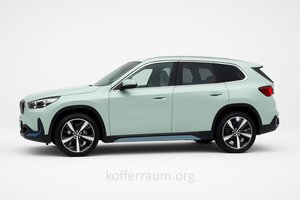
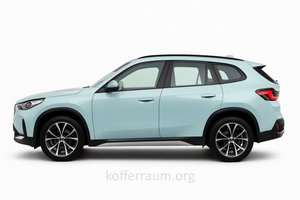
Most Important Difference (>10%)
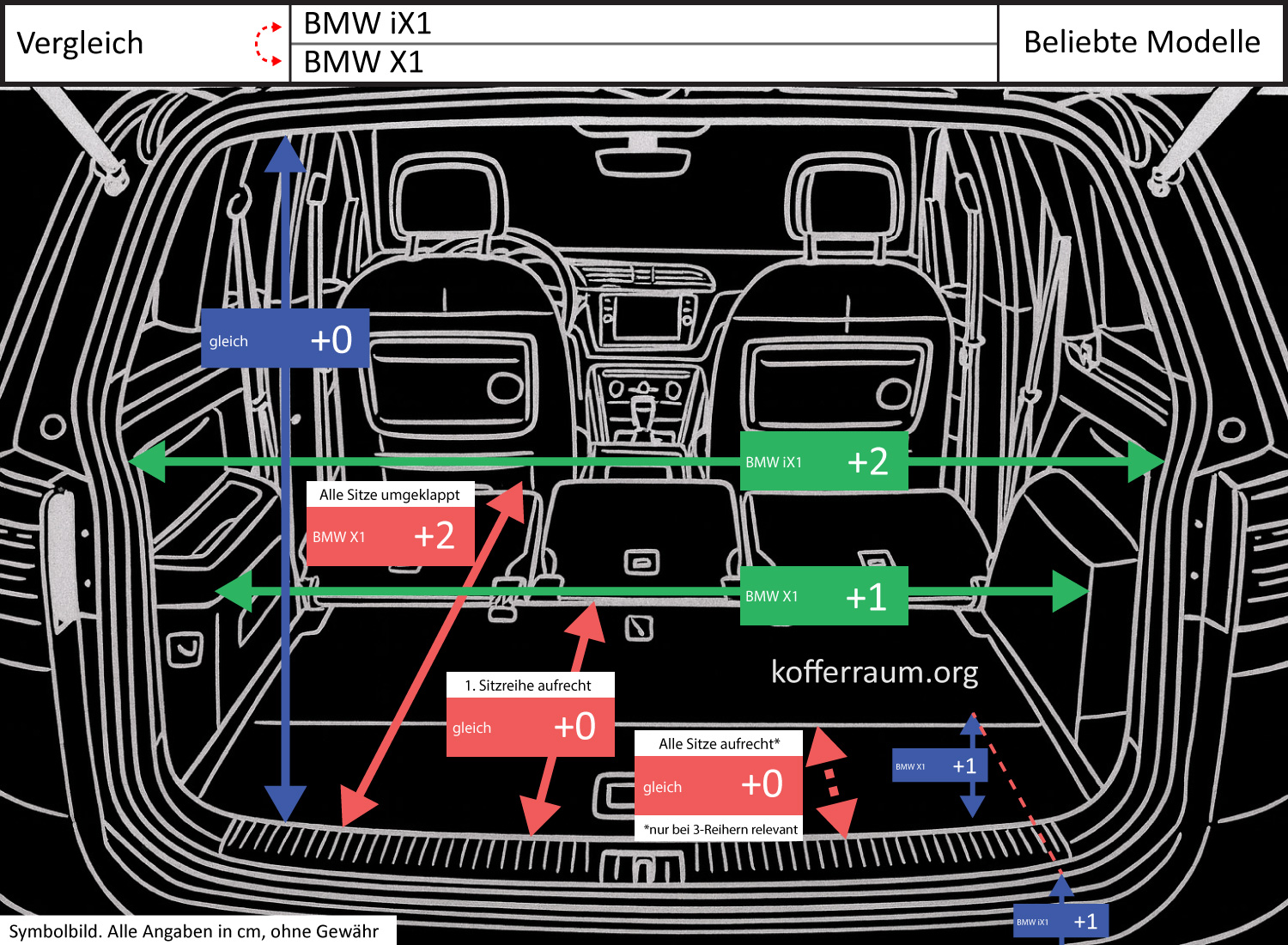
The depth of the trunk (loading edge → trunk floor) is 0.4 in (+50%) greater in the BMW X1 than in the BMW iX1. The high percentage value arises because the underlying measurement in the iX1 is very small; the absolute difference is only 0.4 in.
Practically, this means: The X1 offers slightly more space between the loading edge and trunk floor, which can provide a small advantage when sliding in very flat or elongated items (e.g., pallet pieces, flat boxes).
Impact on Usability
Since the absolute difference is only 0.4 in, the practical effect remains minor. For most everyday scenarios—shopping bags, suitcases, sports or camping equipment—both models are effectively equally usable. Specific effects:
- For very flat or precisely measured items, the X1 has a slight advantage when loading/sliding due to the 0.4 in greater depth.
- The loading edge of the iX1 is 0.4 in higher above the ground, making lifting heavy items slightly more strenuous; however, this difference is also minimal.
- Regarding ergonomics (e.g., frequent lifting of heavy loads), the X1 might be more comfortable due to the slightly deeper loading area, but in everyday use, the effect is marginal.
Other Negligible Differences (≤10%)
The remaining differences are very small and hardly affect usability:
- With the first row of seats upright, the trunk length of both models is the same.
- The trunk opening height is identical.
- With seats folded down, the X1 is only 0.8 in (≈1%) longer.
- The narrowest trunk width is 0.4 in (≈1%) greater in the X1; the width of the trunk opening is 0.8 in (≈2%) greater in the iX1.
Conclusion: Apart from a minimally greater trunk depth in the X1, the practical differences are very small. For everyday use, both models are largely equivalent; only with very specific loading requirements or for ergonomic reasons might the small deviations matter.