
Trunk comparison: BMW iX1 vs BMW X5

Key Differences
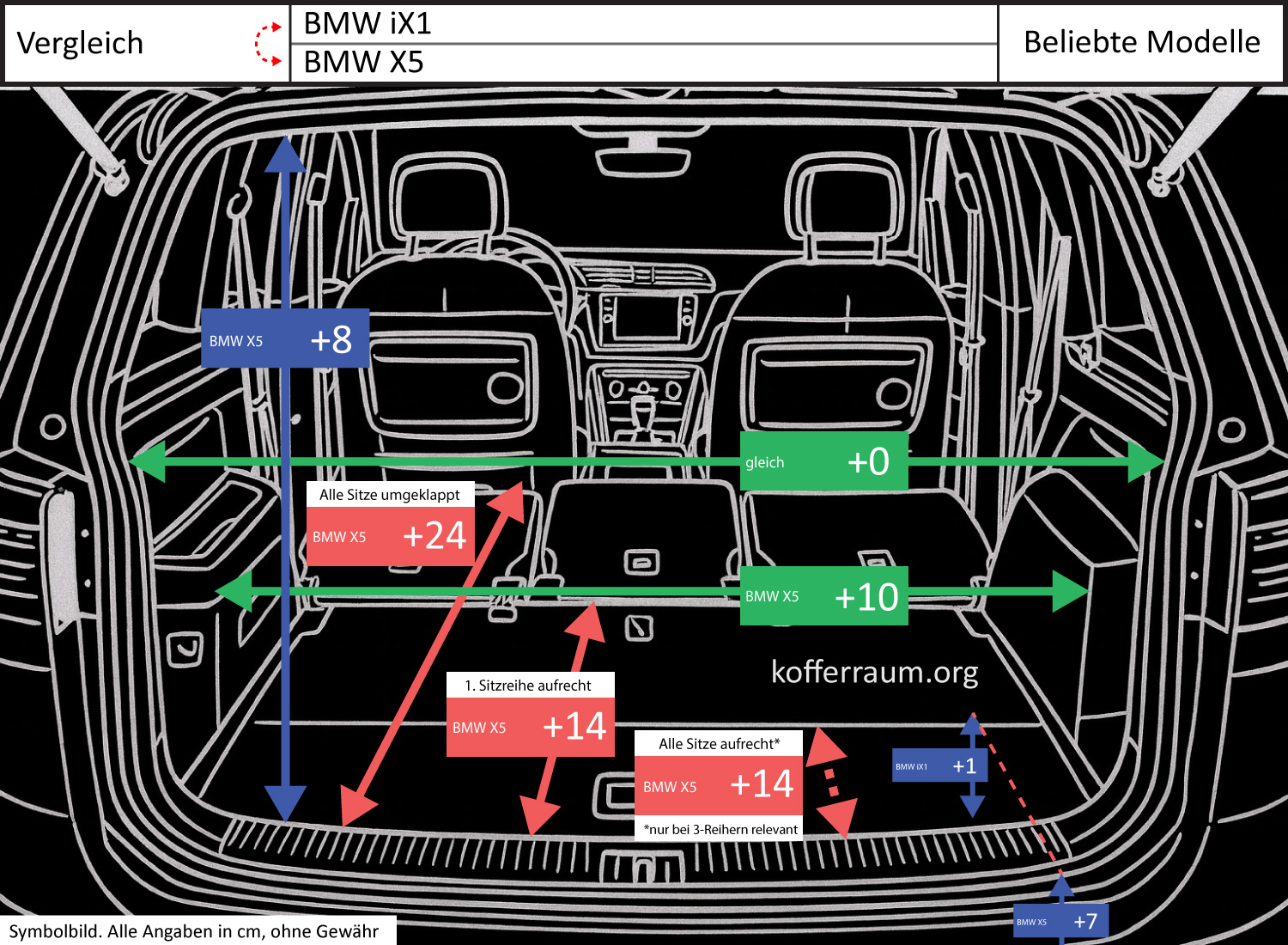
The BMW X5 offers clear length and height advantages in cargo space: with the seats folded down, the X5's trunk is 9.4 in (15%) longer and with the first row of seats upright, 5.5 in (16%) longer than the iX1. Additionally, the height of the X5's trunk opening is 3.1 in (11%) greater.
In contrast, the iX1 has a 0.4 in (100%) greater depth between the loading edge and trunk floor (absolute difference very small).
The width of the trunk opening is the same for both models; the narrowest width is 10% larger on the X5 and the loading edge of the X5 is 2.8 in (10%) higher above the ground (both 10% values are not highlighted here since the threshold >10% is required).
Impact on Usability
More length in the X5 (15–16%): The X5 is significantly more flexible for long or bulky cargo. Folding down the seats allows longer items (e.g., long furniture parts, skis, building materials, or multiple suitcases) to fit much better.
In everyday use, the longer loading area also means more variability when loading without complicated stowing.
Higher trunk opening in the X5 (11%): The greater opening height makes it easier to load tall items and reduces tilting or lifting large boxes. This makes loading and unloading bulky, voluminous cargo more practical and comfortable.
Smaller but noteworthy differences: The iX1's 0.4 in greater depth (percentage-wise large, absolutely very small) has little practical impact — it only provides marginally more floor space immediately behind the loading edge.
The higher loading edge of the X5 (+2.8 in) increases the effort required to lift heavy items in, while the slightly larger narrowest width of the X5 (+10%) helps with sideways fitting of wider goods; however, the opening width itself is the same.
Conclusion: Those who regularly transport long or tall items or need maximum flexible cargo space benefit from the X5. For mostly urban or occasional transport, the iX1 is practically sufficient despite its shorter cargo length; its minimally larger interior floor depth is not a decisive advantage.