
Trunk comparison: BMW iX1 vs Citroen C3

Key Differences
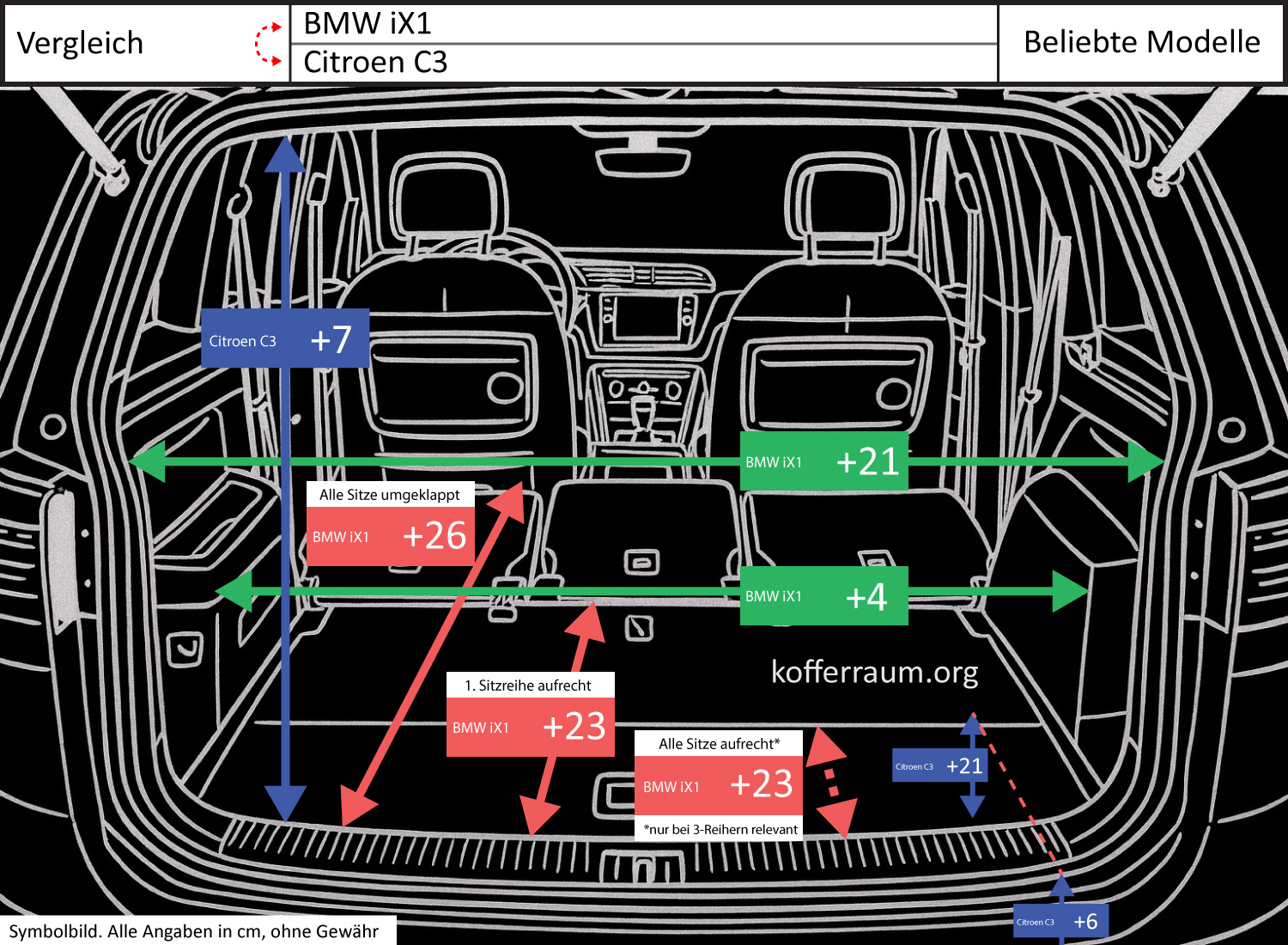
Clear strengths emerge on both sides regarding the volume and shape of the trunk: the BMW iX1 offers a cargo space that is 10.2 in (19%) longer with the seats folded down and 9.1 in (34%) longer usable length with the seats upright than the Citroën C3. At the same time, the Citroën has a significantly greater depth between the loading edge and the trunk floor (+8.3 in / 1050%).
Additionally, the width of the trunk opening in the BMW iX1 is 8.3 in (24%) wider, making it easier to fit wide items.
Implications for Usability
The advantages of the BMW iX1 (longer cargo space and significantly wider opening) make it more practical if you frequently need to transport long or wide items — such as furniture parts, long sports equipment, or bulky boxes.
The wider opening facilitates sliding in wide parts, and the greater length allows for longer loads even when the seats are upright.
The Citroën C3 scores with its significantly deeper trunk floor behind the loading edge. This creates more "vertical" space immediately behind the loading edge and is better suited for taller or bulky items that need to be loaded upright or stacked.
However, the loading edge of the C3 sits somewhat higher (by 2.4 in / 8%), which can make lifting heavy loads more difficult.
Other differences are smaller: The trunk opening height of the C3 is 2.8 in (10%) higher — a practical advantage for very tall cargo, but exactly at the 10% mark and therefore not highlighted here. The narrowest interior width differs by only 4% in favor of the iX1 and is usually not critical in everyday use.
Conclusion
If you often transport long or wide items and prefer easy loading and unloading, the BMW iX1 is more advantageous.
If, on the other hand, you more frequently need to load tall or bulky items, the Citroën C3 can be more practical with its significantly greater depth — though note the higher loading edge, which makes lifting more difficult.