
Trunk comparison: BMW iX1 vs Hyundai i10
Key Differences (highlighted: >10%)
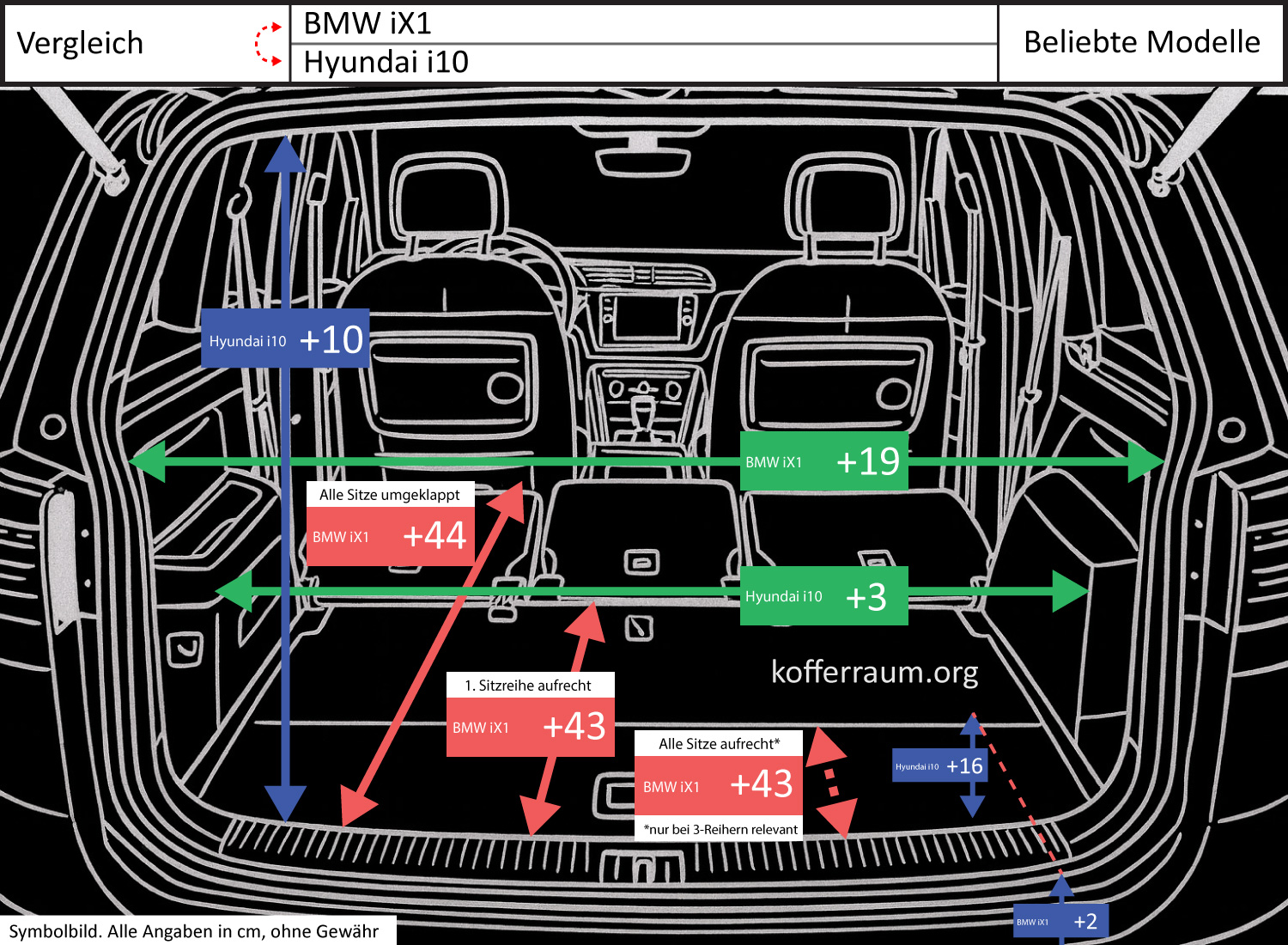
The BMW iX1 offers significantly more cargo length: with the seats folded down, the trunk of the iX1 is 17.3 in (≈37%) longer, and with the first row upright, it is even 16.9 in (≈91%) longer than the Hyundai i10. The width of the trunk opening is 7.5 in (≈21%) larger in the iX1, making it easier to load wide items.
The Hyundai i10 has advantages in vertical dimensions: the height of the trunk opening is 3.9 in (≈14%) larger in the i10, and the depth between the loading edge and the trunk floor is significantly greater in the i10 (+6.3 in / ≈800%).
Impact on Everyday Usability
Due to the significantly greater cargo length, the BMW iX1 is better suited for long items (e.g., furniture parts, skis, long boxes) and for users who regularly transport large or elongated loads. The wider trunk opening of the iX1 facilitates loading bulky and flat goods and sliding large packages in from the side.
The Hyundai i10 scores in vertical usability: the higher opening and the significantly greater depth create more space in height or in a deeper cargo well.
This is practical for taller stacked or bulky but not too wide items (e.g., suitcase stacks, boxes), and for securely recessing smaller items below the loading edge.
However, the narrower opening of the i10 (barely relevant at the narrowest point) and the significantly shorter loading length considerably limit options for long or very wide loads.
Smaller differences such as the slightly higher loading edge of the iX1 (+0.8 in / 3%) or the 1.2 in greater narrowest width of the i10 are hardly relevant in practice compared to the points mentioned above.