
Trunk comparison: BMW iX1 vs Hyundai IONIQ
Key Differences
Two clear differences stand out from the data:
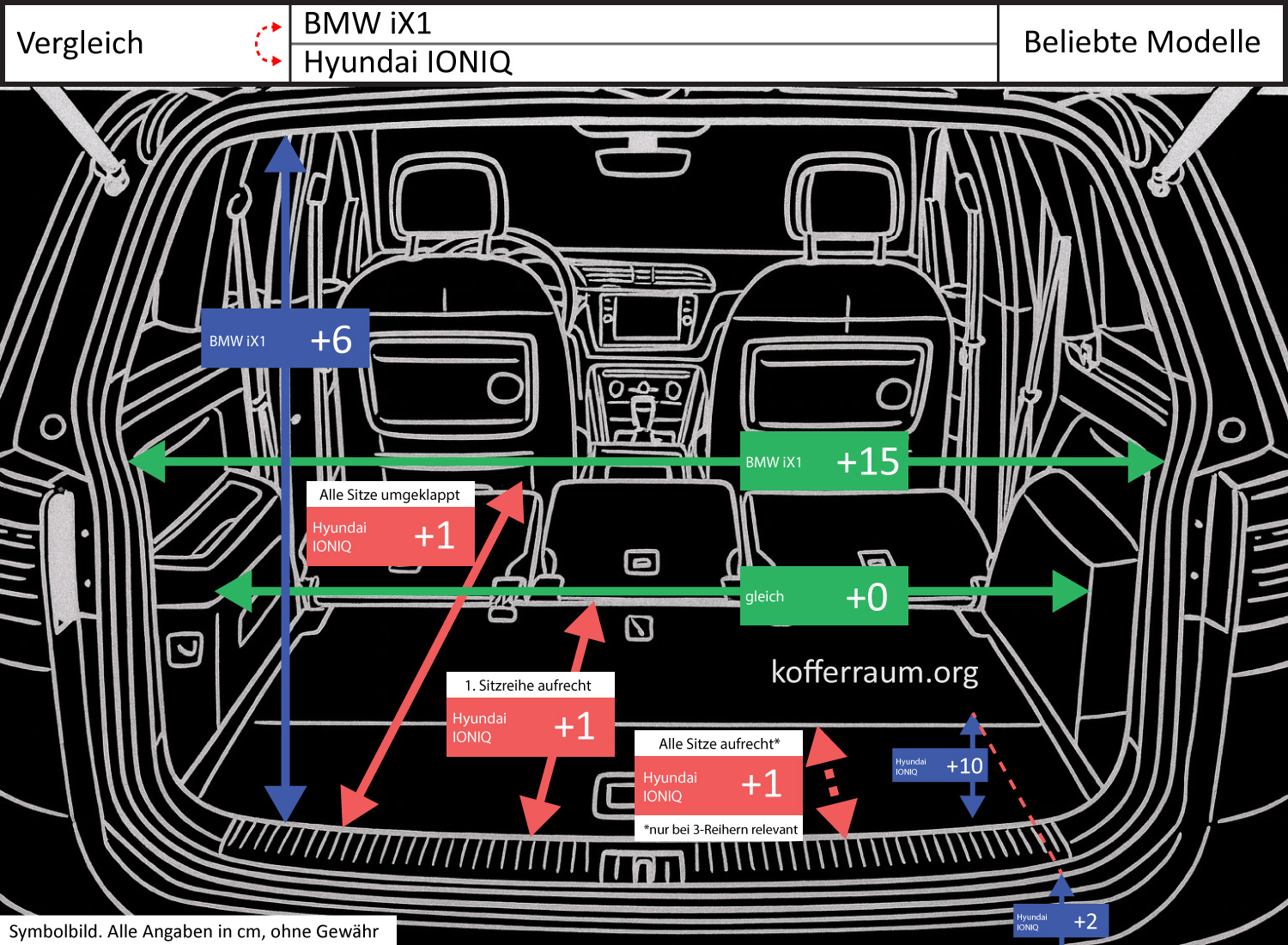
- Larger trunk opening on the BMW iX1: The width of the BMW iX1's trunk opening is +5.9 in (16%) wider than that of the Hyundai IONIQ.
- Significantly greater trunk depth dimension on the Hyundai IONIQ: The depth of the trunk (loading edge to trunk floor) of the Hyundai IONIQ is +3.9 in (500%) greater than that of the BMW iX1.
Impact on Usability
These two differences affect practical use as follows:
- Wider trunk opening on the BMW iX1: A 16% wider opening dimension makes loading and unloading wider or bulky items (e.g., furniture boards, strollers, wide boxes) easier. Bulky items can also be maneuvered more easily in one piece through the opening, even if the internal dimensions at the narrowest point are the same.
- Deeper loading area on the Hyundai IONIQ: The 3.9 in greater depth (500% relative to the very small reference) means more space between the loading edge and trunk floor. This is advantageous for tall or bulky cargo that needs to be placed deep inside, as well as for better stacking behind the loading edge. Practically, this means more usable volume in length/height direction and better protection of luggage during acceleration/braking.
- Other smaller differences (not >10%) — e.g., slightly longer trunk in the IONIQ (+0.4 in), higher trunk opening on the iX1 (+2.4 in / 9%), and slightly higher loading edge on the IONIQ (+0.8 in / 3%) — have only minor effects. The same width at the narrowest point also means that internal bottlenecks may remain identical, even if the opening size differs.
Conclusion / Recommendation
For users who frequently load wide, bulky items, the BMW iX1 is more practical due to the larger opening. Those who need more depth and thus more usable cargo volume behind the loading edge (taller/bulkier loads, better stacking) benefit more from the Hyundai IONIQ.