
Trunk comparison: BMW iX1 vs Renault Austral
Key Differences
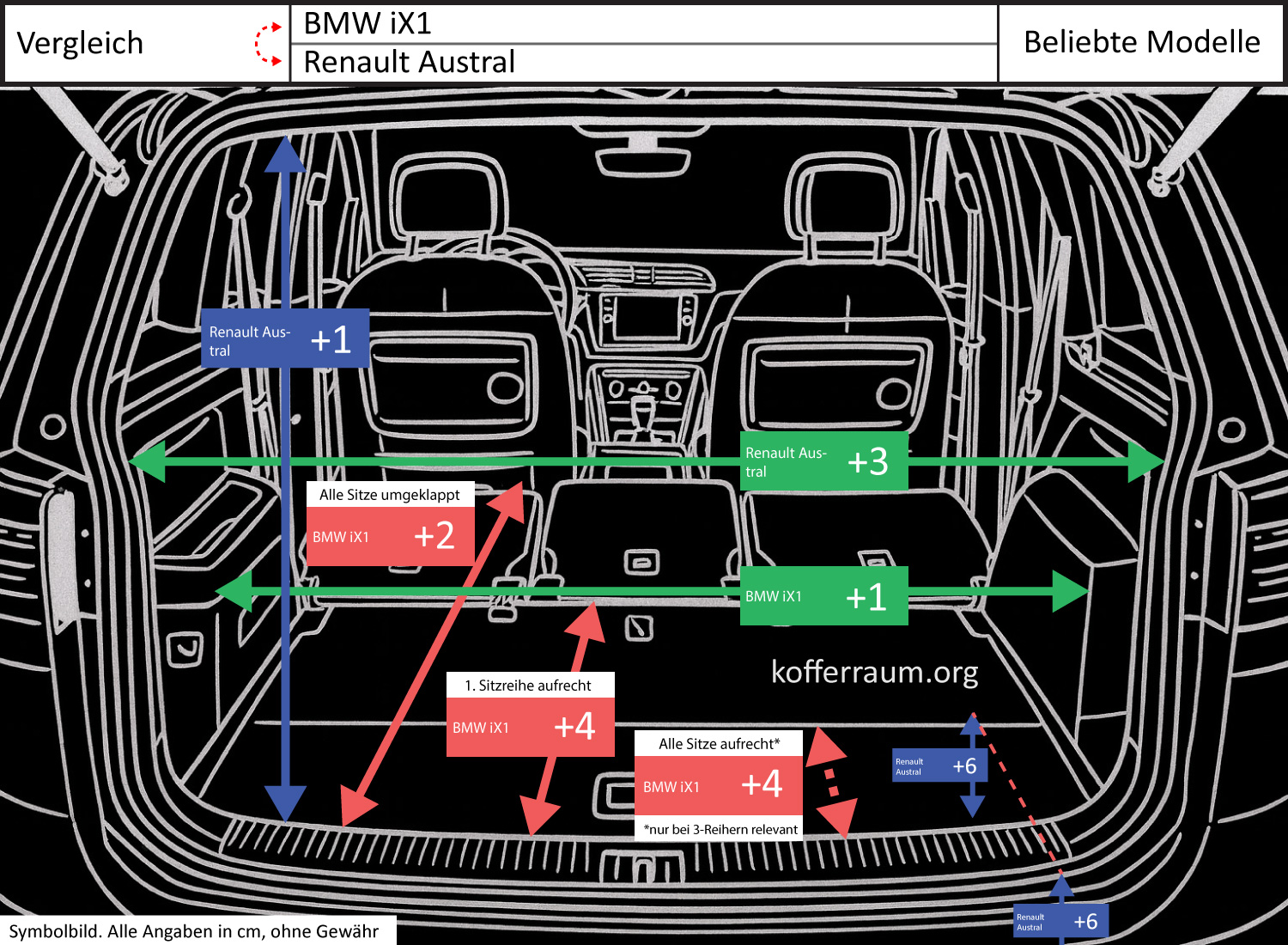
The most noticeable difference lies in the depth of the cargo area: the depth (loading edge to trunk floor) of the Renault Austral is 2.4 in or 300% greater than that of the BMW iX1.
All other dimensions differ only slightly: the BMW iX1 has +0.8 in (1%) more cargo length with folded seats and +1.6 in (5%) more with the first row upright.
The trunk opening of the Renault is 0.4 in (1%) higher and 1.2 in (3%) wider, and the loading edge of the Renault is 2.4 in (8%) higher above the ground. The narrowest trunk width is 0.4 in (1%) larger in the BMW.
Impact on Usability
The significantly greater trunk depth of the Renault Austral practically means more "vertical space" inside the cargo area: bulky or taller items can be placed deeper, allowing upright or voluminous cargo to be better accommodated or more stably secured.
This is a clear advantage when transporting tall boxes, plants, or irregularly shaped items.
On the other hand, the loading edge of the Renault is about 2.4 in higher. This increases the effort required to lift heavy items into the trunk and can make loading less convenient for individuals, although the deeper loading floor can partially compensate for this disadvantage.
The BMW iX1, by contrast, offers slightly more length (especially with the rear seat upright) and a bit more width at the narrowest point. In practice, this means: for very long, flat items or when ease of loading (lower loading edge) is a priority, the iX1 is often more practical.
The slightly larger opening width of the Renault marginally eases loading wider items but remains a secondary advantage compared to the deep cargo floor.
Conclusion: If you frequently transport tall or bulky cargo, the Renault Austral offers the greatest practical benefit due to its significantly greater trunk depth.
If ease of loading and unloading (lower loading edge) or somewhat more usable length/width at critical points are more important, the BMW iX1 is preferable.