
Trunk comparison: BMW iX1 vs Skoda Elroq

Key Differences and Impact on Usability
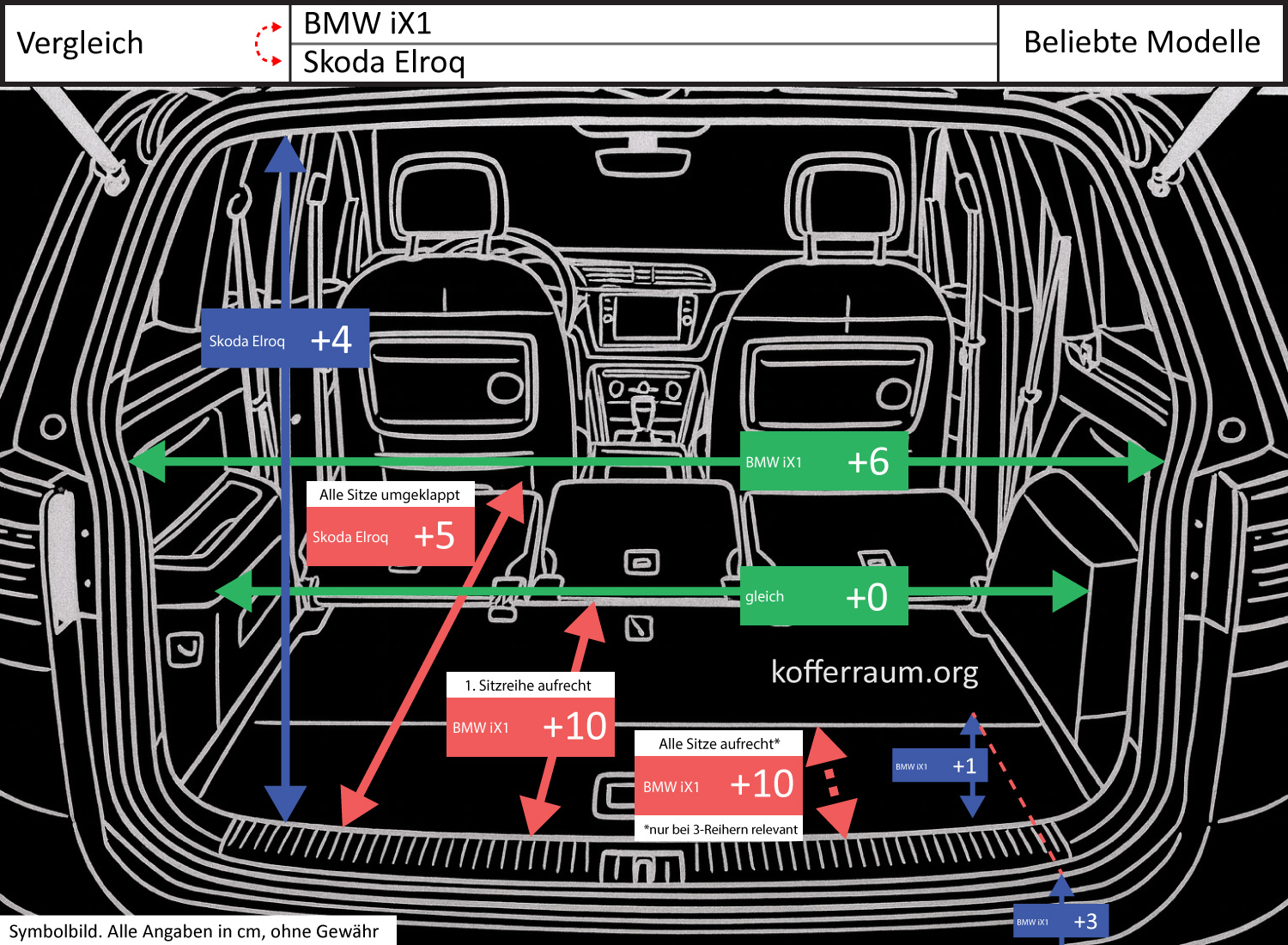
Two differences stand out clearly from the data: The BMW iX1 offers a cargo space that is 3.9 in (13%) longer with the rear seats upright compared to the Škoda Elroq, and the measured depth of the trunk (distance from loading edge → trunk floor) of the BMW is given as +0.4 in (100%).
The 1-cm figure is practically very small and the percentage seems inconsistent; in practice, the absolute difference here is minimal but — if correct — would mean a slightly deeper loading floor, causing cargo to sit a bit lower and the usable interior height behind the loading edge to increase slightly.
Practical relevance: The 13% longer loading floor with the rear seats upright makes the BMW more flexible in everyday use for longer items without folding the seats (e.g., skis, slats, longer boxes).
The stated 1-cm depth (if present) is only marginal — it can slightly improve securing and stability of cargo but is negligible for volume or large items.
Other smaller differences (under 10%) also affect practical use but less significantly: The Škoda Elroq has a 2 in (3%) longer cargo space with the seats folded down — thus slightly advantageous when transporting very long, flat cargo.
The trunk opening of the Elroq is 1.6 in (6%) higher, which simplifies loading tall items.
The BMW has the loading edge 1.2 in (4%) higher above the ground, making lifting heavy items somewhat more strenuous, and the width of the BMW’s opening is 2.4 in (6%) larger, making it easier to load wider parts. The narrowest interior width is the same in both models.
Conclusion: For more frequent transport of longer items with normal seating, the BMW iX1 is advantageous. For very flat, fully folded loading floors and loading tall parts, the Škoda Elroq offers slight advantages. Many differences are small and only marginally affect everyday usability.