
Trunk comparison: BMW iX1 vs Skoda Octavia Wagon
Key Differences
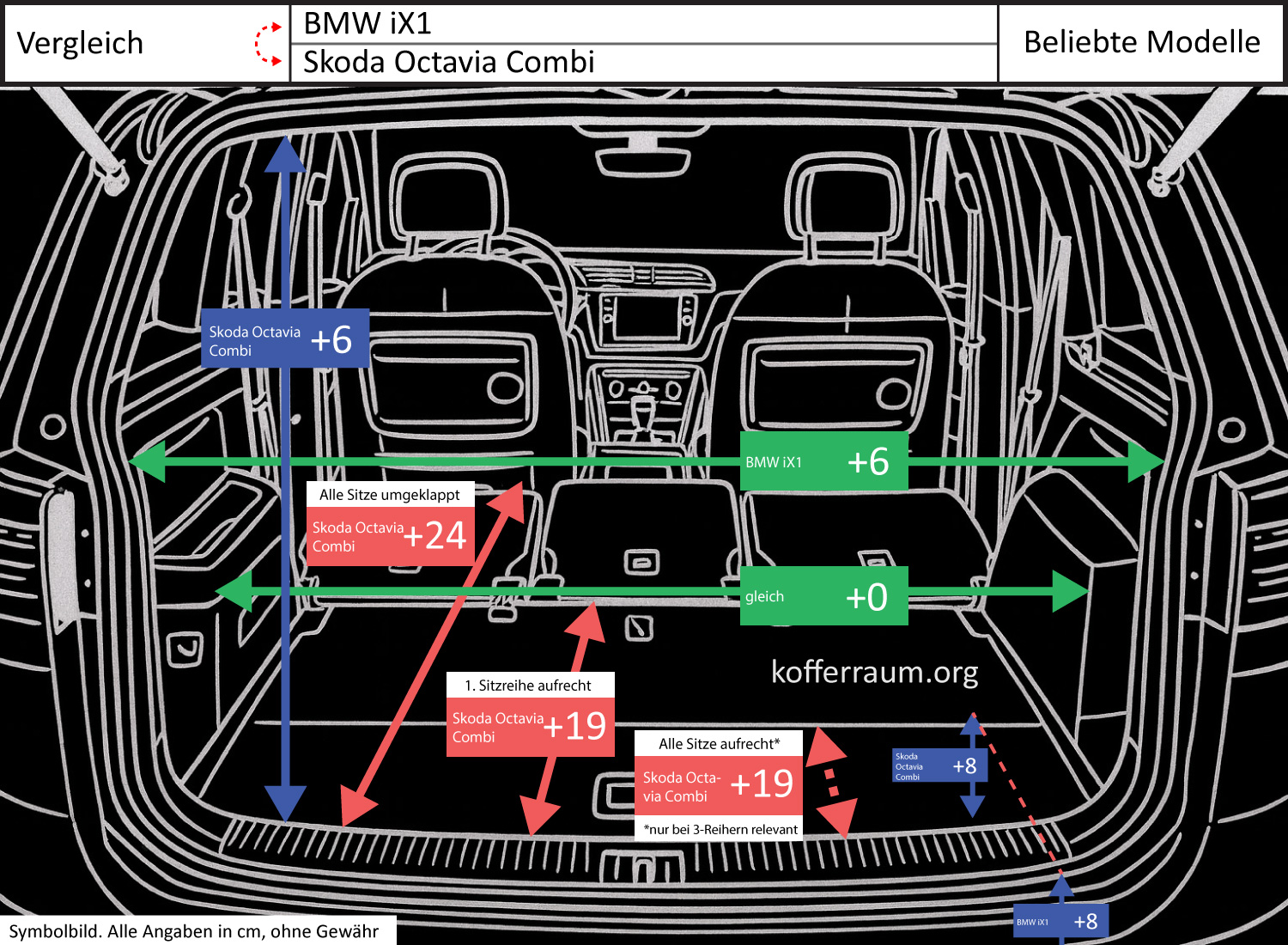
The Škoda Octavia Wagon offers significantly more usable cargo space: with the seats folded down, the trunk is 9.4 in (≈15%) longer, and with the front seats upright, it is 7.5 in (≈21%) longer than the BMW iX1. The depth of the cargo area (distance from loading edge to trunk floor) is 3.1 in (≈400%) greater in the Octavia.
In contrast, the loading edge of the BMW iX1 sits 3.1 in (≈13%) higher above the ground than that of the Octavia.
The differences in trunk opening height (Škoda +2.4 in / 8%) and trunk opening width (BMW +2.4 in / 6%) are under 10%; the narrowest point of the trunk is equally wide in both models.
Impact on Usability
The greater length in the Octavia (15–21%) means longer items — such as skis, furniture parts, or long luggage — can be transported more easily and without folding additional seats. Even when fully loaded with the front seats upright, more usable depth remains.
The significantly greater depth of the Octavia (the stated +3.1 in / 400% suggests a much lower cargo floor below the loading edge) increases packing volume near the loading edge and allows better stacking or transporting of tall items without them protruding over the loading edge.
The 3.1 in higher loading edge of the BMW iX1 makes lifting heavy items into the trunk more strenuous — especially noticeable with repeated or heavy loads. The slightly larger opening width of the BMW (≈6%) is not a decisive advantage since the narrowest point of both trunks is equally wide.
Conclusion
For users who frequently transport long or bulky items, require a lot of cargo capacity, or often load and unload heavy loads, the Škoda Octavia Wagon is the more practical choice. The BMW iX1 has only a minor advantage in opening width, while the higher loading edge reduces everyday usability when loading.