
Trunk comparison: BMW iX1 vs VW Tiguan
Key Differences
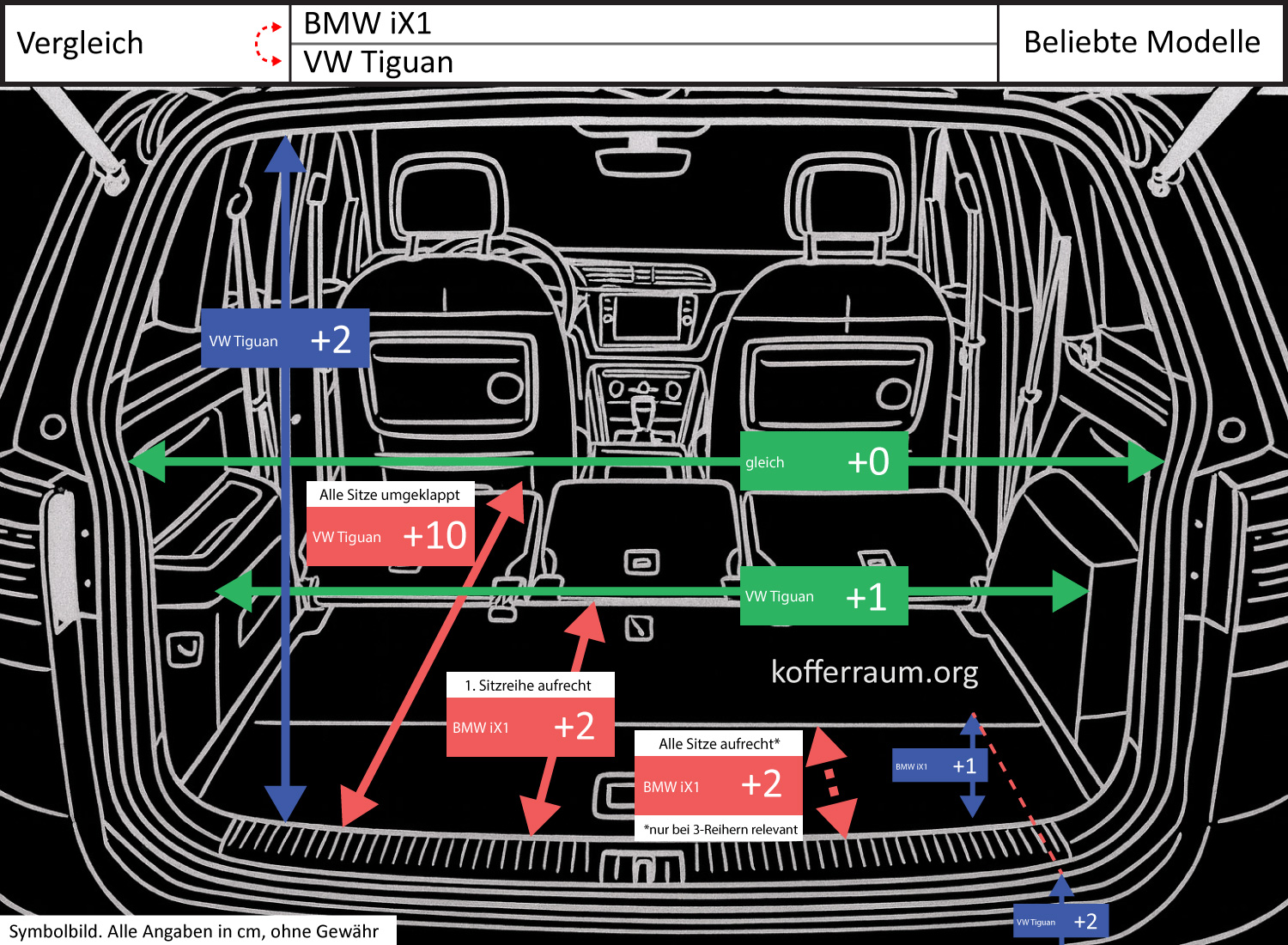
The only difference exceeding 10% in relative terms is the depth between the loading edge and the trunk floor: the BMW iX1 is 0.4 in (+100%) deeper here than the VW Tiguan. Important: the percentage seems large, but in absolute terms it is only 0.4 in.
All other deviations are well below 10%: - The Tiguan offers 3.9 in (≈6%) more depth longitudinally with the seats folded down. - With the first row of seats upright, the BMW has 0.8 in (≈2%) more usable length. - The Tiguan's trunk opening is 0.8 in (≈3%) higher. - The Tiguan's loading edge is 0.8 in (≈3%) higher above the road. - The narrowest width is 0.4 in (≈1%) larger in the Tiguan; the width of the opening is the same.
Impact on Usability
The 0.4 in greater depth of the BMW iX1 (given as +100% relatively) means that very flat or small items can be recessed a bit better in the trunk footwell and protected against slipping. Practically, the effect is minor because it is only 0.4 in in absolute terms.
For longer items, the Tiguan is noticeably more advantageous in everyday use: with folded seats, it offers 3.9 in more usable length, making it easier to accommodate long parts (skis, slats, flat furniture parts).
The Tiguan's 0.8 in higher trunk opening helps when loading taller cargo but can make lifting slightly more strenuous due to the 0.8 in higher loading edge.
The BMW additionally scores with a slightly longer loading floor with rear seats upright and a lower loading edge, which facilitates loading and unloading heavy items.
Overall, the differences are small to moderate; those who frequently transport very long items benefit more from the Tiguan, while those who prefer a slightly lower loading edge and minimally more "recessed" storage space are better off with the iX1.