
Trunk comparison: BMW X1 vs BMW X3


Summary of Differences
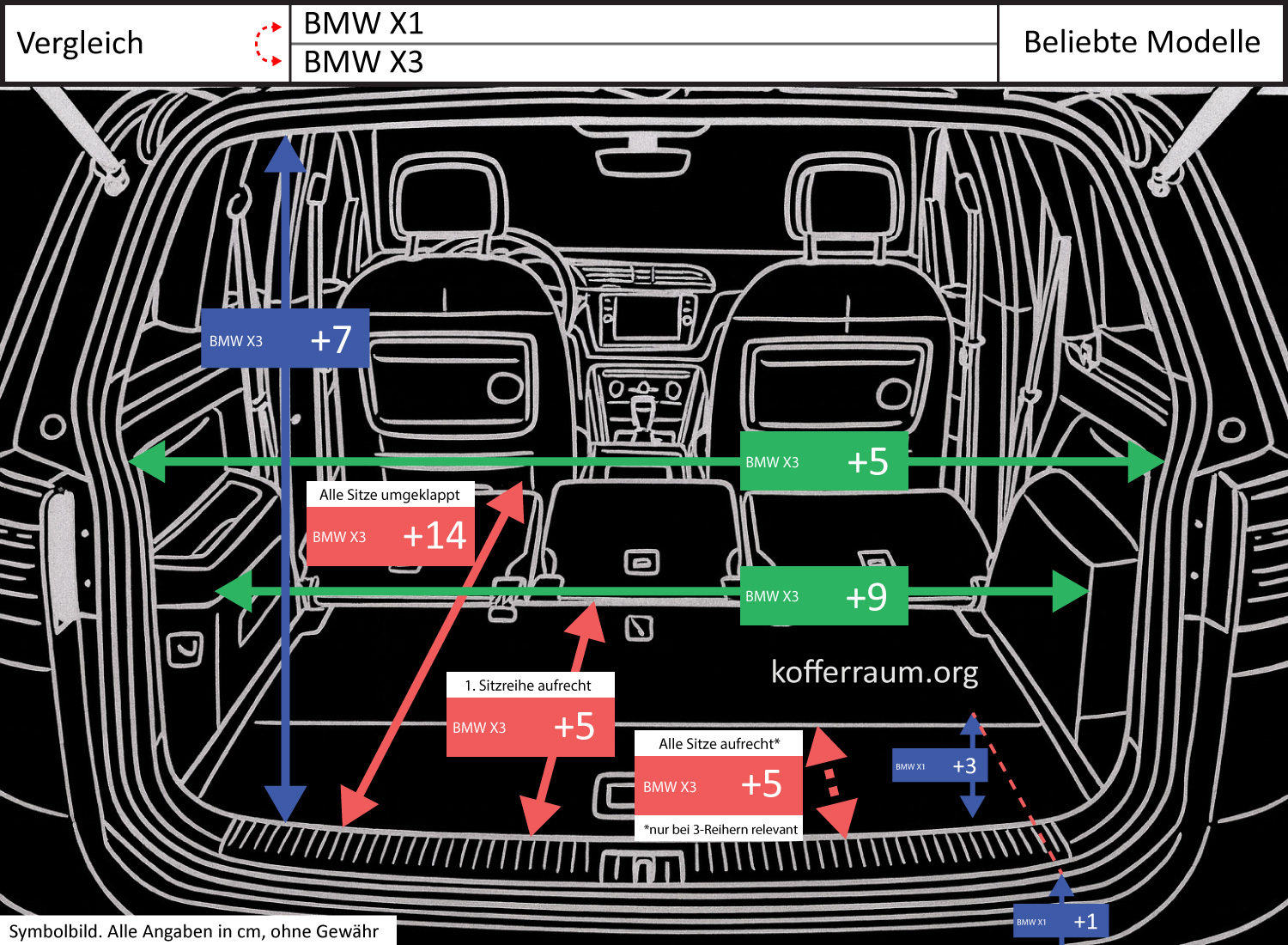
The BMW X3 offers a longer and wider cargo area: with the seats folded down, the trunk of the X3 is 5.5 in longer (+9%), and with the first row upright, 2 in longer (+6%). The trunk opening of the X3 is 2.8 in higher (+10%) and 3.5 in wider (+9%) at its narrowest point; the opening width is +2 in (+5%).
The loading edge of the X1 is only 0.4 in higher above the ground (+1%). The depth alone (loading edge to trunk floor) is significantly larger: the X1 is 1.2 in deeper or 200% larger than the X3 here.
What are the practical implications?
Because the X3 has longer and wider dimensions, it is better suited for long or bulky items (e.g., long boxes, furniture parts, skis) and for maximizing volume utilization with folded seats. The higher trunk opening makes loading tall or bulky items easier.
The X1 scores with the significantly greater depth between the loading edge and trunk floor (+1.2 in / 200%). Practically, this means items can be pushed further into the cargo space, causing taller or irregularly shaped loads to protrude less over the loading edge.
For stacking boxes or storing tall items directly behind the loading edge, the X1 is more practical in many everyday scenarios, even though its length and width are overall smaller.
Conclusion: For transport tasks requiring length and width (long, wide, or many flat items), the X3 has the advantage. For securely storing taller or compactly stacked cargo directly behind the loading edge, the X1 offers an advantage due to its significantly greater depth.