
Trunk comparison: BMW X1 vs Durchschnitt Wagon

Main Differences
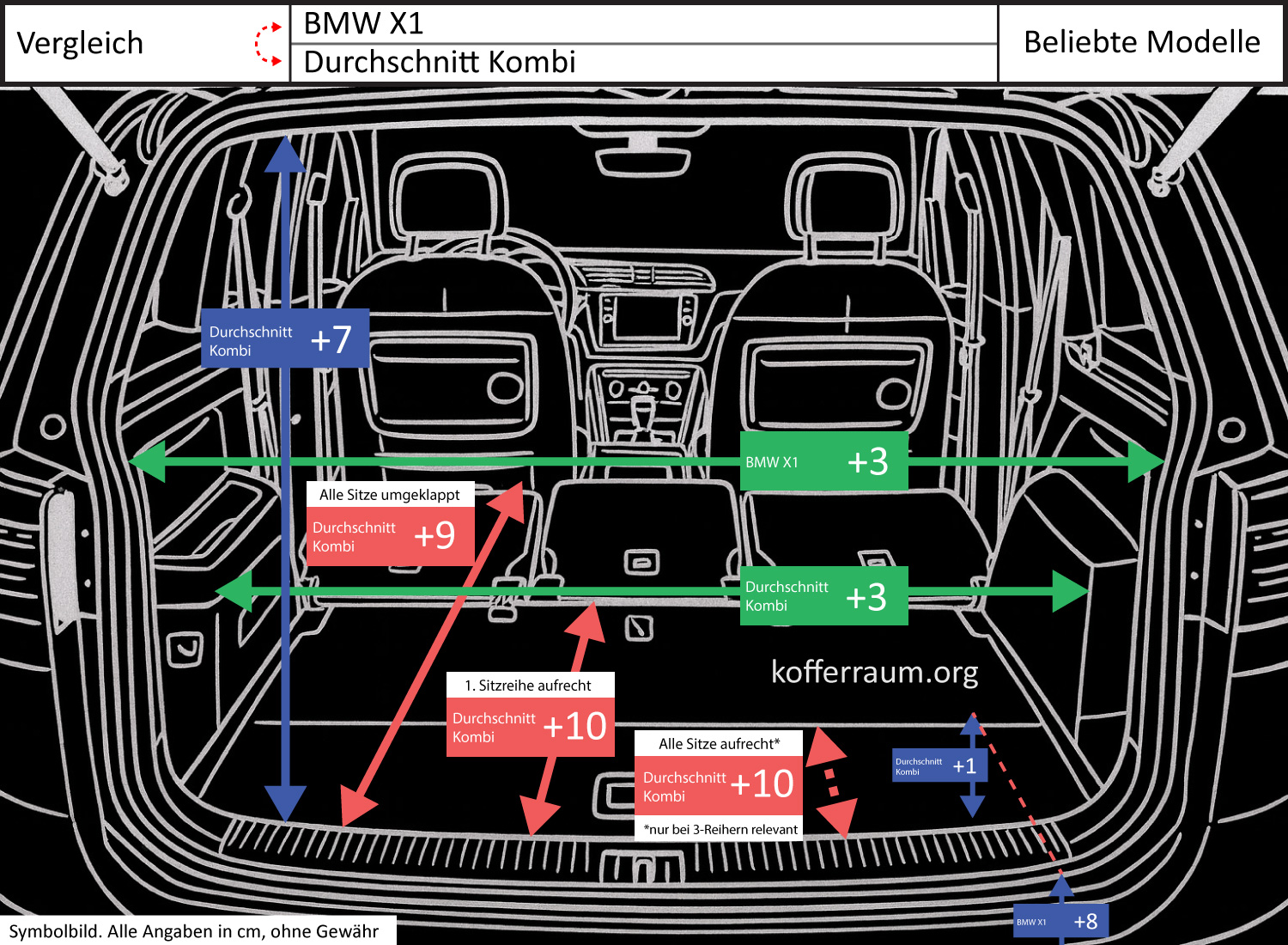
In a direct comparison, three significant differences stand out: The average wagon offers +3.9 in (11%) more trunk length with the rear seats upright than the BMW X1. The trunk depth (loading edge to trunk floor) is significantly larger in the average wagon by +0.4 in (33%).
Conversely, the loading edge of the BMW X1 sits +3.1 in (13%) higher above the road than that of the average wagon.
Smaller deviations concern the trunk length with folded seats (+3.5 in/5% in favor of the wagon), the height of the opening (+2.8 in/10% in favor of the wagon), as well as slight width differences (+1.2 in at the narrowest point in favor of the wagon; +1.2 in opening width in favor of the BMW X1).
What Impact Do These Differences Have on Usability?
The greater length with the rear seats upright (+11%) makes the average wagon more practical for everyday use when the rear seats are occupied: bulky or longer items (skis, furniture parts, shutter packages) can more often be transported without folding down the seats.
The significantly greater depth of the wagon (+33%) means more usable space behind the loading edge: boxes, deep luggage, or shopping stacks can be pushed further back, allowing volume to be used more efficiently.
The higher loading edge of the BMW X1 (+13%) negatively affects handling heavy or bulky loads — loading and unloading require more effort and can be inconvenient, especially with frequent transport of heavy items or without a roof rack.
A positive for the X1 is the slightly wider trunk opening (+1.2 in), which makes maneuvering wider items easier, though the advantage is small.
In practice, this means: If you often travel fully occupied and regularly transport bulky or deep cargo, the average wagon is overall more usable.
If you value a somewhat wider opening and less frequent heavy lifting, the BMW X1 remains a more compact alternative — but the higher loading edge makes loading less comfortable.