
Trunk comparison: BMW X1 vs Hyundai i10
Key Differences
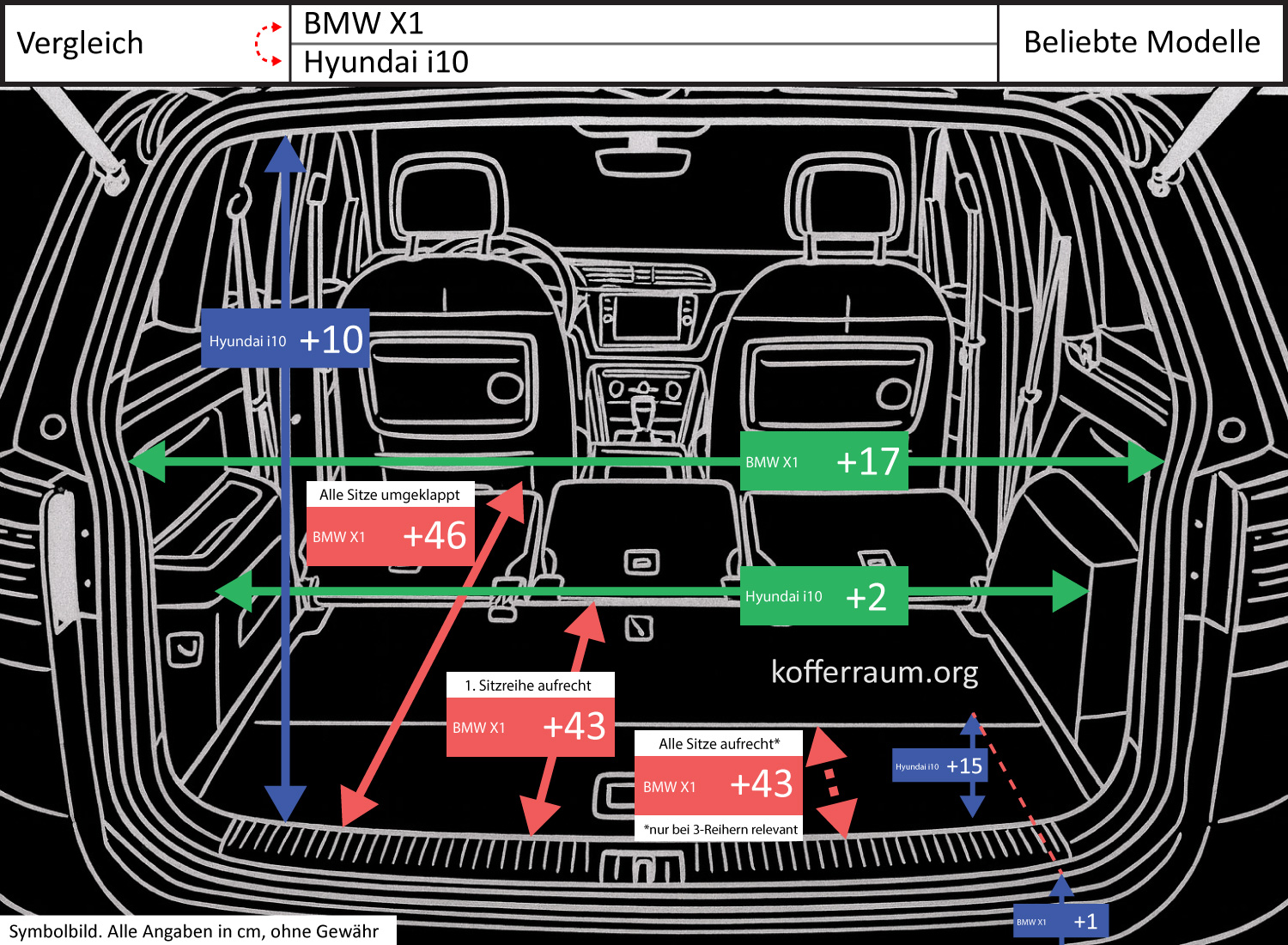
The BMW X1 offers significantly more cargo length: with the seats folded down, the trunk is +18.1 in (+39%) longer, and with the first row of seats upright, it is even +16.9 in (+91%) longer than the Hyundai i10. The width of the trunk opening is also noticeably larger in the BMW X1 (+6.7 in / +19%).
In contrast, the Hyundai i10 has a higher trunk opening (+3.9 in / +14%) and a significantly deeper loading lip compared to the trunk floor (+5.9 in / +500%).
Impact on Usability
These differences lead to clearly distinct strengths: The BMW X1 is better suited for long or wide cargo — such as long furniture pieces, skis, or multiple suitcases lined up — because it offers significantly more usable length and a wide opening.
Loading long, flat items and flexible loading with length-oriented cargo is easier in the X1.
The Hyundai i10 scores with tall or bulky single items: the higher opening and greater depth behind the loading lip create more vertical space directly behind the entry, which makes it easier to accommodate tall boxes or bulky, upright cargo.
However, the shorter cargo length and narrower opening significantly limit the ability to carry long or very wide items. The deep loading lip can also make lifting heavy items in more difficult, while flat sliding cargo is usually easier to handle in the X1.
Conclusion: For users who often transport long or wide loads, the BMW X1 is the better choice. Those who more frequently carry tall or bulky single items (with lower length requirements) and want a higher opening will find advantages in the Hyundai i10.