
Trunk comparison: BMW X1 vs Mazda Mazda CX-60


Key Differences (Summary)
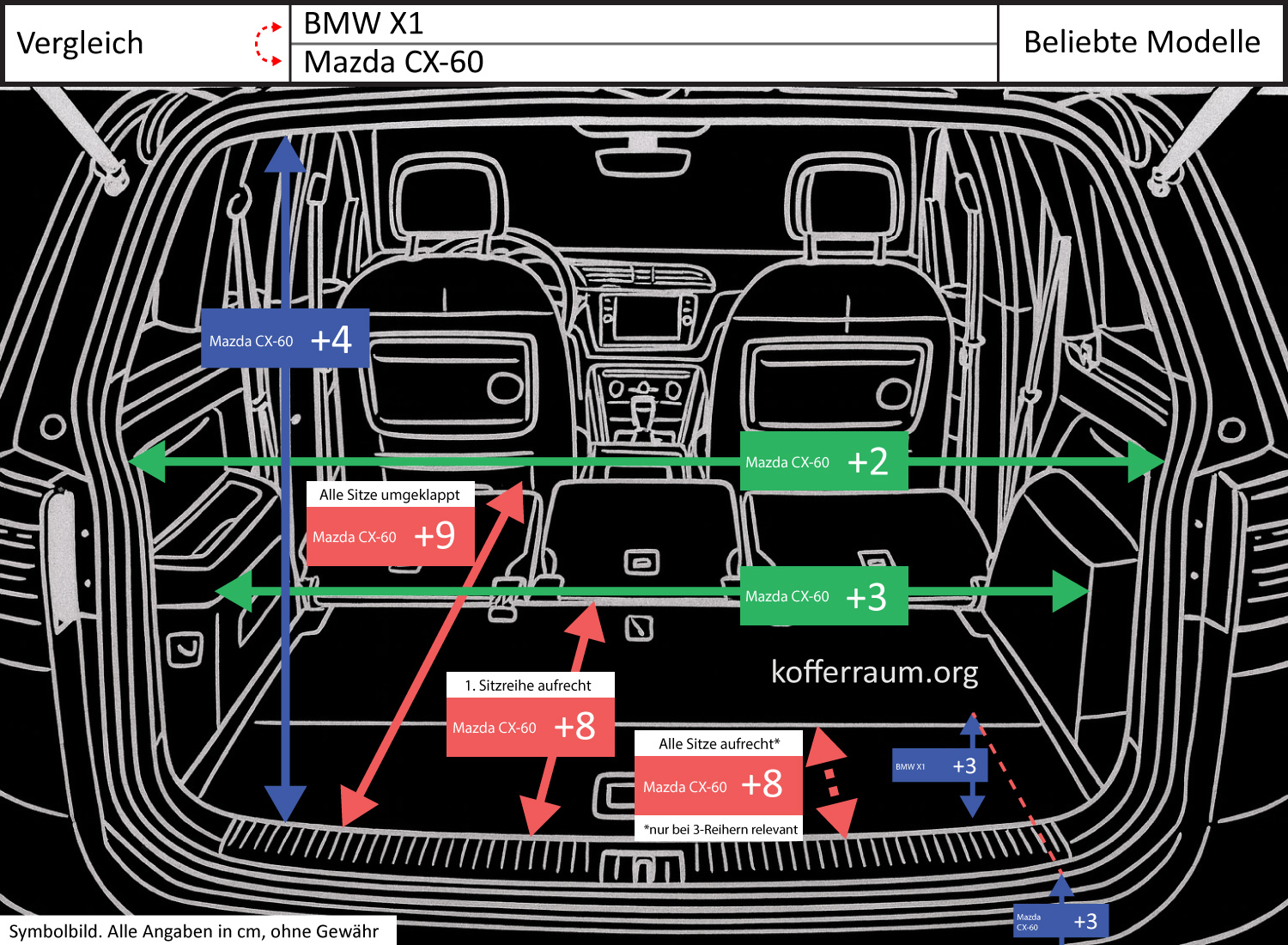
The data mostly shows small absolute differences in centimeters favoring the Mazda CX-60 in length, width, and trunk opening height.
However, a clearly pronounced difference lies in the depth of the cargo area: The BMW X1 has a 1.2 in greater trunk depth (specification: +1.2 in / 200%), which here is the only feature that clearly exceeds the 10% mark.
What These Differences Mean in Practice
Mazda CX-60: The CX-60 offers slightly more usable length (both with folded seats and upright rear bench) as well as a bit more width at the narrowest point and a slightly larger opening height.
Practically, this means longer or bulky items can be more easily accommodated in the CX-60, and the larger opening facilitates maneuvering boxes or furniture parts. However, the CX-60's loading edge is about 1.2 in higher above the road, which can slightly complicate lifting heavy loads.
BMW X1: The X1 has a significantly deeper loading area between the loading edge and trunk floor (+1.2 in; indicated here as a large percentage value). In practice, this means cargo sits deeper — items are positioned a bit lower and are better secured against shifting.
Additionally, the X1's loading edge is lower than the CX-60's, which makes lifting heavy items from the ground into the trunk easier. Overall, this is an advantage when handling heavy or more compact cargo, despite slightly smaller length and width.
Conclusion
The Mazda CX-60 offers better dimensions for longer and wider cargo and a slightly larger opening height — useful for larger, bulky items. The BMW X1 scores with a deeper cargo floor and a lower loading edge, which facilitates storing heavy or more densely packed goods.
Which model is more practical depends on typical cargo: for long/bulky items, the CX-60 is preferable; for frequent lifting of heavy items or better cargo sinking, the X1 is better.