Trunk comparison: BMW X1 vs Tesla Model 3
Key Differences
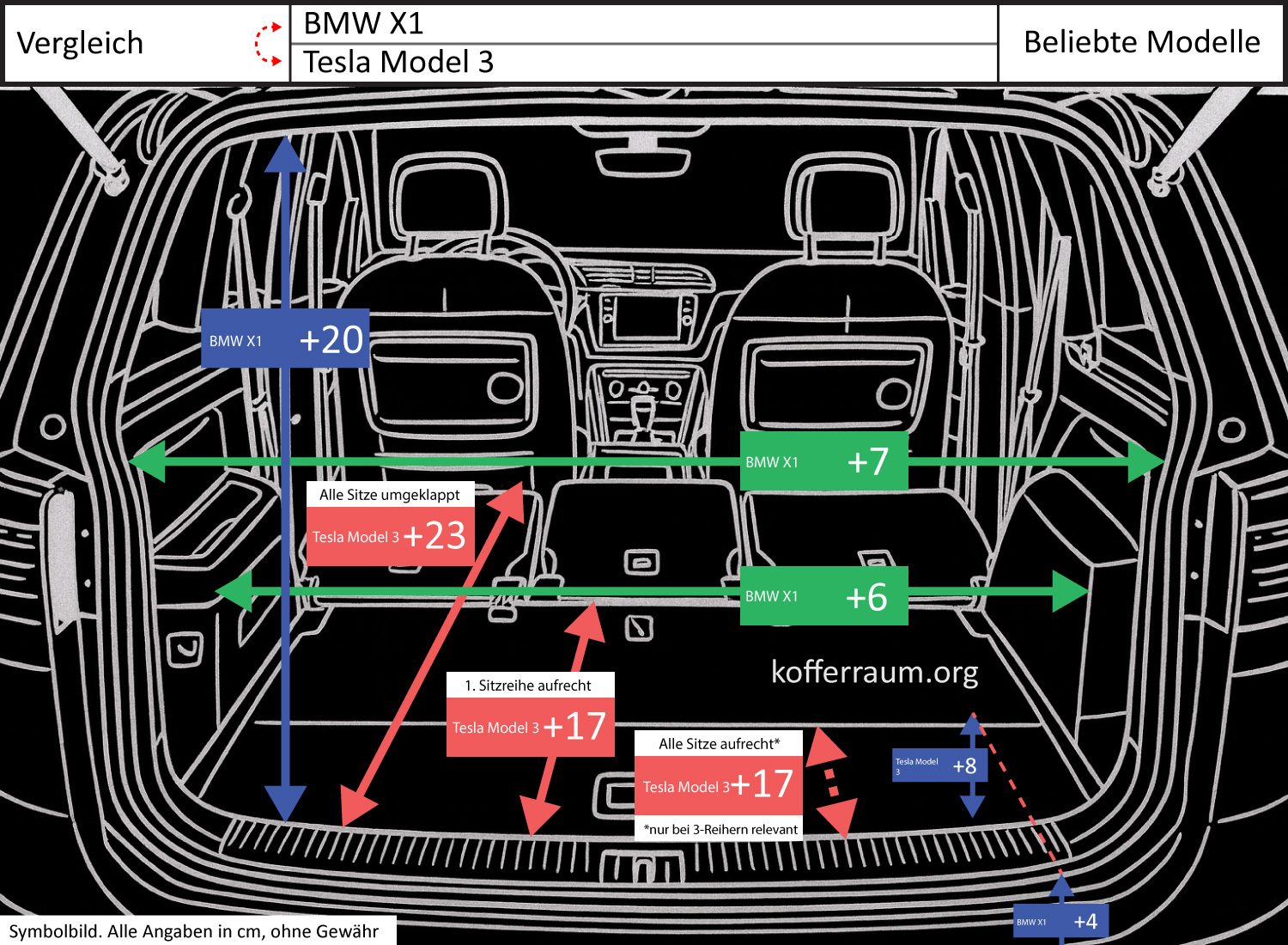
Four differences stand out from the data: the Tesla Model 3 offers a 9.1 in (+14%) longer cargo floor when all seats are folded down, and a 6.7 in (+19%) longer cargo floor when the rear seat is upright. The trunk opening of the BMW X1 is 7.9 in (+38%) higher than that of the Tesla.
Additionally, the trunk depth in the Tesla (measured from the loading edge to the trunk floor) is 3.1 in (+267%) greater than in the BMW. Smaller differences (narrowest width +6%, opening width +7%, loading edge height +6% in favor of the BMW) remain under 10% and are rather marginal.
Impact on Usability
The longer cargo floor of the Tesla (both with folded seats and with the rear seat upright) makes it more practical for long items like skis, furniture boards, or longer luggage; seats need to be folded down or items angled less often.
For users who frequently transport long loads, the Tesla is therefore more advantageous.
The significantly higher trunk opening of the BMW makes it easier to load tall or bulky items (boxes, cartons, equipment) because less tilting or turning is required. Those who often load tall cargo or transport bulky items upright benefit from the larger opening height of the BMW.
The greater depth in the Tesla (larger distance from loading edge to floor) means more usable volume in the cargo well and that cargo lies deeper and thus more stably.
Combined with the lower loading edge height of the Tesla (the BMW is only slightly higher), there is an advantage for heavy cargo with the Tesla: easier sliding in and a lower, more secure storage. However, a deeper cargo well can make lifting very heavy single items over the edge somewhat more demanding.
The slightly greater width and opening width of the BMW are only minor advantages and hardly change everyday usability; they marginally ease maneuvering very wide items.
Conclusion: The Tesla Model 3 is better suited for long and flat cargo as well as back-friendly sliding in of heavy loads. The BMW X1 has an advantage with tall or bulky items thanks to the higher opening. For most everyday cases, both are well usable; the choice depends on the preferred type of cargo.