
Trunk comparison: BMW X1 vs Volvo V90

Key Differences
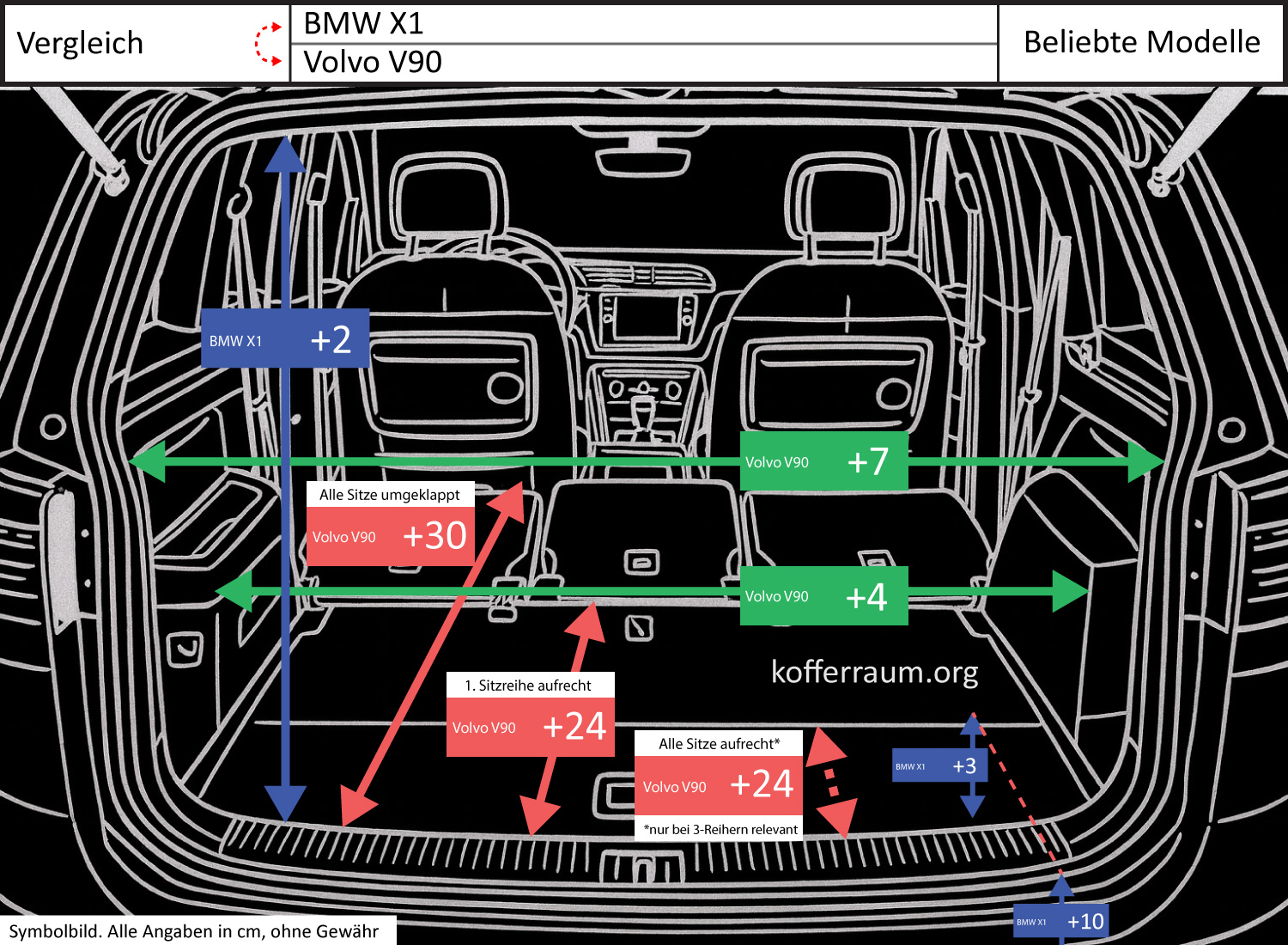
The Volvo V90 offers a significantly larger cargo space in length: with the seats folded down, the trunk of the V90 is
longer than that of the BMW X1, and with the first row upright, the advantage is
. In contrast, the BMW X1 has a trunk depth (loading edge to trunk floor) that is
greater — although this is only 1.2 in in absolute terms — and the loading edge is
higher above the ground than in the V90. Smaller differences: the height of the trunk opening is 0.8 in (+3%) larger in the X1; the narrowest trunk width is 1.6 in (+4%) larger in the V90, and the opening width is 2.8 in (+7%) larger in the V90.
What are the practical implications of these differences?
The longer loading dimensions of the Volvo V90 practically mean more space for long items (e.g., slats, pipes, skis, longer furniture parts) both with folded seats and in normal 5-seat operation. This makes the V90 overall more flexible for transports requiring length and often reduces the need to fold down or angle the cargo. The BMW X1 scores with a deeper loading floor relative to the loading edge, which — despite only +1.2 in — results in a slightly deeper cargo area where flat-lying or low-stacked items can be positioned more securely below the threshold. At the same time, the higher loading edge of the X1 makes lifting heavy items into the trunk more difficult: +3.9 in means noticeably more lifting effort when loading, especially with bulky or heavy cargo. The moderately larger widths and the slightly larger opening width of the V90 (each under 10%) support loading wider items but are less significant than the length differences. The slightly higher trunk opening of the X1 (+0.8 in) has hardly any practical impact. In summary: For long or bulky transport, the Volvo V90 is more practical; the BMW X1 offers a slightly deeper cargo well but requires more lifting effort due to the higher loading edge.