
Trunk comparison: BMW X1 vs VW T-Cross
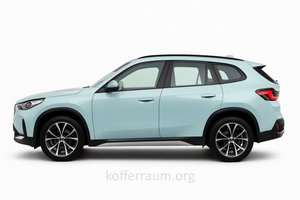
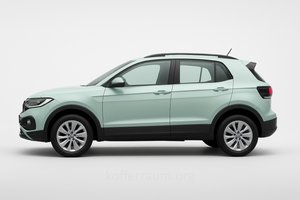
Key Differences
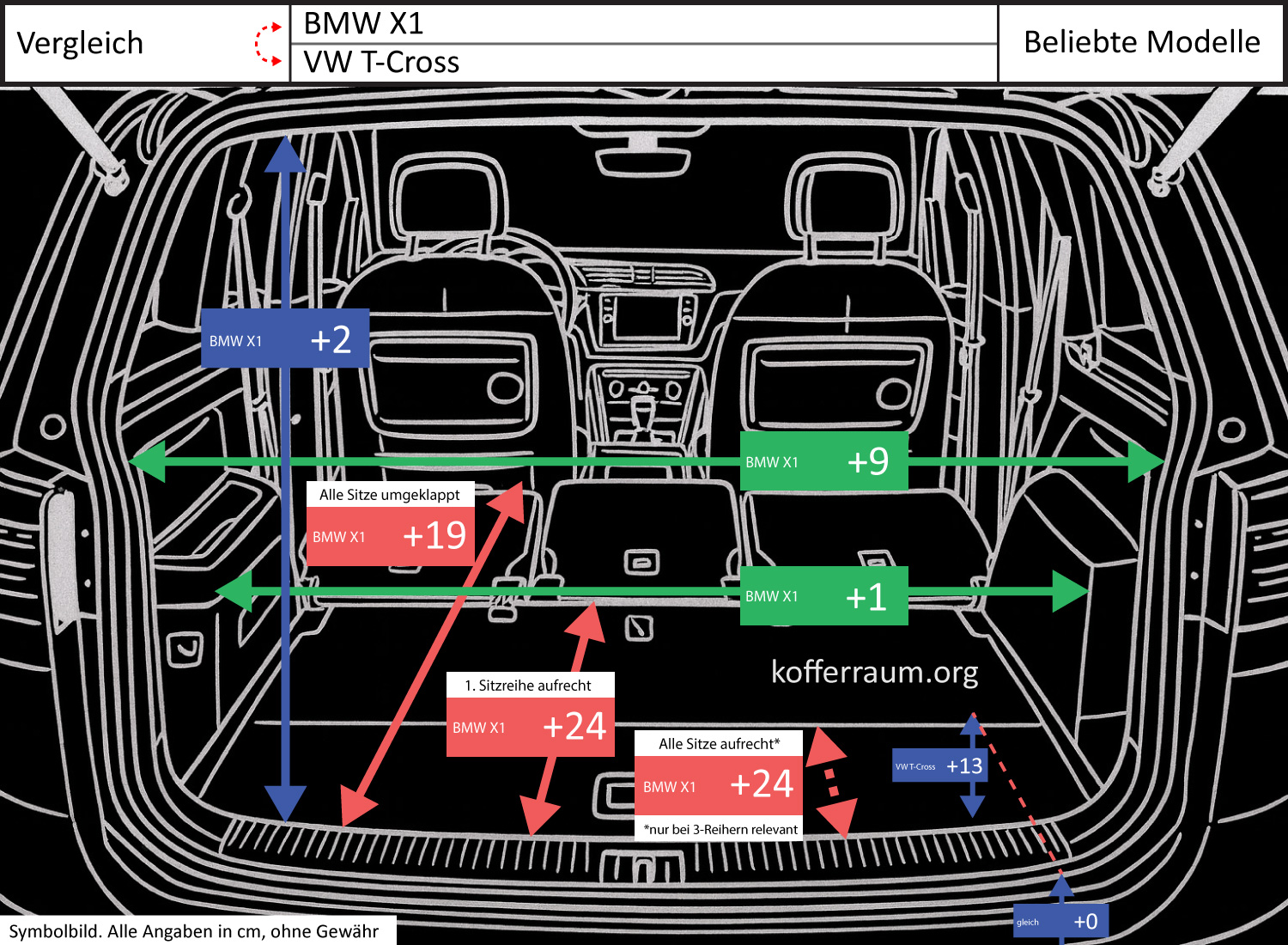
The models mainly differ in three aspects regarding space: The BMW X1 offers a cargo area that is +7.5 in (≈13%) longer with the seats folded down compared to the VW T-Cross, and with the seats upright, the BMW is even +9.4 in (≈36%) longer.
Conversely, the VW T-Cross has a significantly greater depth between the loading edge and the trunk floor: here it exceeds the BMW X1 by +5.1 in (≈433%). Smaller differences such as +0.8 in opening height, +3.5 in opening width, or +0.4 in narrowest width are comparatively minor and remain unhighlighted.
Impact on Usability
The longer cargo dimensions of the BMW X1 (both with folded and upright seating) make it more practical for long items — such as slats, skis, long boxes, or furniture parts. If you frequently transport longer goods or need a continuous cargo surface, the X1 reduces the need to rearrange and fit bulky loads.
The significantly greater depth drop in the VW T-Cross means more volume directly behind the loading edge: small to medium-sized bulky items can be sunk deeper, making the visible cargo volume appear larger.
This is advantageous for irregularly shaped or tall cargo that primarily requires space in depth rather than length. At the same time, a deeper floor requires items to be lowered or lifted further, which often results in loading and unloading heavy loads in a less favorable posture.
Conclusion: For transporting longer parts and continuous cargo surfaces, the BMW X1 is better suited.
For more usable storage volume behind the loading edge and for bulky, not particularly long cargo, the VW T-Cross is more appropriate. Smaller differences in opening dimensions and width have only a minor practical impact.