Trunk comparison: BMW X2 vs BMW X5

Key Differences
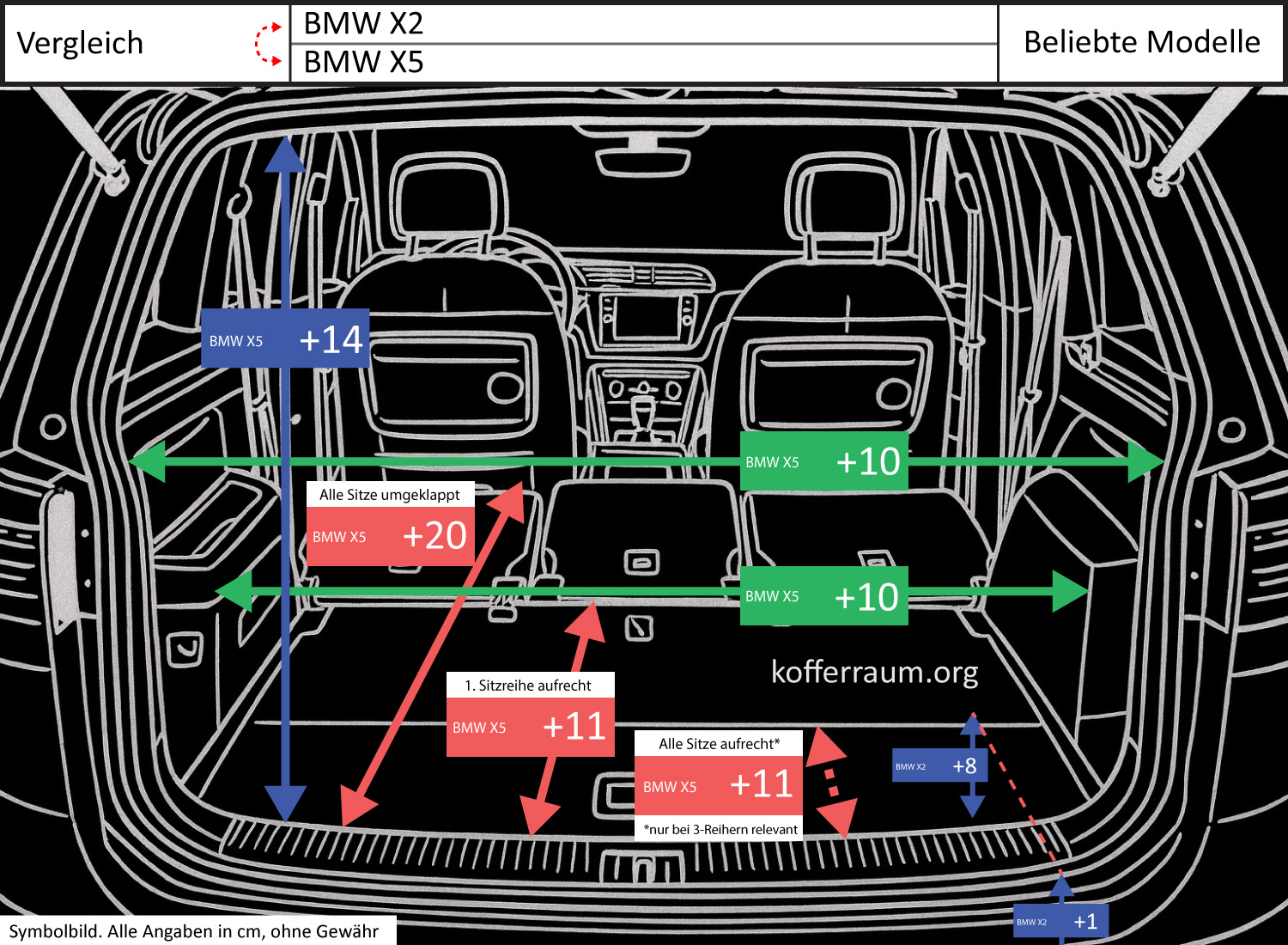
Compared to the BMW X2, the BMW X5 offers a 7.9 in (12%) longer cargo area with the seats folded down and a 4.3 in (12%) longer trunk with the first row of seats upright.
The trunk opening of the X5 is 5.5 in (21%) higher than that of the X2. Conversely, the X2 has a significantly greater depth between the loading edge and the trunk floor: this is 3.1 in (800%) higher in the X2 than in the X5. Smaller differences: the width at the narrowest point and the width of the trunk opening are each 10% larger in the X5, and the loading edge of the X2 is 1% (≈0.4 in) higher above the ground.
What impact do these differences have on usability?
- Longer loading surface in the X5 (each +12%): The X5 is better suited for long items (e.g., furniture parts, long sports equipment, transports with folded seats). If long cargo is regularly transported, the X5 offers noticeable advantages.
- Higher trunk opening in the X5 (+21%): The higher opening makes loading and unloading bulky or tall items easier and improves access to the cargo space. Large boxes or cartons can be more easily tilted and loaded.
- Greater depth measurement of the X2 (+3.1 in, very large relative difference): The X2 has more interior height closer to the loading edge (trunk floor positioned lower relative to the loading edge).
This is advantageous when items are taller rather than longer and need to be placed deep in the trunk (e.g., tall boxes, coolers). However, the overall length and opening height remain smaller than in the X5, so long or bulky parts less often fit completely in the X2.
- Width and loading edge height: The 10% greater width of the X5 at the narrowest point and at the opening is a moderate advantage when loading wider items. The 0.4 in higher loading edge of the X2 is practically negligible but can slightly complicate handling heavy loads.
Conclusion: For regular transport of long or very bulky items, the X5 is the more practical choice (longer cargo area, higher opening). The X2 scores with greater depth directly at the loading area—useful for tall, compact cargo—but is overall less suitable for long or particularly bulky goods.