
Trunk comparison: BMW X2 vs Hyundai IONIQ
Summary
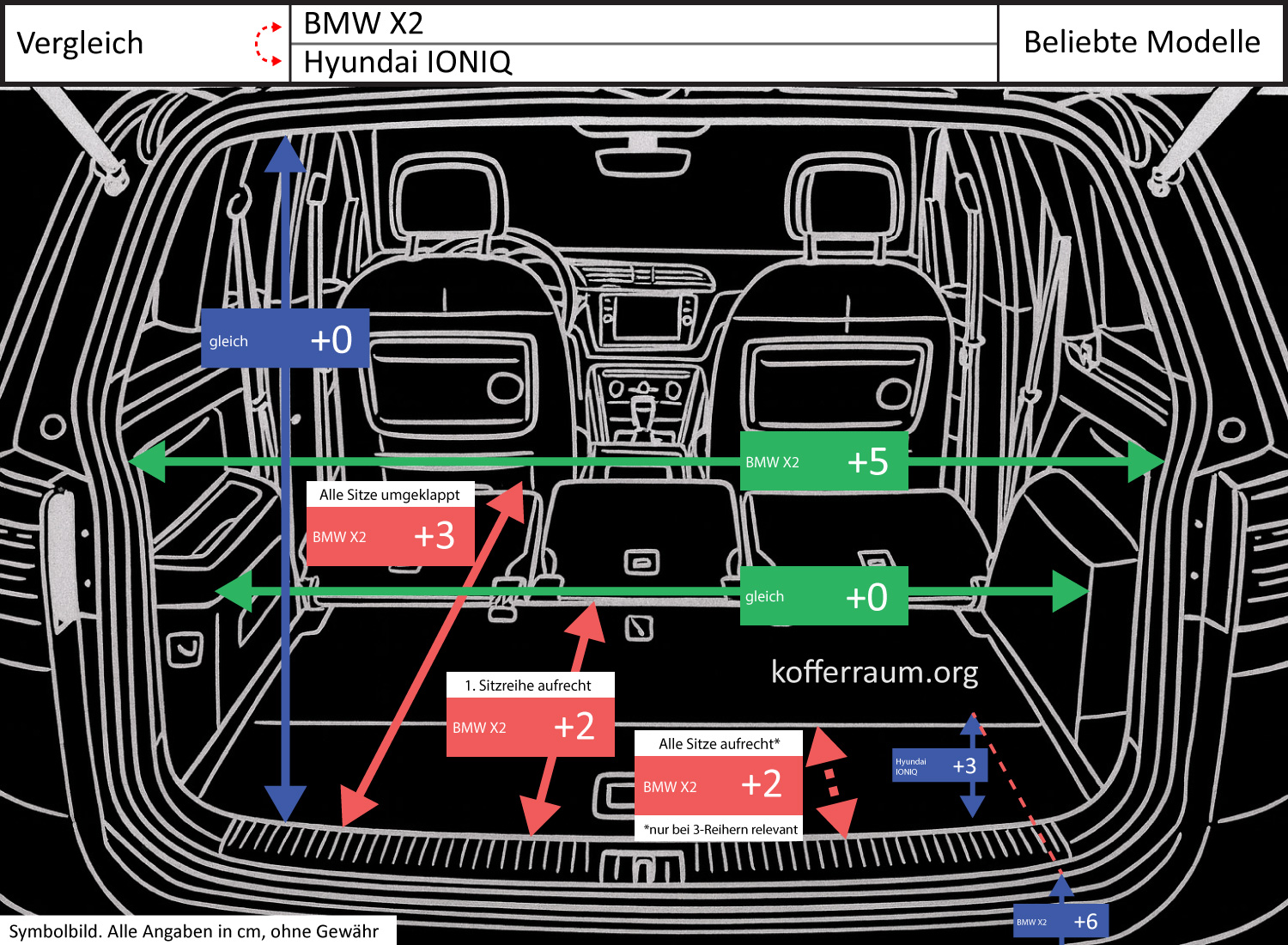
The measurements reveal a clear difference: The depth of the trunk (distance from loading edge to trunk floor) of the Hyundai IONIQ is 1.2 in, or +33%, greater than that of the BMW X2. This difference of over 10% is the only significant gap and will be highlighted below. All other deviations are between 2–8% or are equal (trunk opening height and narrowest width are the same; BMW: +1.2 in/2% longer trunk with folded seats, +0.8 in/2% with front seats upright; BMW trunk opening +2 in/5% wider; BMW loading edge +2.4 in/8% higher).
Impact on Usability
The significantly greater depth in the IONIQ means more usable vertical space near the loading edge: items can be lowered further "into" the trunk, which is especially advantageous when storing tall or bulky items, crates, or bags.
Practically, this means that with the Hyundai, bulky or stackable loads can be stored more space-efficiently and securely on the floor because more depth is available.
For everyday use, this results in the following usage behavior: the Hyundai makes loading heavy items overall easier because the cargo floor is deeper and the loading edge (combined with the slightly lower loading edge height of the IONIQ) facilitates lifting loads close to the ground.
The BMW X2, on the other hand, offers a slightly higher loading edge and a shallower trunk depth; this can make loading very heavy loads somewhat more demanding but provides a more easily reachable storage level for quickly accessible items due to the smaller distance between the loading edge and the trunk floor.
Other small differences (longer trunk dimensions in the BMW by 2%, wider opening by 5%) only marginally affect usability: the wider opening width of the BMW slightly eases sliding in wide items from the side, while the practically identical opening height and narrowest width in both vehicles mean similar limitations for very wide or tall loads.