
Trunk comparison: BMW X2 vs Mazda Mazda CX-60


Key Differences and Implications for Usability
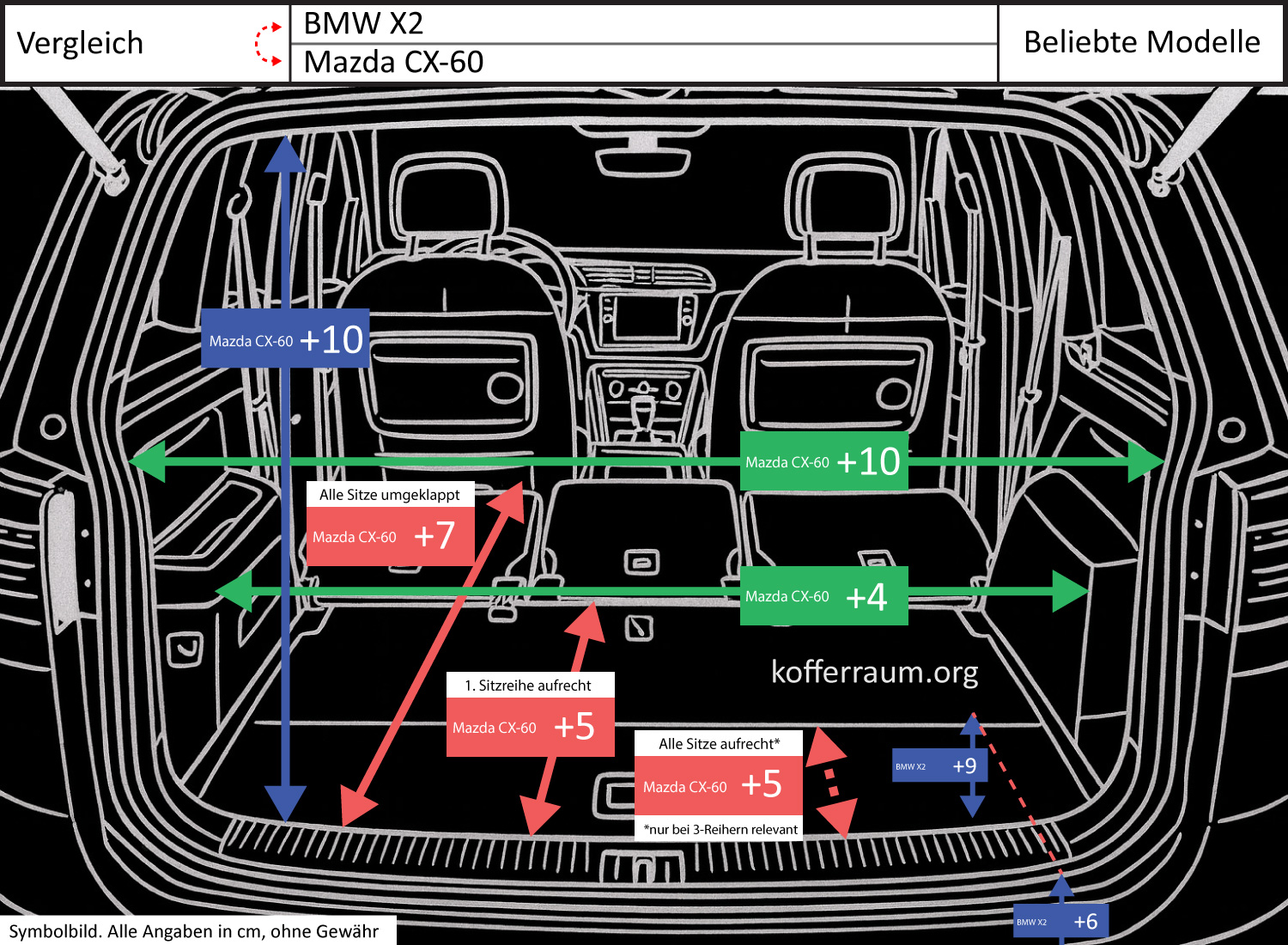
In the comparison, it is particularly noticeable that the rear opening of the Mazda CX‑60 is 3.9 in (15%) higher than that of the BMW X2. The greater opening height significantly facilitates loading tall or bulky items and reduces the risk of bumping when placing them inside.
Another striking difference is the depth of the trunk (measurement: loading edge to trunk floor): In the BMW X2, this is 3.5 in — indicated as +800% compared to the CX‑60 — significantly more pronounced. This means a noticeable step between the loading edge and the floor: luggage or cargo sits deeper in the X2 and is therefore less visible and often more stable, but lifting over the loading edge is more strenuous and easily sliding heavy items through is more difficult.
Other, smaller differences: The Mazda CX‑60 offers about 2.8 in (4%) more cargo length with the seats folded down and about 2 in (5%) more depth with the first row upright than the BMW.
The narrowest loading width is 1.6 in (4%) larger in the CX‑60; the width of the trunk opening in the CX‑60 is 3.9 in (10%) above the BMW value, which facilitates loading wider items, even though this difference is exactly 10%.
The loading edge of the BMW is also about 2.4 in (8%) higher above the road, making loading heavy items somewhat more cumbersome.
Practical consequence: Those who frequently load tall or bulky parts (e.g., bicycles, furniture boxes, large cartons) benefit from the Mazda CX‑60 due to the higher opening and the slightly larger length and width dimensions.
Those who value a deeper trunk space (better anchoring, less shifting) and have no issues with somewhat higher lifting effort will find advantages in the BMW X2. For comfortable lifting of heavy loads, the Mazda is usually more favorable in practice due to the lower loading edge and flatter step.