
Trunk comparison: BMW X3 vs Durchschnitt Compact SUV

Key Differences
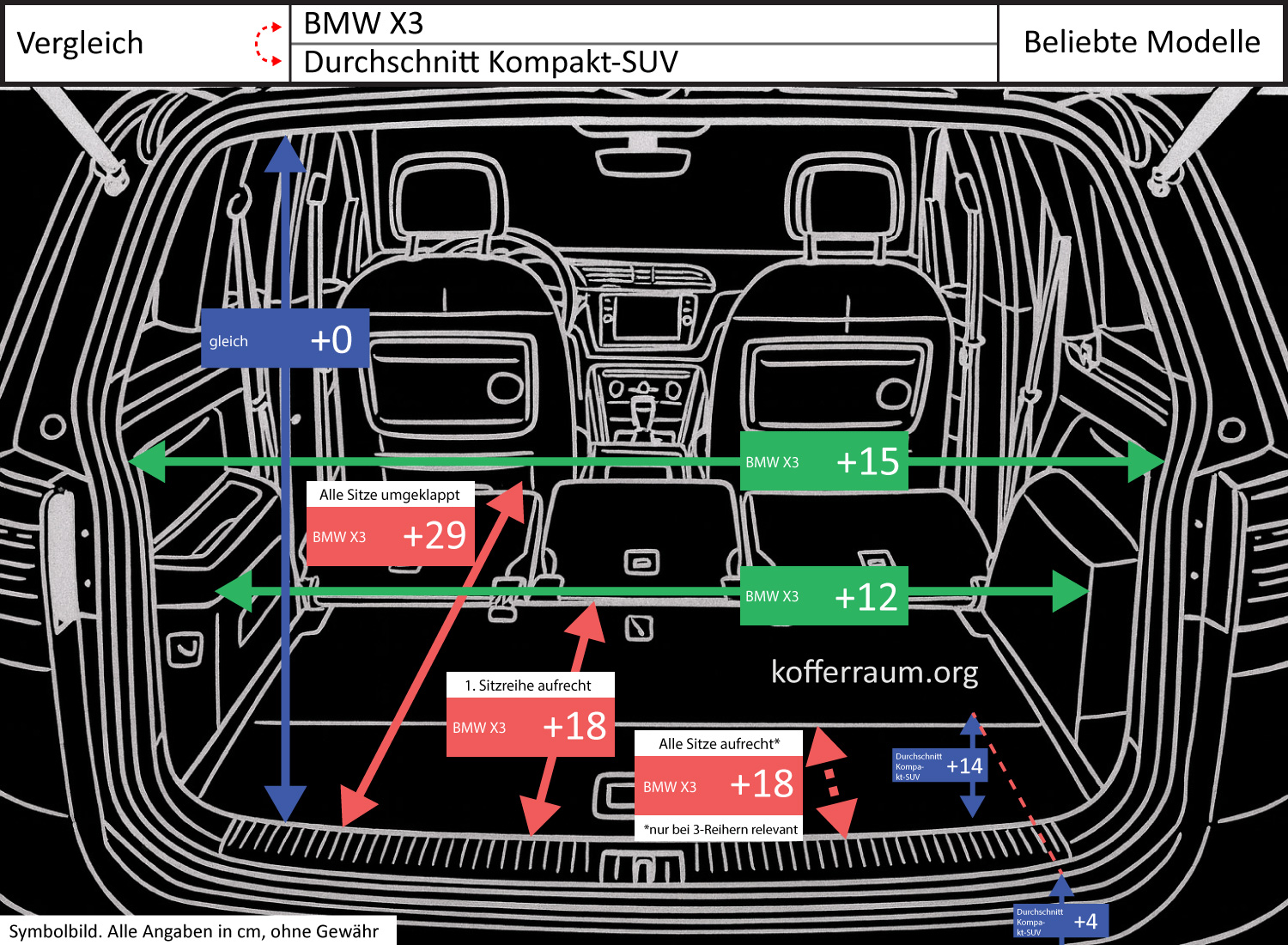
The BMW X3 offers with the rear seats folded down +11.4 in (≈19%) longer cargo space and with the front seats upright +7.1 in (≈23%) longer cargo space compared to the average compact SUV.
The width at the narrowest point is +4.7 in (≈12%) larger in the X3, and the width of the trunk opening is even +5.9 in (≈15%) larger than the average.
The height of the trunk opening is the same. In contrast, the interior depth (loading edge to trunk floor) is significantly greater in the average: +5.5 in (≈1300%) compared to the BMW X3. The loading edge height above the ground is only slightly higher in the average (+1.6 in / ≈6%).
Impact on Usability
The greater interior length of the BMW X3 (both with folded rear seats and upright front seats) makes it noticeably more practical for long items such as furniture parts, skis, or longer boxes.
Combined with the greater narrowest width and the wider opening, wide or bulky items can be turned and loaded more easily — less maneuvering when loading.
The significantly greater interior depth of the average SUV means more vertical storage space behind the loading edge. This is advantageous for tall or bulky cargo that can be lowered deep into the trunk (e.g., stacked crates, large camping gear).
At the same time, a deeper loading well can make lifting heavy items somewhat more difficult because more lifting work is required.
Since the loading edge height differs only slightly (≈6%) and the opening height is the same, the entry height hardly affects daily loading.
In summary: For transporting long and wide items, the BMW X3 is clearly advantageous; for very tall/bulky cargo, the average compact SUV may be better suited due to the greater depth.
For regular transport of heavy, tall loads, one should consider the deeper cargo compartment (but slightly higher loading edge) of the average; for flexible, easy loading of bulky parts, the X3 is presumably more practical.