
Trunk comparison: BMW X3 vs Durchschnitt SUV


Key Differences
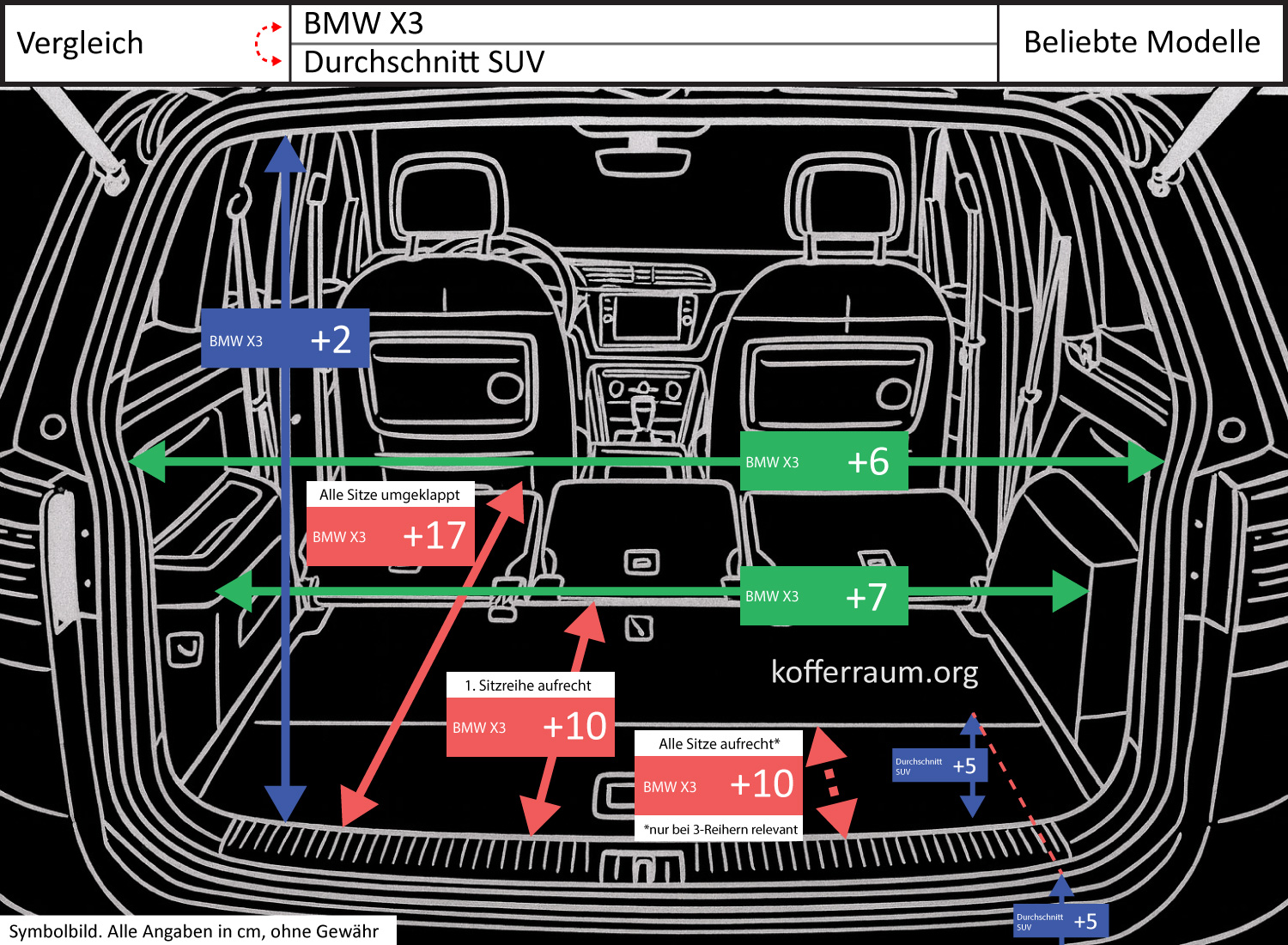
The BMW X3 offers a loading length that is +6.7 in (11%) longer than the average SUV with the seats folded down and +3.9 in (12%) longer with the first row of seats upright.
In contrast, the trunk depth (loading edge to trunk floor) of the average SUV is +2 in (400%) greater than that of the BMW X3. Smaller differences: the height of the X3's trunk opening is +0.8 in (3%) higher, the loading edge height of the average SUV is +2 in (7%) above the ground, the narrowest trunk width of the X3 is +2.8 in (7%) wider, and the opening width of the X3 is +2.4 in (6%) larger.
Impact on Usability
The larger length dimensions of the X3 (each >10%) specifically mean: longer items fit more easily inside, both with normal seating and with seats folded down — an advantage when transporting furniture, sports equipment, or long boxes.
However, the significantly shallower trunk depth of the X3 reduces usable vertical space near the loading edge; as a result, tall or stackable loads are harder to accommodate than in the average SUV.
In practice, this means the X3 is better suited for long, flat, or wide items, while the average SUV is better for bulky, highly stackable cargo.
The smaller differences in opening and width dimensions (3–7%) as well as the slightly lower loading edge of the X3 assist with loading but are not major factors compared to the highlighted length and depth differences above.