
Trunk comparison: BMW X3 vs Ford S-MAX

Main Differences
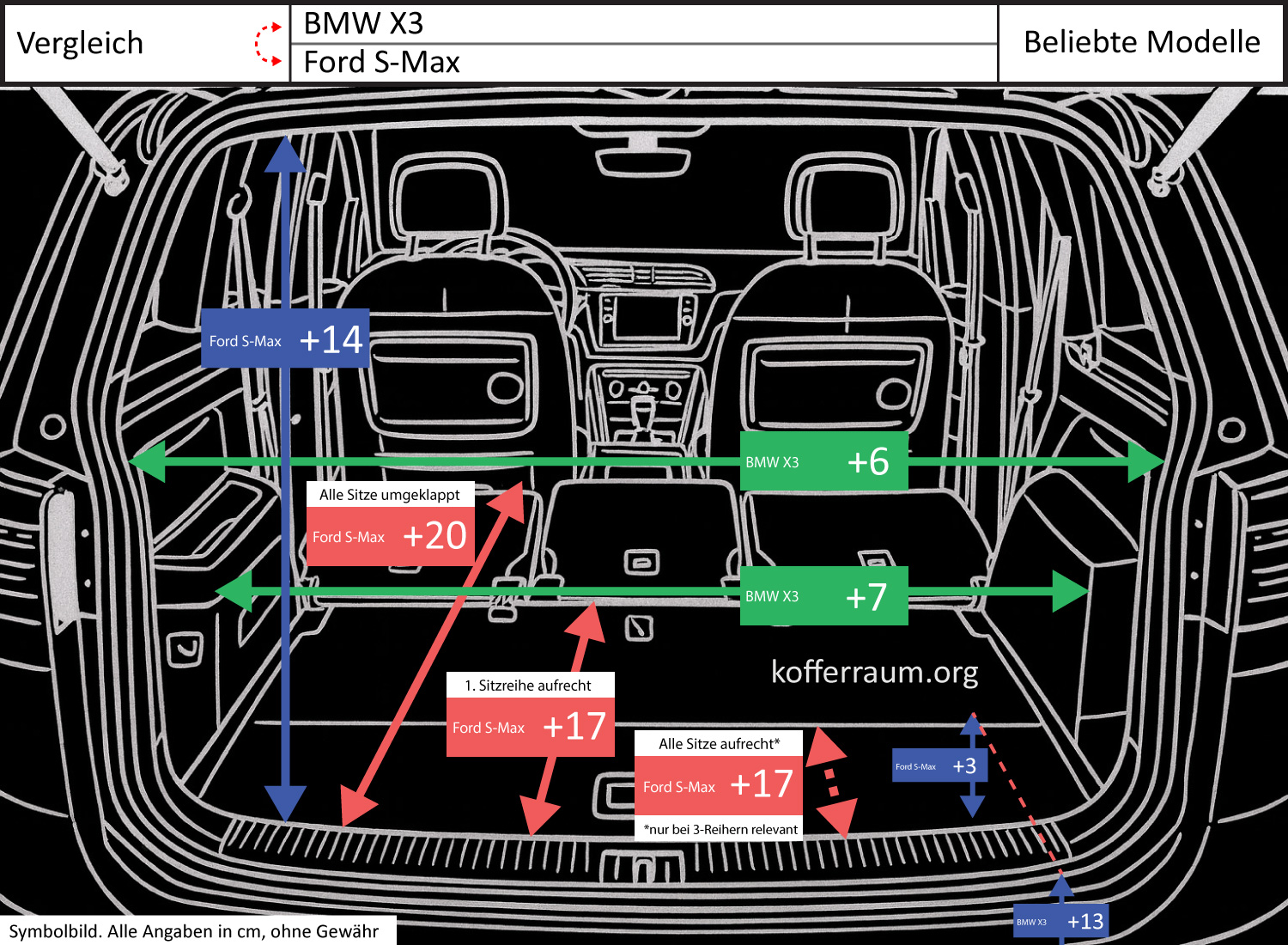
In the cargo space, the Ford S-Max shows clear advantages in length and opening: with the seats folded down, it is +7.9 in (11%) longer, and with the first row of seats upright, +6.7 in (18%) longer. The trunk opening is also significantly higher on the S-Max: +5.5 in (18%).
The depth between the loading edge and the trunk floor is +1.2 in (200%) greater on the Ford. In contrast, the loading edge of the BMW X3 is higher above the road — the X3 is elevated here by +5.1 in (23%).
Width differences are small: at the narrowest point, the BMW is +2.8 in (7%) wider, and the opening width is +2.4 in (6%) larger on the BMW.
Implications for Usability
The longer loading dimensions and higher opening of the S-Max make loading long or tall items significantly easier — such as bicycles, long pieces of furniture, or bulky sports equipment.
The greater depth from the loading edge area increases the usable interior height directly behind the loading edge, which improves stackability of boxes.
Because the loading edge is lower on the Ford (the X3 is significantly higher here), lifting heavy items into the BMW requires more effort; the S-Max is more ergonomic for frequent or heavy loading and unloading.
The BMW X3 scores on width: its slightly larger narrowest interior width and marginally larger opening width make it easier to accommodate wider items. However, since these differences are under 10%, their practical impact is rather small and mainly affects very wide cargo.
Conclusion: Those who regularly transport long, tall, or heavy loads or prefer easier loading benefit from the Ford S-Max. Those who occasionally need to transport wider items and prefer a more compact SUV profile will find the BMW X3 offers a generally wider but otherwise smaller loading solution.