
Trunk comparison: BMW X3 vs Hyundai IONIQ
Key Differences
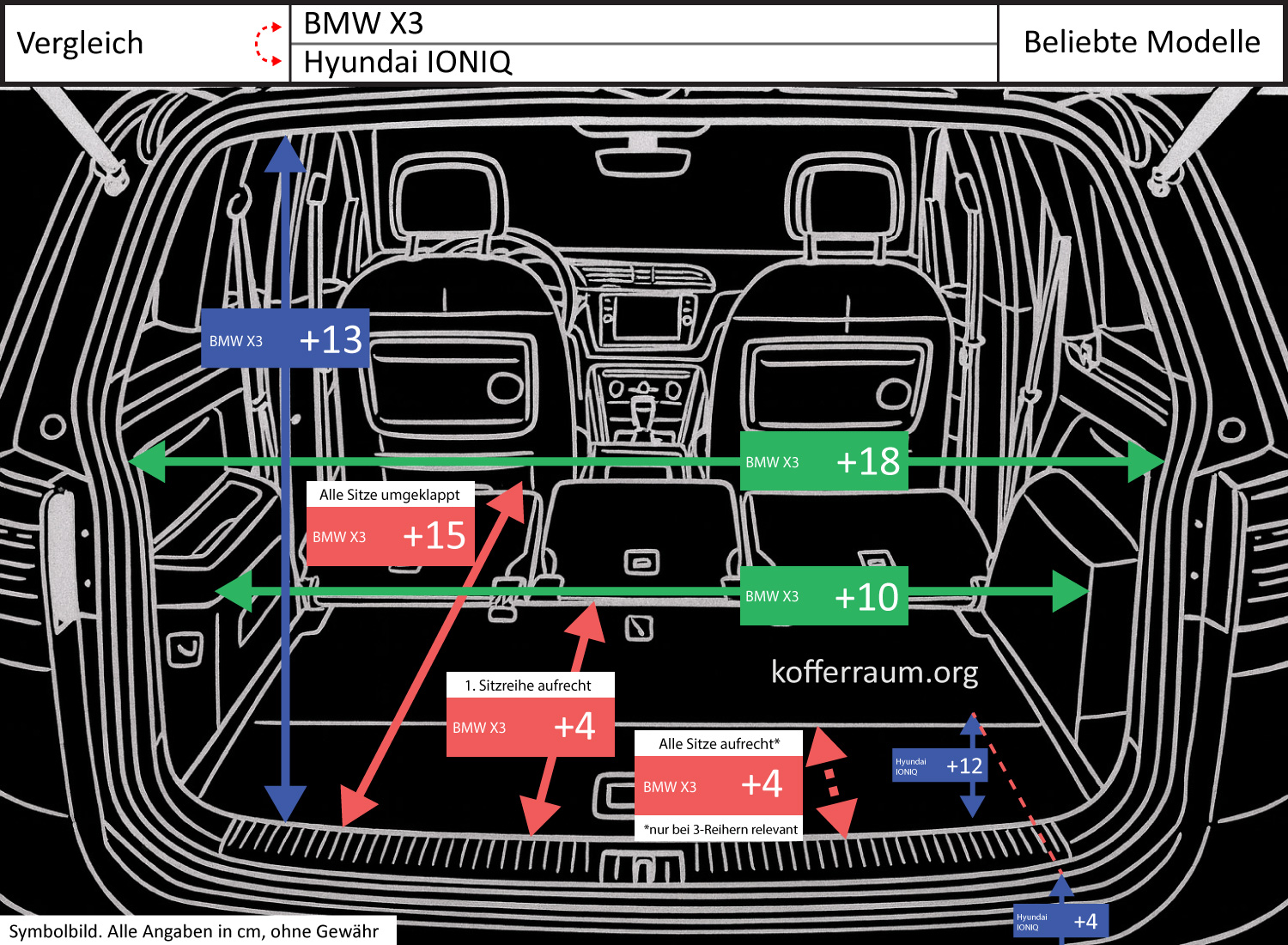
In a direct comparison, three points stand out: The height of the trunk opening of the BMW X3 is 5.1 in (20%) larger than that of the Hyundai IONIQ, the width of the trunk opening of the BMW X3 is 7.1 in (19%) larger than that of the IONIQ, and the depth of the trunk (distance from loading edge → trunk floor) is 4.7 in (1100%) larger in the Hyundai IONIQ than in the BMW X3.
Impact on Usability
The larger opening height and width of the BMW X3 make it easier to load and unload wide and tall items: furniture parts, large suitcases, or bulky sports equipment fit more easily through the opening, there is more space when maneuvering bulky cargo, and there is less risk of bumping into the opening.
This makes the X3 more practical in everyday use when frequently transporting bulky or voluminous cargo.
The Hyundai IONIQ offers a deeper cargo space with the significantly larger distance between the loading edge and the trunk floor. This creates more usable volume below the loading edge and is better suited for stacked luggage or items that should be recessed in a deeper cargo area.
However, the IONIQ has a slightly higher loading edge above the road, which makes lifting heavy loads from the ground into the trunk somewhat more strenuous. Additionally, the smaller opening height and width can make it difficult to accommodate very wide or tall objects, even if there is more depth inside.
In summary: For frequent transport of wide or tall items, the BMW X3 has the advantage. For maximum cargo space used in depth (stacked suitcases, deeper cargo), the Hyundai IONIQ offers benefits but impairs loading and unloading of bulky parts due to the smaller opening and the slightly higher loading edge.