
Trunk comparison: BMW X3 vs Renault Austral


Key Differences
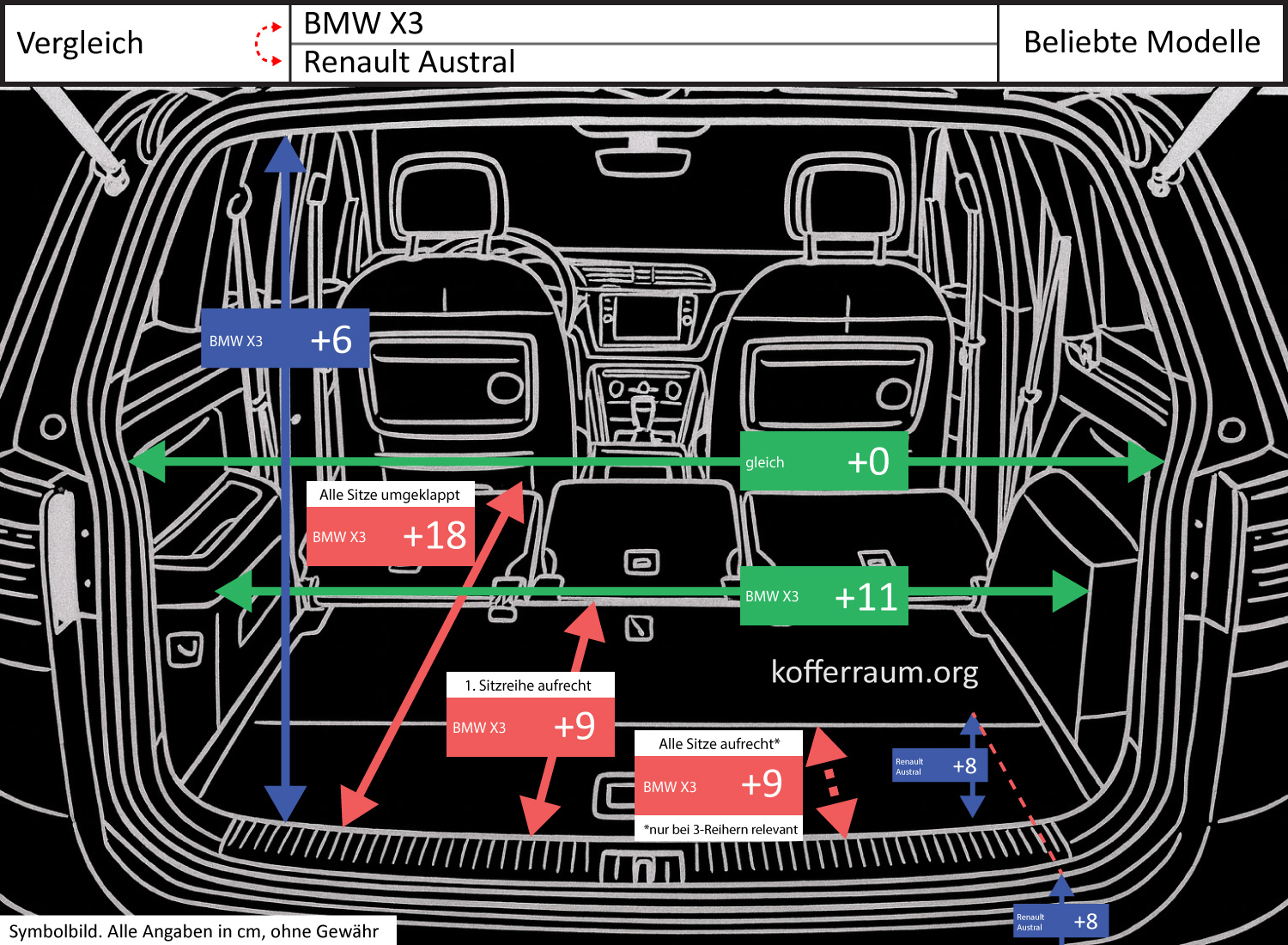
When comparing the trunk dimensions, three differences stand out clearly: The BMW X3 offers a longer cargo floor by +7.1 in (11%) when folding down all seats compared to the Renault Austral.
The narrowest point in the trunk is also larger in the X3, namely +4.3 in (11%). On the other hand, the Renault Austral has a significantly greater depth between the loading edge and the trunk floor: +3.1 in (700%).
Additionally, the loading edge of the Austral is 3.1 in (11%) higher above the road.
The width of the trunk opening is the same for both models; smaller differences such as the X3's 3.5 in (10%) longer cargo floor with the rear seats upright or the X3's 2.4 in (8%) higher opening exist but do not exceed the 10% threshold.
Implications for Usability
The longer cargo floor and the larger narrow point in the X3 clearly indicate better suitability for transporting long or wide items (e.g., furniture parts, long slats, skis).
The identical opening width means that bulky items are not limited at the entrance, but the Austral's narrowest interior point can make loading wide items more difficult.
The significantly greater distance from the loading edge to the trunk floor in the Austral increases usable vertical volume and allows stacking taller items or accommodating deeper cargo trays.
However, these storage advantages come at the cost of a higher loading edge: loading and unloading heavy items requires more effort or a step lift, and sliding cargo in smoothly is less convenient.
Conclusion: Those prioritizing longer or wider cargo and easier handling when loading will be better served by the BMW X3. Those needing more vertical volume inside the trunk and valuing stacking/depth loading will find advantages in the Renault Austral but must accept a higher loading edge.