
Trunk comparison: BMW X3 vs Seat Leon
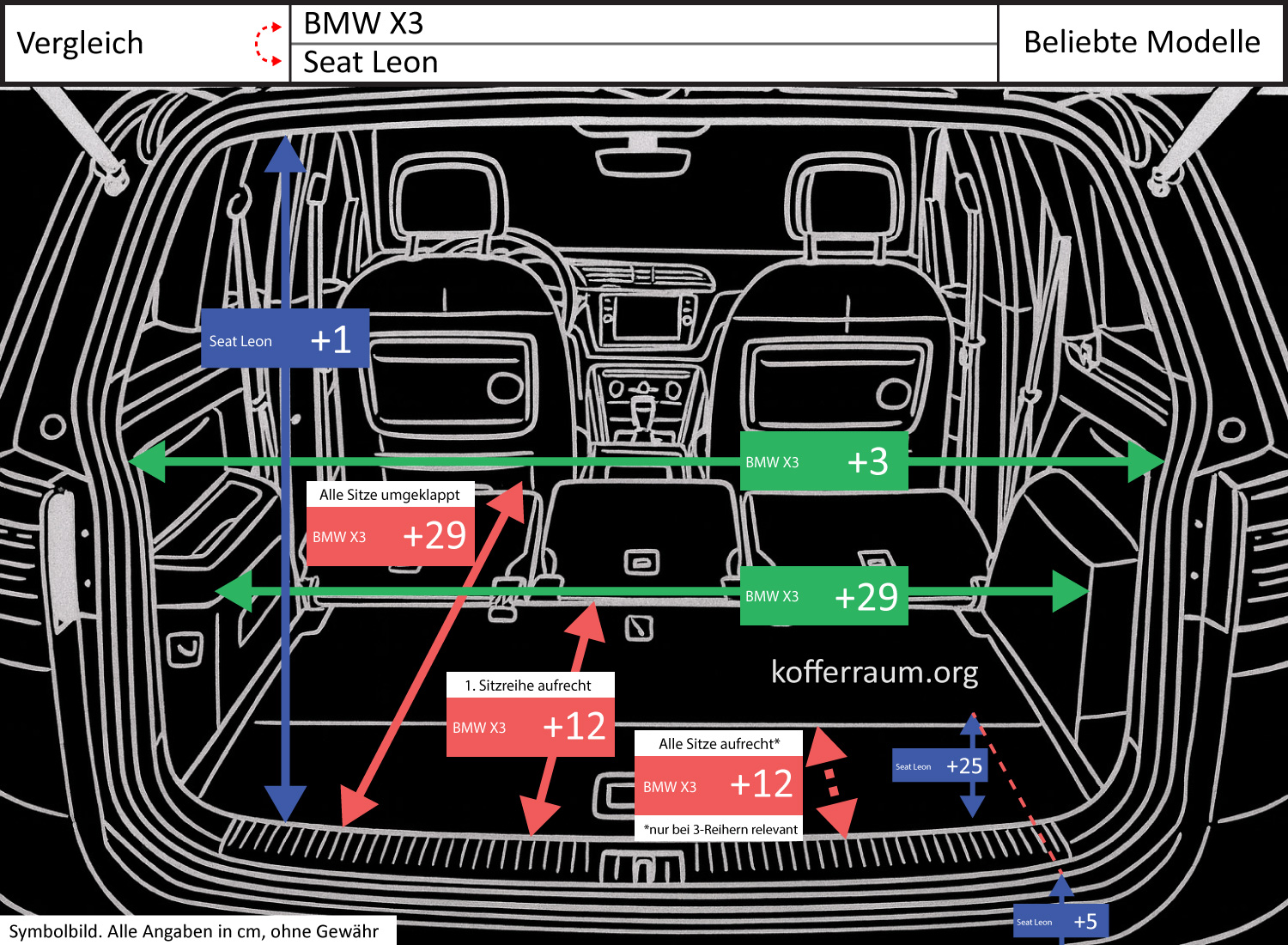
Biggest Differences (highlighted)
The BMW X3 offers more cargo length both with folded seats and with the first row upright than the SEAT Leon: folded +11.4 in (19%) and upright +4.7 in (14%). At the narrowest point, the BMW X3's trunk is significantly wider: +11.4 in (36%).
In contrast, the SEAT Leon has a considerably greater depth between the loading edge and trunk floor: +9.8 in (2400%). Smaller differences (≤10%) such as the slightly higher trunk opening of the Leon (+0.4 in/1%) or the 2 in (7%) higher loading edge of the Leon are not highlighted here.
Implications for Usability
The longer loading heights of the BMW X3 (both with folded and upright seats) make it more practical for long items like slats, skis, or furniture parts — such items can be placed further inside, often without awkward pushing or diagonal packing.
The significantly greater width at the narrowest point in the X3 also means that wider or two side-by-side items can be accommodated more easily; overall, the X3 is more flexible for bulky cargo.
The much greater depth measurement in the SEAT Leon (distance loading edge–floor) indicates a significantly deeper trunk floor. This can increase capacity in depth and offer advantages when stacking boxes, but makes loading heavy items less practical because more vertical space must be bridged.
Additionally, the slightly higher loading edge of the Leon (+2 in) further complicates lifting heavy loads.
In practice, this means the Leon can score points with volume-intensive but not too heavy or very bulky cargo due to its depth, while the X3 is more user-friendly for frequent loading and unloading of heavy or bulky items.
In summary: For frequent transport of long or wide items, the BMW X3 is advantageous; for deeper packed, volume-oriented cargo, the SEAT Leon can be an advantage, although the higher loading level makes handling more difficult.