
Trunk comparison: BMW X3 vs Skoda Kamiq

Biggest Differences
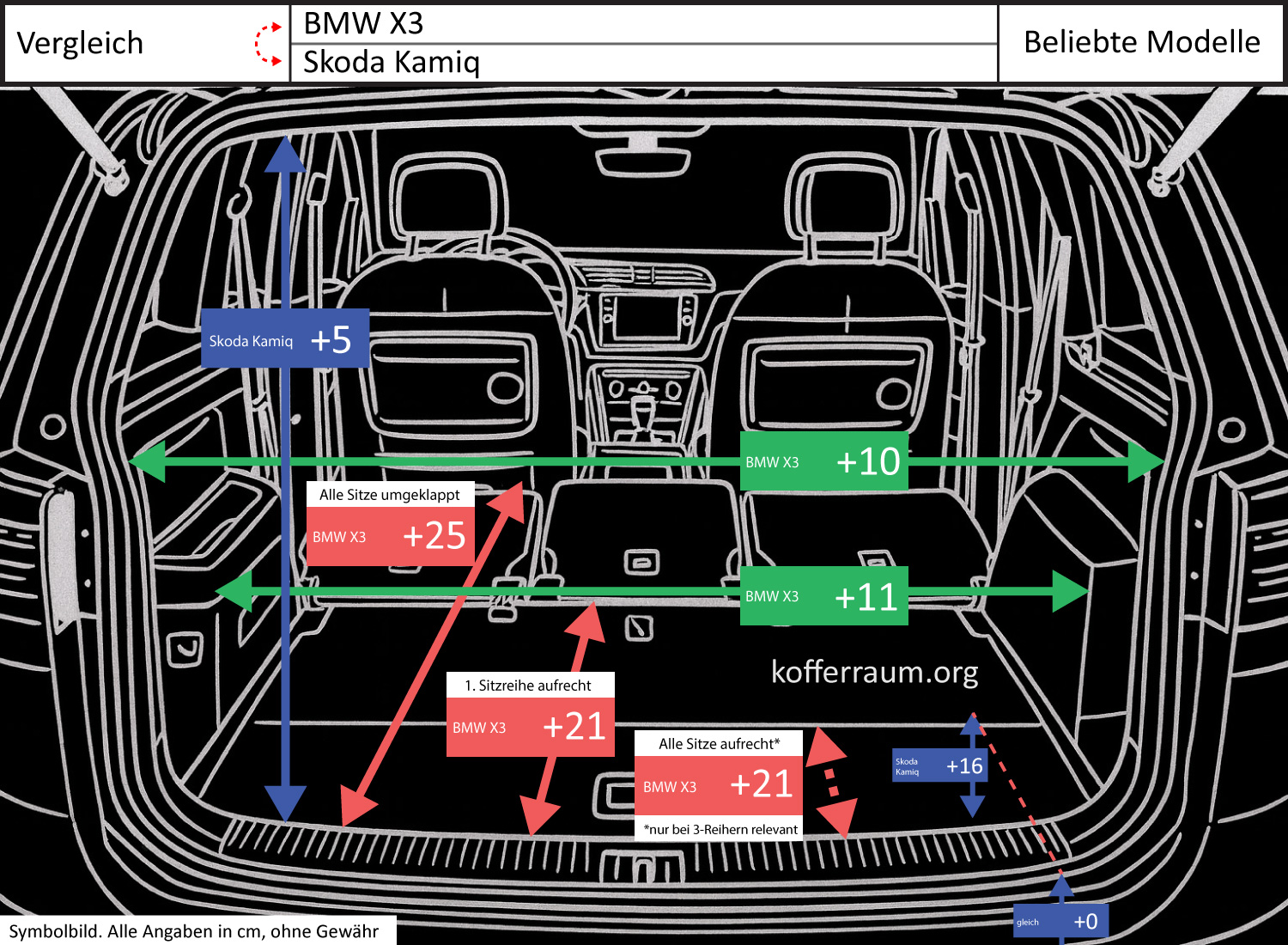
The BMW X3 offers significantly more length in the loaded cargo space: With the seats folded down, the trunk of the X3 is 9.8 in (16%) longer than that of the Škoda Kamiq, and with the first row upright, it is even 8.3 in (28%) longer.
At the narrowest point, the trunk of the X3 is 4.3 in (11%) wider than that of the Kamiq.
Also notable is the depth between the loading edge and the trunk floor: here, the Škoda Kamiq is 6.3 in (1500%) higher than the BMW X3. Smaller differences, which remain below the 10% threshold, are the higher trunk opening of the Kamiq (+2 in / 6%) and the 3.9 in (10%) wider opening width of the X3.
Impact on Usability
The greater cargo length of the BMW X3 (both with folded seats and with the first row upright) makes it better suited for long or bulky loads such as slats, furniture parts, or longer luggage; even in everyday use, more or longer items can be transported behind the seats.
The greater narrowest width increases flexibility when loading wide suitcases or boxes.
The significantly greater distance from the loading edge to the trunk floor in the Škoda Kamiq means its cargo floor is deeper. This provides more usable vertical space volume but can make lifting heavy items during loading more difficult because the interior extends deeper.
At the same time, the trunk opening of the Kamiq is slightly higher, which slightly facilitates inserting tall items, though this advantage is small.
Since the loading edge height of both models is the same, the shoulder or lifting height when loading remains comparable — the difference mainly arises from the different interior floor position and the length/width dimensions.
In summary: For longer or wider loads, the BMW X3 is more practical; for somewhat more vertical volume with a deeper cargo floor, the Škoda Kamiq offers advantages, which, however, come with somewhat less favorable handling when lifting.