
Trunk comparison: BMW X3 vs Skoda Superb Wagon
Key Differences
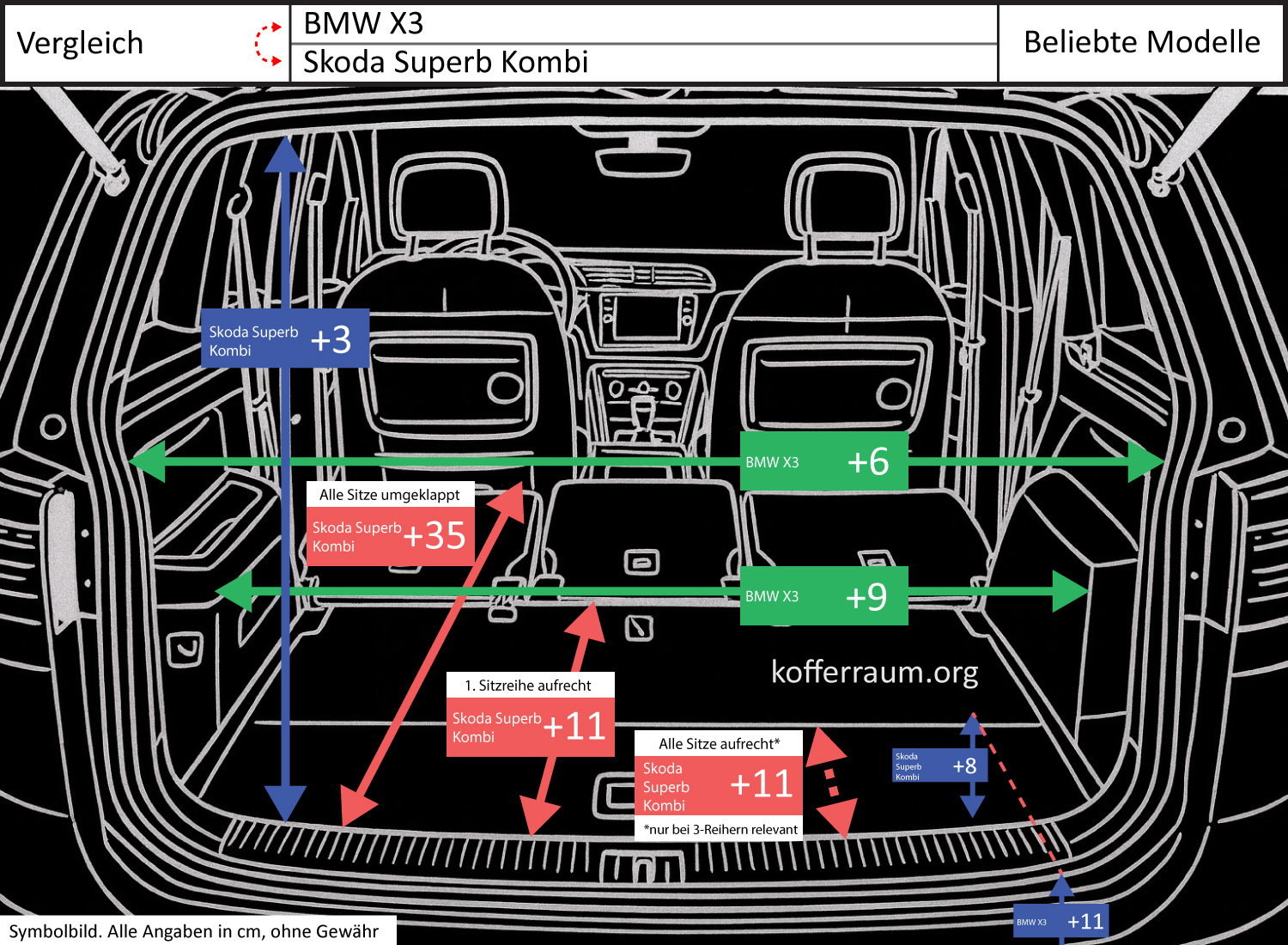
The Škoda Superb Wagon offers significantly more cargo length: with the seats folded down, the trunk is 13.8 in (+20%) longer, and with the first row of seats upright, 4.3 in (+12%) longer than in the BMW X3. The trunk depth (distance from loading edge to trunk floor) is 3.1 in (+700%) greater in the Superb.
In contrast, the loading edge of the BMW X3 sits 4.3 in (+19%) higher above the road than the Superb.
Impact on Usability
The greater cargo length of the Superb makes it more practical for long items (e.g., slats, skis, longer furniture parts): with the seats folded down, significantly longer cargo can be transported without needing to place it diagonally or wrap it extensively.
Even with normal seat configurations, more cargo fits lengthwise in the Superb.
The considerably greater depth in the Superb means that cargo sits deeper, providing more usable volume near the floor; heavy or bulky items lie lower and more securely, which benefits stability and securing.
However, a pronounced trunk recess can make side loading or pulling out flat, long items somewhat more difficult if there is no continuous floor.
The lower loading edge in the Superb (because the BMW’s loading edge is 4.3 in higher) makes lifting heavy loads into the vehicle significantly easier: loading boxes, luggage, or children is physically less strenuous.
The higher entry of the BMW X3 can be disadvantageous for frequent transport of heavy goods or for those with limited physical strength.
Width advantages of the BMW (at the narrowest point +9% / opening width +6%) are less pronounced in comparison and only slightly affect everyday usability: the X3 can accommodate somewhat wider cargo through the opening, but the advantage is below your specified highlight threshold of 10%.