
Trunk comparison: BMW X3 vs Tesla Model 3
Key Differences and Impact on Usability
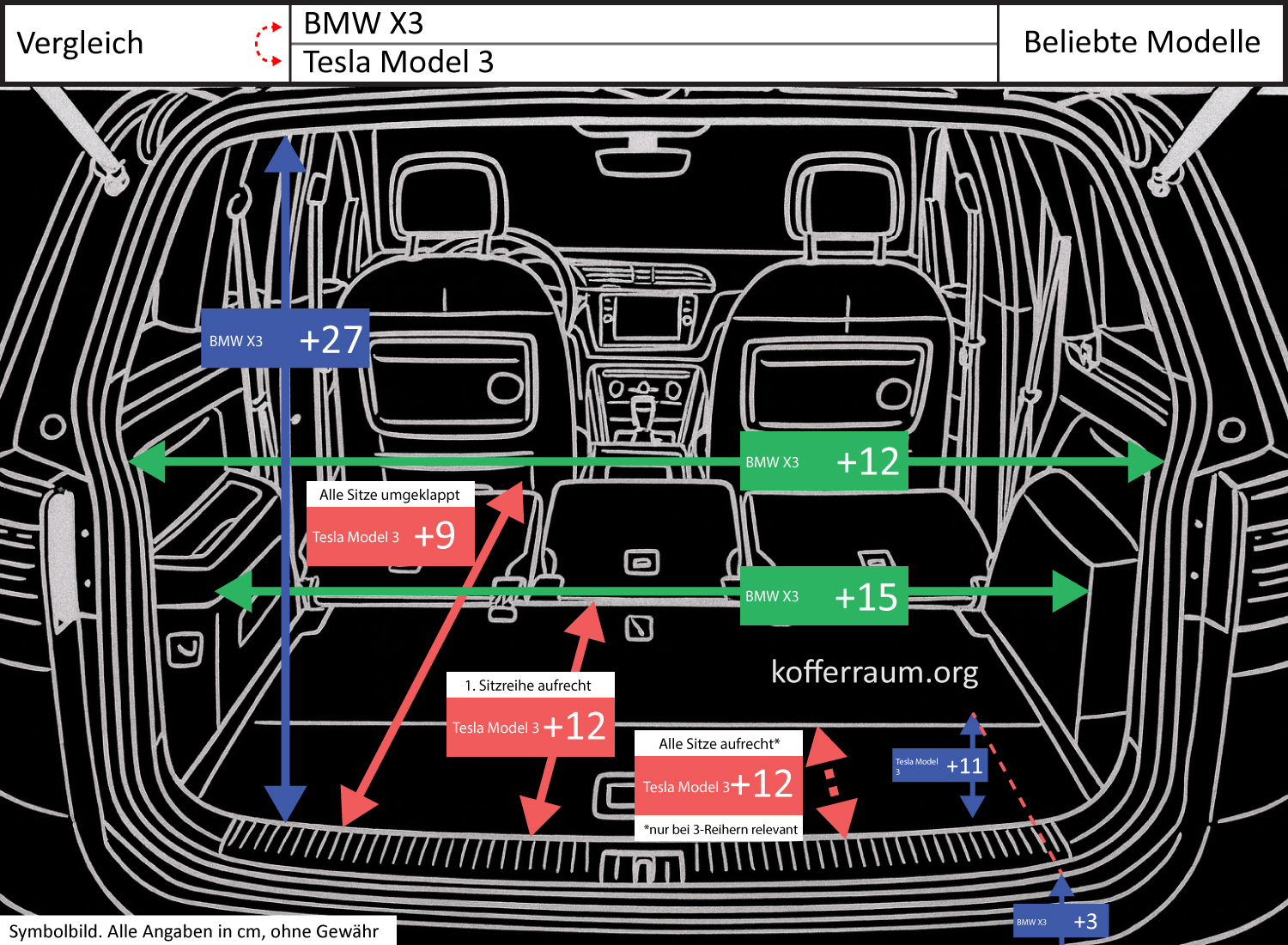
The comparison reveals clear strengths: The Tesla Model 3 scores in usable length and trunk depth, while the BMW X3 excels in opening height and width.
The Tesla Model 3 offers a 4.7 in (13%) longer cargo floor length with the front seats upright, making it more practical for long, flat items (e.g., skis, slats, long boxes) without folding down the rear seats. (With seats folded, the advantage is only 3.5 in / 5%.)
The trunk depth (distance from loading edge to trunk floor) is 4.3 in (1000%) greater in the Tesla.
Practically, this means the floor sits much lower than the loading edge, allowing more volume below the opening and enabling items to be stored deeper and often more securely. Downsides can include harder access to low-lying items and potentially more effort when lifting them inside.
The BMW X3 has a trunk opening that is 10.6 in (52%) higher and an interior width at the narrowest point that is 5.9 in (16%) larger, plus the trunk opening width is 4.7 in (12%) wider.
This makes the X3 significantly more practical for bulky, tall, or wide items (e.g., large boxes, bulky furniture parts, strollers): loading is easier, often without needing to tilt or turn items.
A small practical note: The BMW’s loading edge is only about 1.2 in (4%) higher than the Tesla’s, which slightly complicates loading heavy items; however, this difference is minor and hardly noticeable in everyday use.
Conclusion: For longer, lower loads and more storage space below the opening, the Tesla Model 3 is advantageous. For tall, wide, or bulky cargo, the BMW X3 is better suited due to its significantly larger opening height and width.