Trunk comparison: BMW X3 vs Tesla Model Y
Key Differences
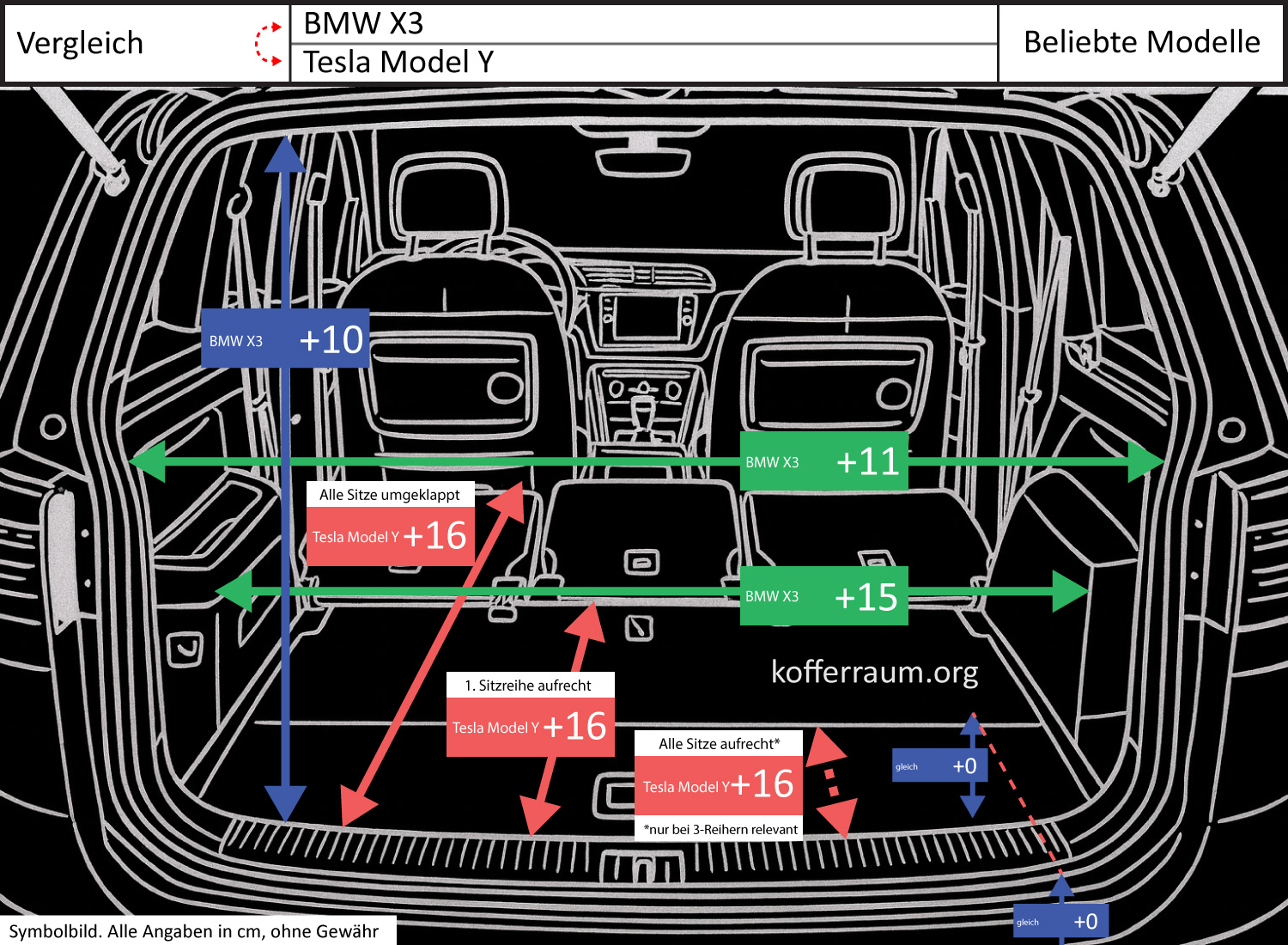
When comparing trunk dimensions, it becomes clear that the Tesla Model Y has advantages in usable cargo length, meaning: with the first row of seats upright, the Model Y's trunk is 6.3 in longer (≈17%) than the BMW X3's.
On the other hand, the BMW X3 scores points in width and opening height: the narrowest point in the X3's trunk is 5.9 in wider (≈16%) than in the Model Y, and the width of the X3's trunk opening is 4.3 in larger (≈11%).
Additionally, the height of the BMW X3's trunk opening is 3.9 in larger (≈14%) than the Model Y's.
Differences below or equal to 10% (both vehicles have the same depth from the loading edge seat to the trunk floor; the loading edge height is also the same; with folded seats there is a length difference of 9%) are not highlighted here.
Impact on Usability
The longer cargo floor of the Model Y with the first row upright makes it more practical for long items (e.g., skis, slats, long boxes) without folding seats down. If long but not particularly wide items are regularly transported, the Model Y thus offers a clear advantage.
The BMW X3 is more advantageous when loading wider or taller items: the greater width at the narrowest point and the wider opening make it easier to load bulky boxes, luggage, or furniture.
The higher trunk opening of the X3 also facilitates lifting tall items in and makes loading overall more comfortable, especially with bulky, voluminous loads.
Since depth and loading edge height are the same in both models, they do not differ in handling flat or heavy items during loading. When maximum loading length with folded seats is needed, the difference is small (≈9%) and negligible in many everyday scenarios.