
Trunk comparison: BMW X3 vs Toyota Corolla Wagon


Key Differences
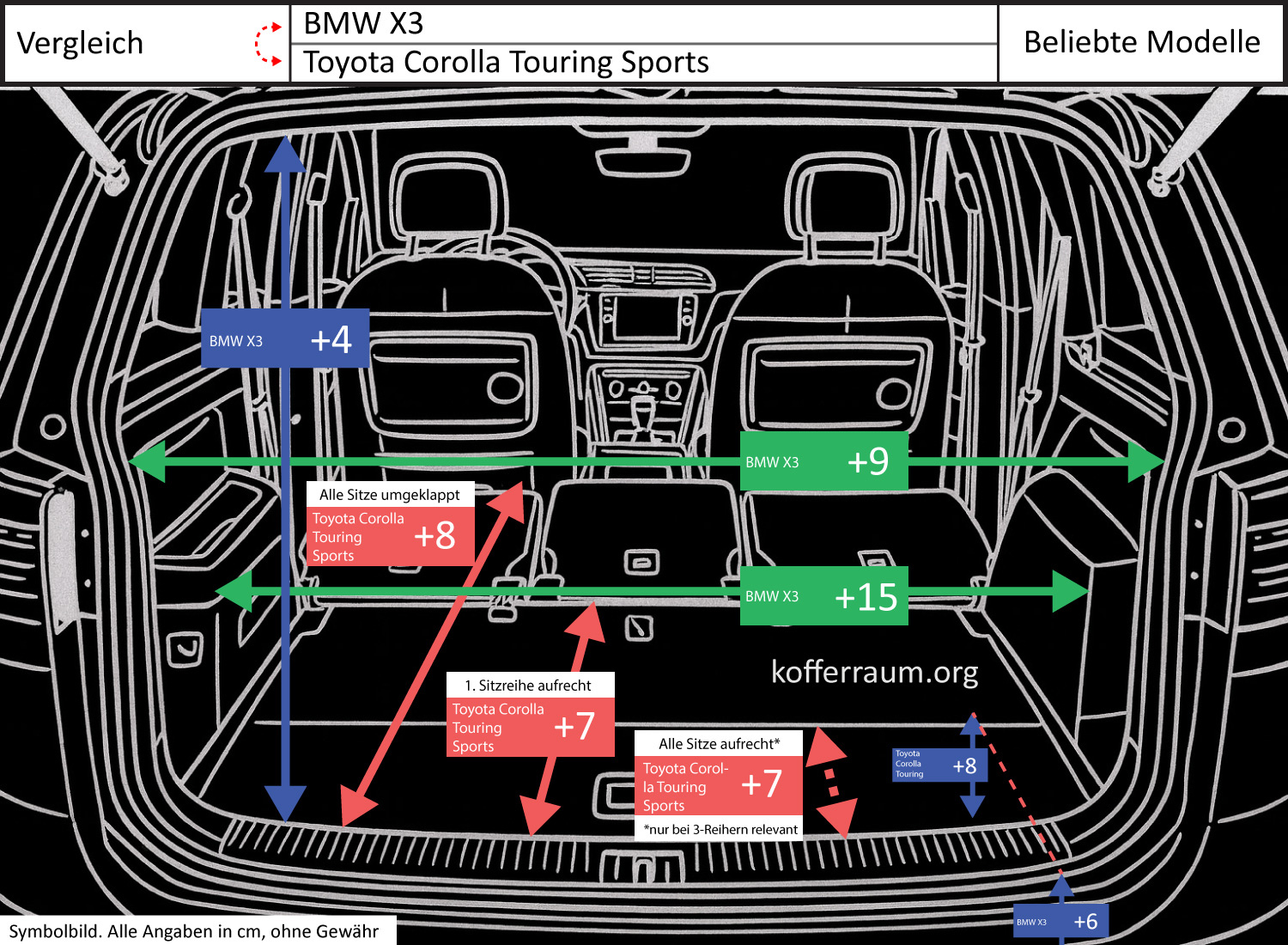
The most significant differences are in the trunk depth and the narrowest trunk width. The depth of the trunk (distance from loading edge → trunk floor) is 3.1 in greater in the Toyota Corolla Touring Sports – this corresponds to an increase of about 700% compared to the BMW X3. The narrowest width in the trunk is 5.9 in greater (about +16%) in the BMW X3 than in the Corolla. Other, smaller differences: The Corolla offers a loading area that is 3.1 in (4%) longer with the seats folded down and 2.8 in (7%) more length with the rear seat upright.
The trunk opening of the BMW X3 is 1.6 in (5%) higher, the loading edge of the X3 is 2.4 in (9%) higher above the road, and the width of the trunk opening in the X3 is 3.5 in (9%) larger than in the Corolla.
Impact on Usability
Due to the significantly greater trunk depth, the Corolla Touring Sports is better suited for deep or stackable cargo that should fit below the loading edge (such as deep boxes, longer items placed crosswise, or more volume under the surface).
The lower loading edge in the Corolla makes lifting heavy items overall easier and more ergonomic.
The BMW X3 scores with the larger minimum width in the trunk and the wider opening: it is easier to load with wide, bulky items (e.g., large suitcases, wide furniture parts, or boxes) because more cross-sectional space is available.
The somewhat higher trunk opening in the X3 can also facilitate inserting tall items, while the higher loading edge makes lifting heavy loads somewhat more difficult.
The length differences with folded or upright rear seats are small and hardly affect everyday practicality. In summary: Corolla = deeper, more accessible storage for deep/stacked cargo; BMW X3 = better for wide/bulky goods.