
Trunk comparison: BMW X3 vs VW ID.3
Key Differences
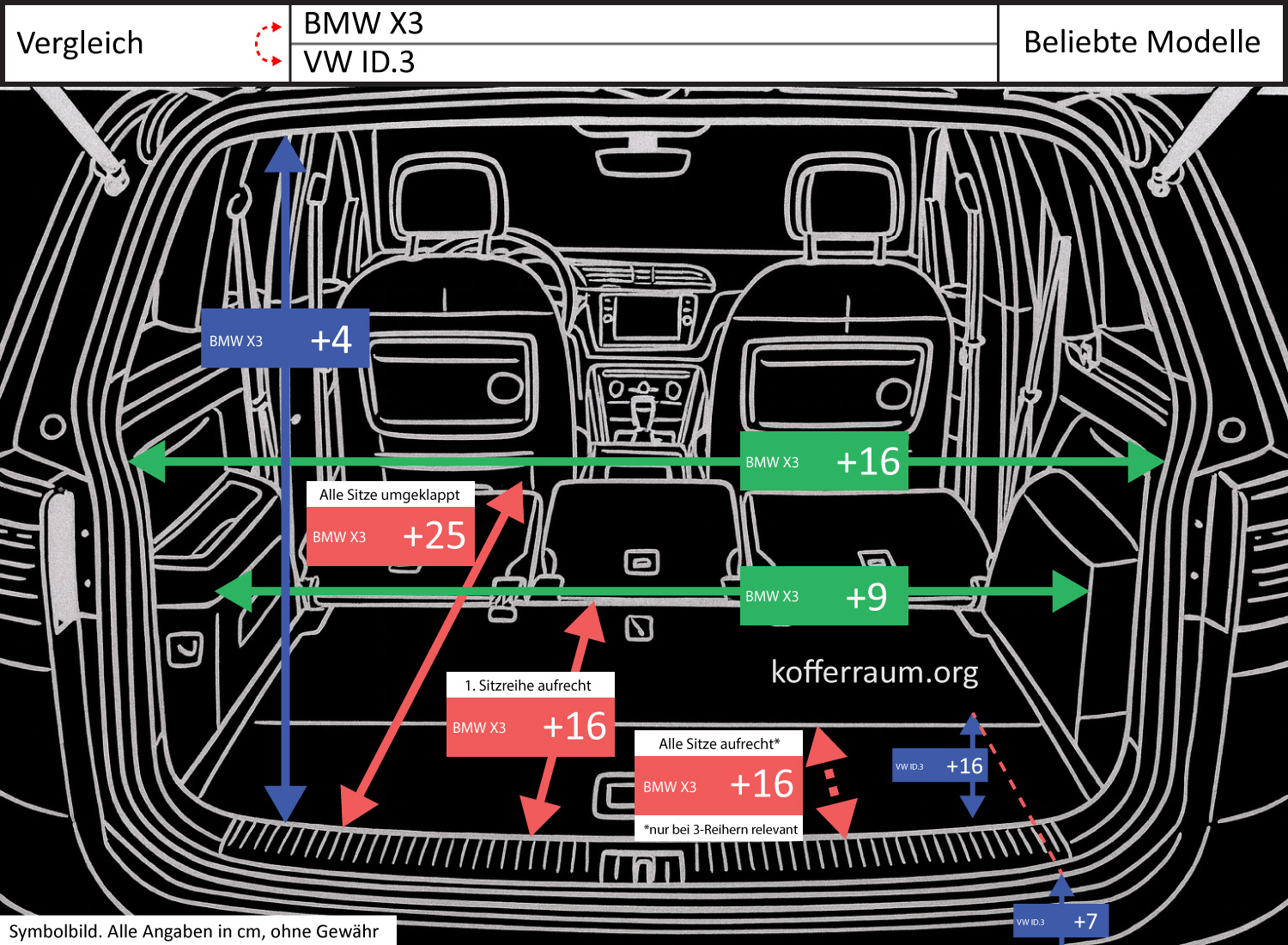
The BMW X3 offers a longer cargo area with the loading floor folded up than the VW ID.3: with the seats folded down, the trunk of the X3 is +9.8 in (16%) longer, and with the front row upright, +6.3 in (20%). The width of the X3's trunk opening is also significantly larger: +6.3 in (17%).
On the other hand, the VW ID.3 has a significantly greater depth between the loading edge and the trunk floor: the distance is +6.3 in (1500%) greater in the ID.3 than in the X3. Smaller differences (e.g., opening height +1.6 in/5%, loading edge height +2.8 in/10%, narrowest width +3.5 in/9%) exist but are at or below 10%.
Impact on Usability
The longer cargo area of the BMW X3 has a positive effect when transporting long items: folded rear seats or even with passengers in front, more horizontal cargo space remains, which simplifies storing furniture parts, skis, or long boxes.
The wider opening makes maneuvering wide items into the vehicle easier and reduces bottlenecks when loading and unloading.
The significantly deeper trunk floor of the VW ID.3 means more vertical storage space below the loading edge—practical when placing tall or unbreakable items "deep down" or stacking bulky cargo higher.
Combined with the slightly higher loading edge (not significantly over 10%), this means that heavy lifting over the loading edge in the ID.3 can be somewhat more strenuous.
In summary: For transport tasks where length and width are decisive (long, flat, or wide items), the BMW X3 is more beneficial.
For cases where additional depth/vertical storage space is important (tall items, deeper storage), the VW ID.3 has the advantages. Smaller differences in opening and loading edge height only moderately affect everyday usability.