
Trunk comparison: BMW X3 vs VW ID.4
Key Differences
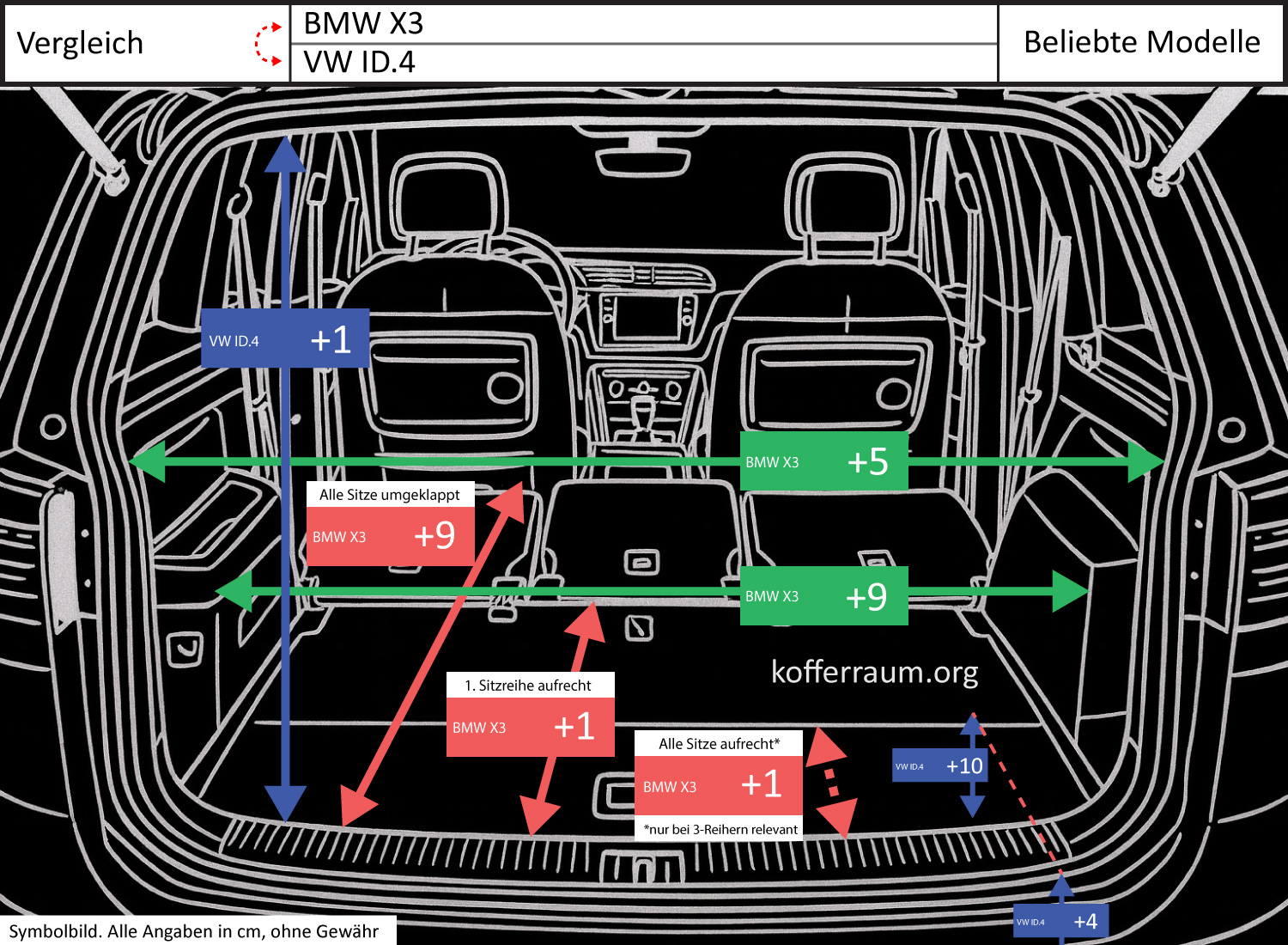
The most noticeable difference lies in the depth of the trunk (measurement: loading edge → trunk floor): The VW ID.4 is 3.9 in (900%) larger here than the BMW X3 — this value is clearly noteworthy.
All other measured deviations are significantly smaller: BMW X3 has a 3.5 in (5%) longer cargo floor with folded seats and +0.4 in (1%) more length with the first row upright; the width at the narrowest point is 3.5 in (9%) greater in the BMW, and the width of the trunk opening is 2 in (5%) larger in the BMW.
The loading edge of the VW ID.4 is 1.6 in (6%) higher, and the height of the trunk opening is 0.4 in (1%) higher in the ID.4.
Impact on Usability
The significantly greater depth of the VW ID.4 creates noticeably more space behind the loading edge for tall or stacked items (e.g., boxes, suitcases, plants).
This increases the usable interior height and makes it easier to accommodate tall cargo, making the ID.4 advantageous for transports where volume in depth is needed.
At the same time, the ID.4 has a loading edge 1.6 in higher, which makes lifting heavy items in somewhat more difficult. Additionally, the ID.4 is narrower at the narrowest point and at the opening compared to the BMW; wide goods can therefore be harder or only more carefully loaded.
The BMW X3 scores with greater width at the narrowest point and a wider opening as well as a lower loading edge — this facilitates loading wide or bulky parts and makes lifting heavy loads more comfortable.
The slightly longer cargo floor with folded seats (+5%) is marginally advantageous but less decisive in everyday use than width and loading edge height.
In short: Those who need more depth and stacking capability benefit from the VW ID.4. Those who frequently load wide or heavy items and prefer easier access are better advised with the BMW X3.