
Trunk comparison: BMW X3 vs VW Passat Wagon
Key Differences
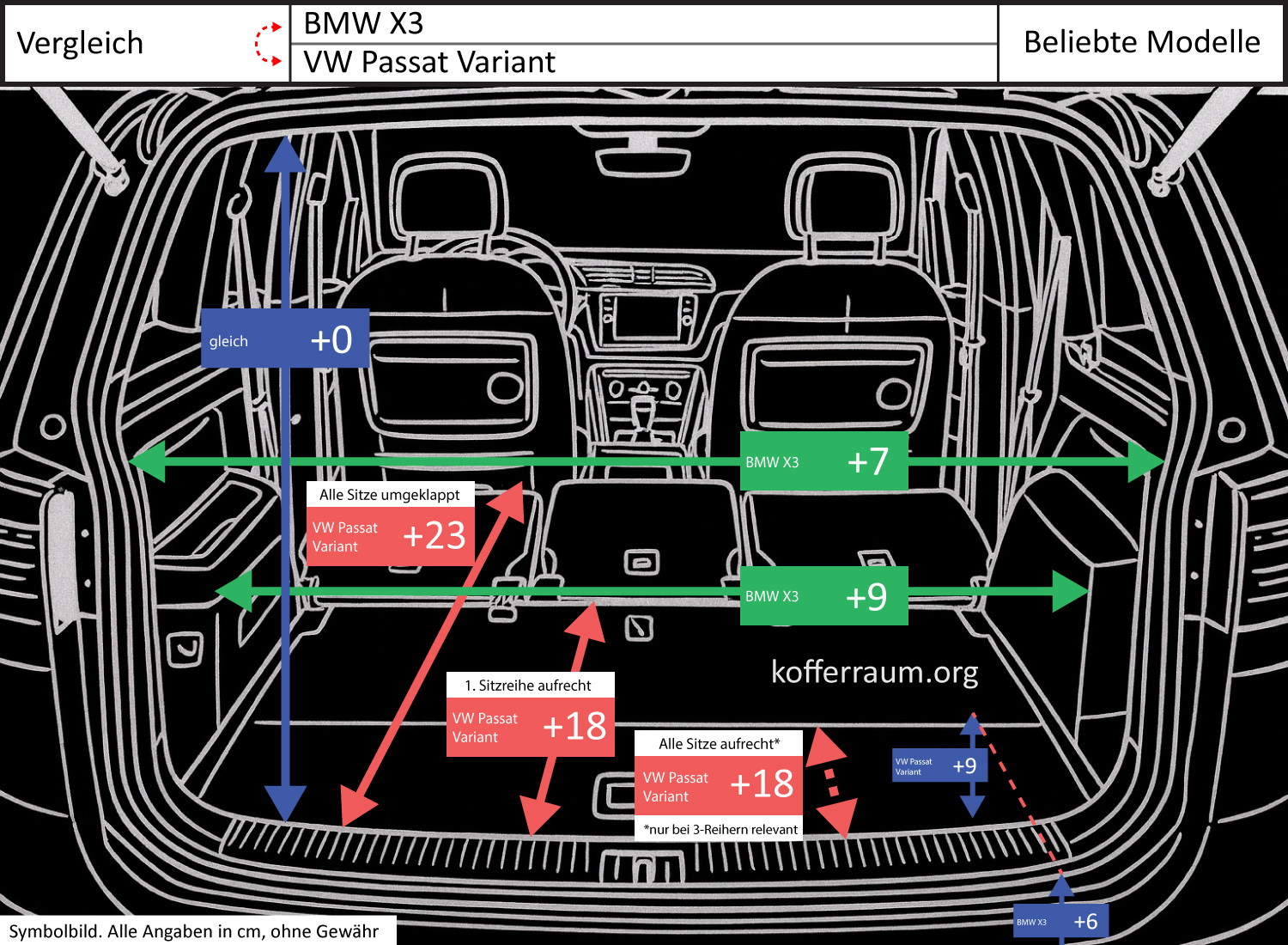
The VW Passat Wagon offers a 9.1 in (13%) longer trunk with the rear seats folded down than the BMW X3. With the front seats upright, the Passat's trunk is 7.1 in (19%) longer.
Additionally, the cargo depth (loading edge to trunk floor) in the Passat is 3.5 in (800%) greater than in the X3. The height of the trunk opening is the same in both models.
Smaller differences (under 10%): The loading edge of the BMW X3 is 2.4 in (9%) higher above the ground, the narrowest interior width of the trunk is 3.5 in (9%) larger in the X3, and the width of the trunk opening in the X3 is 2.8 in (7%) wider than in the Passat.
Implications for Usability
Loading area and length: Due to the significantly greater loading length of the Passat (both with folded seats and with the front seats upright), longer items — e.g., furniture, long packages, or skis — can be loaded more easily and without awkward angling.
For users who regularly transport long cargo, the Passat therefore offers a clear advantage.
Loading depth: The significantly greater depth in the Passat means more usable cargo height between the loading edge and floor; this facilitates stacking boxes and increases volume along the floor area. This makes the Passat more practical especially when transporting tall or multiple boxes.
Width and opening: The BMW X3 is slightly wider at the narrowest point and at the opening, which can favor loading wider but flatter items (e.g., suitcases, flat boxes). However, these advantages are moderate (<10%) and mainly affect very wide cargo.
Loading edge and physical effort: The slightly higher loading edge of the X3 increases the effort required to lift heavy items in; the difference of 2.4 in (9%) is small but can be noticeable with frequent lifting.
The identical opening height of both vehicles means very tall items are treated equally in terms of clearance height.
Practical conclusion: Those who often transport long or deep cargo benefit from the Passat Wagon.
Those who more frequently load wide, bulky items or prefer a higher entry (e.g., easier access height to the trunk) find slight advantages in the BMW X3. Overall, the Passat is utilitarianly designed for longer/deeper cargo; the X3 scores in width and typical SUV seating position.