Trunk comparison: BMW X3 vs VW T-Cross
Key Differences
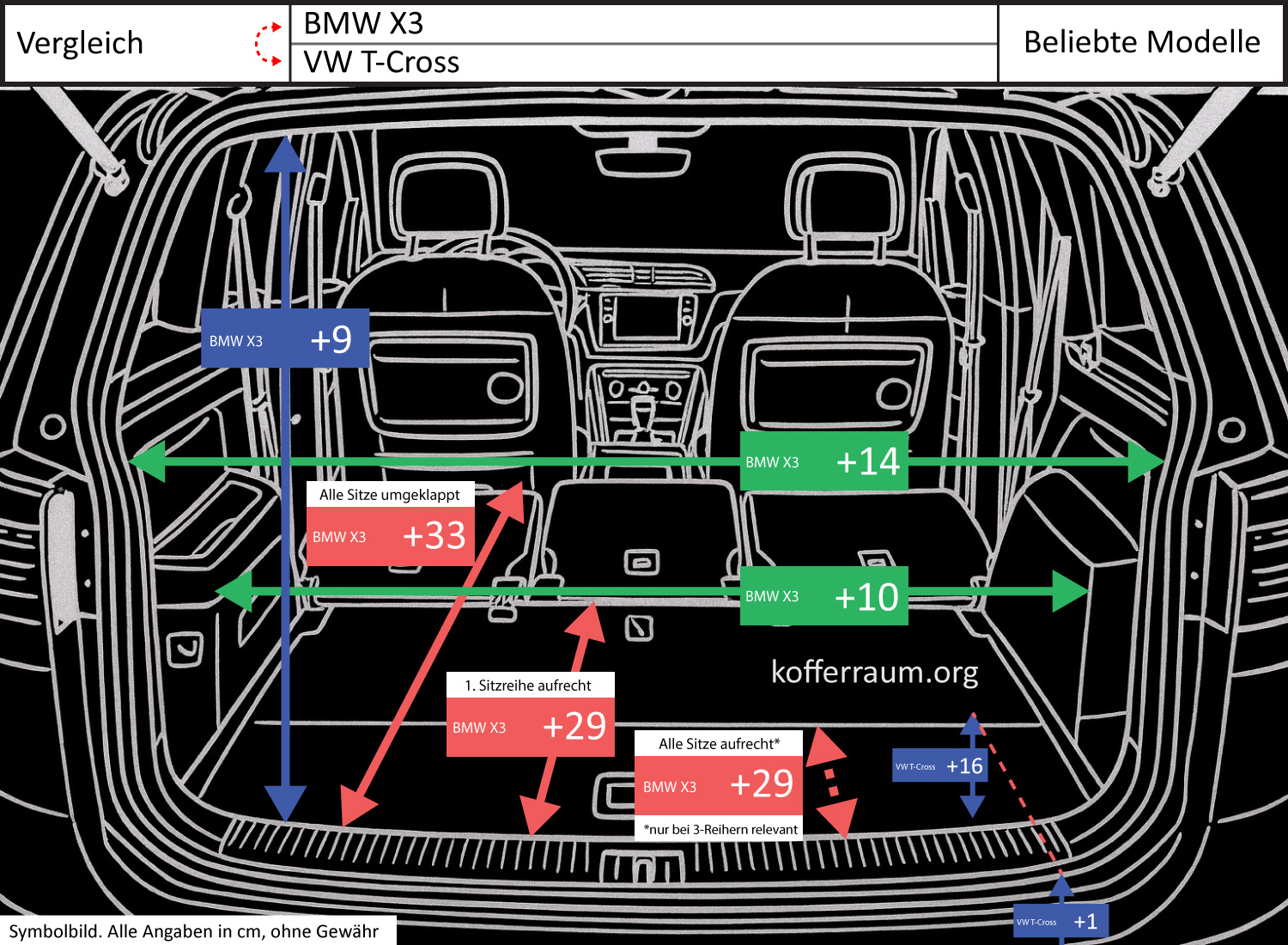
In terms of length dimensions, the BMW X3 has clear advantages: with the seats folded down, the trunk of the BMW is 23% (±13 in) longer, and with the first row of seats upright, it is even 44% (±11.4 in) longer than the VW T-Cross.
The height of the trunk opening in the BMW is 13% (±3.5 in) higher than that of the T-Cross. The width of the trunk opening is 14% (±5.5 in) larger in the BMW.
The VW T-Cross stands out clearly in only one aspect: the depth between the loading edge and the trunk floor is 1500% (±6.3 in) greater in the T-Cross than in the BMW (absolute difference 6.3 in).
Other measurements: The narrowest point of the trunk is 10% (±3.9 in) larger in the BMW — this is at the threshold of the highlighting rule, so it is a small but present advantage for the BMW. The loading edge height differs by only 1% (±0.4 in) and is practically the same.
Implications for Usability
BMW X3 — better for long and wide cargo: The significantly greater loading length (with seats folded and upright) plus the higher and wider opening make the X3 clearly more suitable for long items (e.g., slats, skis, furniture parts), bulky boxes, and wide luggage.
The greater opening width and height facilitate loading and unloading large or unwieldy objects and increase flexibility when loading.
VW T-Cross — advantage in vertical storage space: The significantly greater depth between the loading edge and the trunk floor means more space in the driving direction behind the loading edge on a smaller length plane.
This can be advantageous when items are stacked high or stored in a deep recess (e.g., taller boxes, bulky but less long cargo). However, the lower opening height and width as well as the shorter overall length of the T-Cross limit the accommodation of wide or very long items.
Practical conclusion: For users who frequently transport long or wide cargo (craftsmen, often long luggage, furniture transport), the BMW X3 is clearly more flexible in practice.
Those who mainly transport smaller or tall, compactly stacked cargo and prefer a more compact vehicle can manage well with the T-Cross — the deeper loading floor offers a specific benefit there but limits versatility for large dimensions.