
Trunk comparison: BMW X3 vs VW T-Roc
Key Differences (>10%)
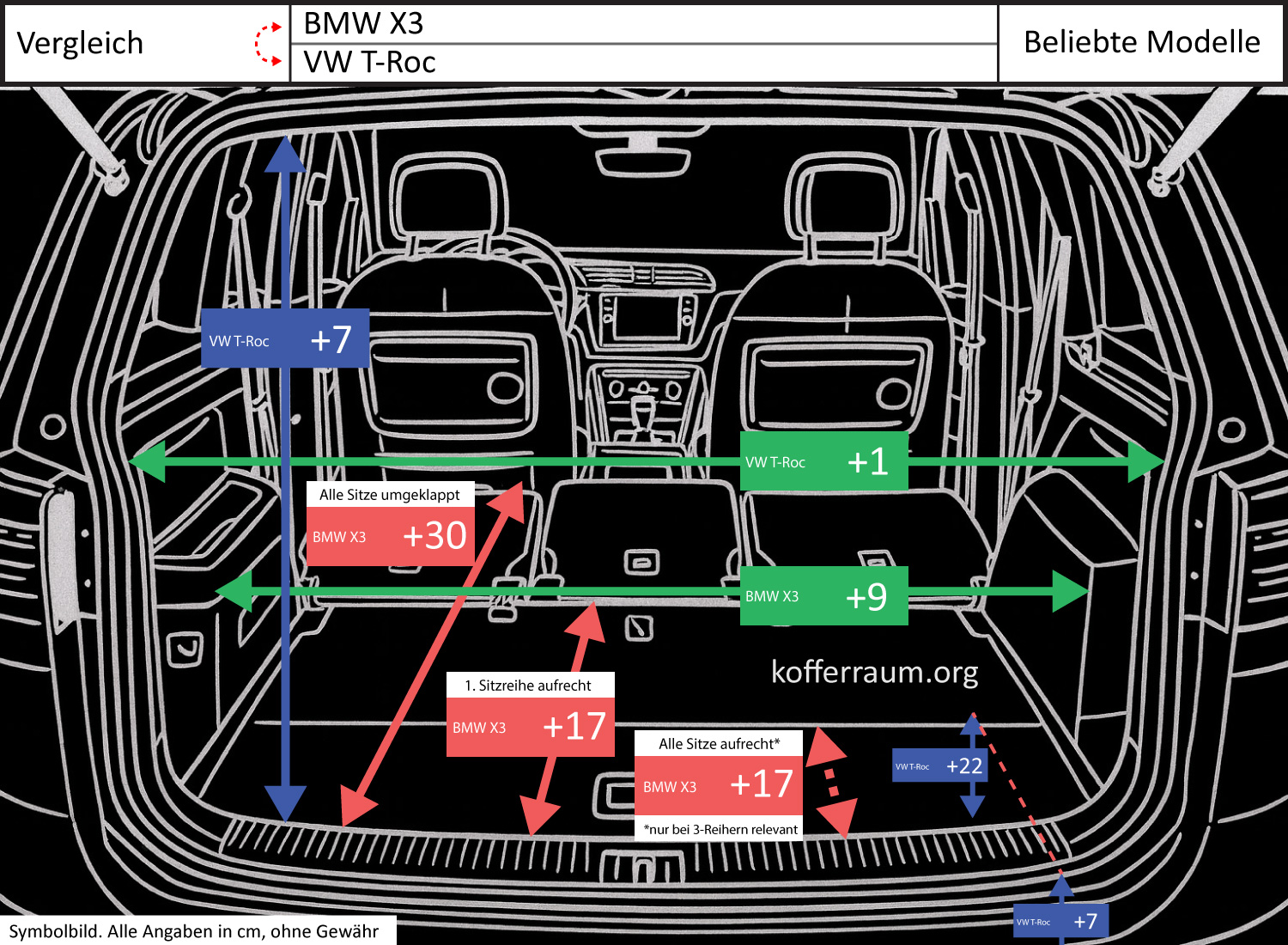
The BMW X3 offers a cargo space length that is 11.8 in (≈20%) longer with the rear seats folded down than the VW T-Roc. Even with the first row of seats upright, the BMW X3 is 6.7 in (≈22%) longer than the T-Roc.
Conversely, the VW T-Roc has a significantly deeper trunk floor: +8.7 in (≈2100%) between the loading edge and the trunk floor.
Impact on Usability
More length in the BMW X3 practically means: longer items (e.g., skis, slats, longer boxes, or furniture parts) can be transported more easily, even when the seats are upright.
With the seats folded down, there is a significantly larger continuous cargo area, which simplifies loading long or flat goods and allows more flexible use for moving or recreational equipment.
The greater depth in the VW T-Roc means that volume is hidden further below the loading edge: more usable interior space along the Z-axis, better ability to store luggage "deeper" and cover it from view.
This is advantageous for bulky but not extremely long loads and for stacking suitcases. A downside is that lower floors can make lifting heavy loads over the loading edge more difficult and pushing items in harder, especially if the loading edge is also somewhat higher.
In summary: For transport tasks involving long items and a flat, continuous cargo area, the BMW X3 is better suited. For more hidden volume and a deeper trunk floor (e.g., for securely storing suitcases out of sight), the VW T-Roc is more advantageous.
Smaller differences in opening width, trunk opening height, and loading edge height exist but only slightly affect practical use.