
Trunk comparison: BMW X4 vs BMW X5


Key Differences
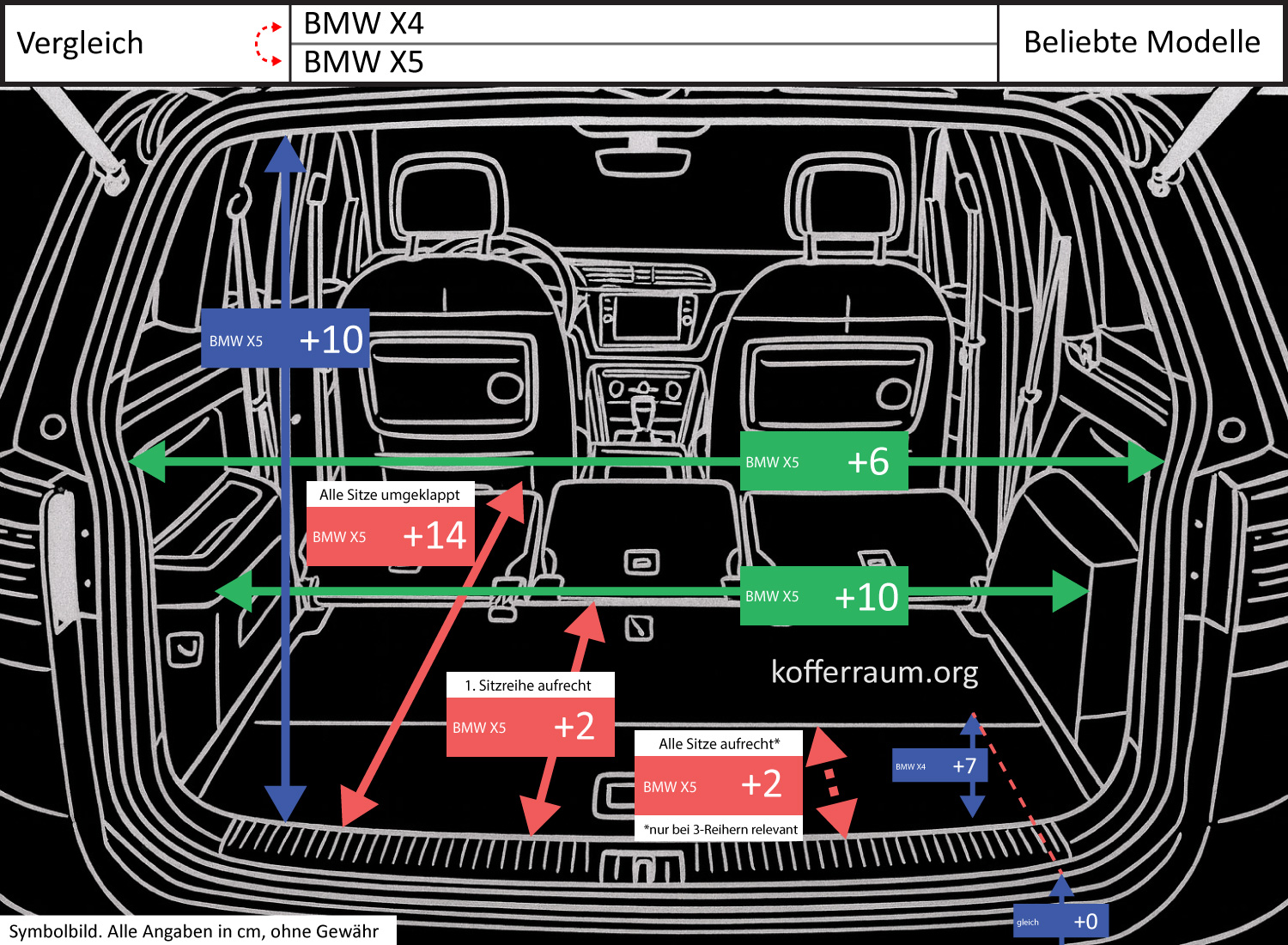
In short: The BMW X5 offers a cargo space length that is 5.5 in (≈8%) longer with the seats folded down and 0.8 in (≈2%) more length with the first row of seats upright compared to the X4. The loading edge height is the same on both models.
The main differences exceeding 10% are: the trunk opening of the X5 is 3.9 in (≈14%) higher and the depth (loading edge → trunk floor) of the X4 is 2.8 in (≈700%) greater. Additionally, the narrowest width in the trunk is 3.9 in (≈10%) larger on the X5 and the opening width of the X5 is 2.4 in (≈6%) larger.
Impact on Usability
Higher trunk opening on the X5 (≈14%): The larger opening dimension makes it easier to load tall items (e.g., cabinet elements, large boxes, or bulky packages) because less tilting or angling is required. Bulky, tall cargo is more likely to fit directly through the opening.
Greater depth on the X4 (≈700%): The X4 has significantly more distance between the loading edge and the trunk floor.
Practically, this means flat or elongated items can be pushed further forward and lie deeper in the cargo space, which facilitates stacking and hiding luggage (e.g., under a parcel shelf). For very flat loads, the X4 can thus offer more effectively usable storage space below the upper loading height.
Width and overall length: The X5 is 3.9 in wider at its narrowest point and the opening is 2.4 in larger — this helps when loading wider parts but is only a moderate advantage. The overall 5.5 in longer loading surface with seats folded down makes the X5 better suited for longer items.
Practical recommendation: For frequent transport of tall or wide items, the X5 is better suited. For flat, elongated cargo that should lie deep and stable in the trunk, the X4 offers advantages due to its greater depth.
If you have both requirements, the X5 is overall more flexible thanks to its larger opening and longer loading surface.