
Trunk comparison: BMW X4 vs VW T-Cross
Main Differences
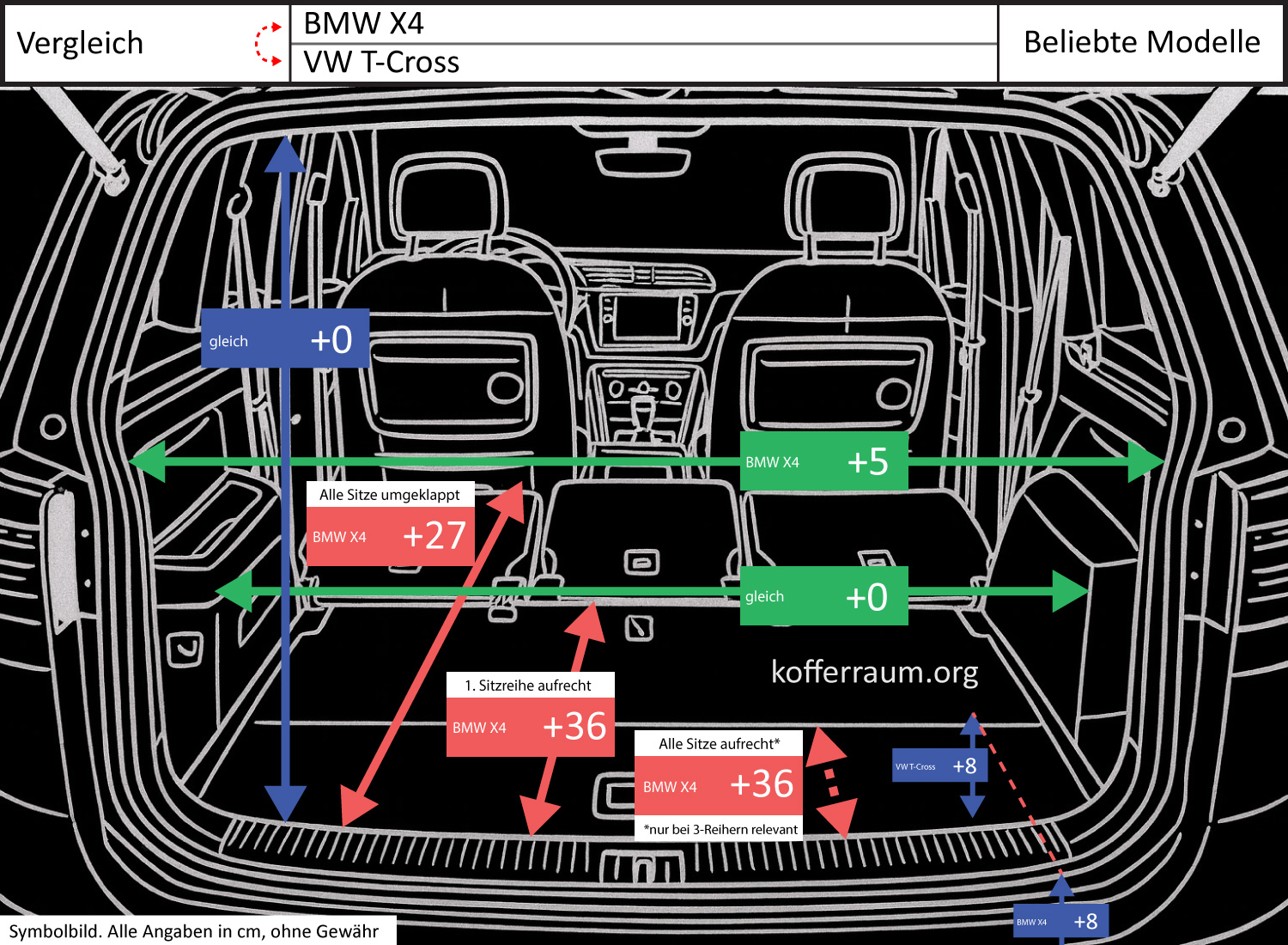
Significant differences mainly concern the length dimensions and the loading height: The BMW X4 offers a loading area that is 10.6 in (19%) longer with the seats folded down and even a loading area that is 14.2 in (55%) longer with the first row of seats upright than the VW T-Cross.
Regarding the distance from the loading edge to the trunk floor, the VW T-Cross is 3.1 in (100%) higher than the BMW X4. Additionally, the loading edge of the BMW X4 sits 3.1 in (11%) higher above the ground than that of the T-Cross.
All other measured values are either equal or below the 10-percent threshold (trunk opening height is the same, narrowest width is equal; opening width at the X4 is only +2 in/5% larger).
Impact on Usability
The significantly greater usable length of the BMW X4 makes it better suited for long items (e.g., slats, long boxes, skis in appropriate packaging) and for an overall more spacious cargo area, even when the rear seats remain upright. This means more flexibility for transports requiring lengthwise space.
The VW T-Cross, on the other hand, scores with a deeper cargo floor and a lower loading edge: the trunk floor is lower, and loading is easier due to the reduced lift height.
This facilitates regularly stowing heavy or bulky items (groceries, strollers, crates) because less effort is needed when lifting and the cargo area immediately behind the loading edge offers more usable height.
Practically, this means: Those who often need to transport long items or require maximum cargo space lengthwise are better served by the BMW X4. Those who value easy loading and unloading as well as a lower loading edge benefit more from the VW T-Cross.
Other dimensions (opening height, narrowest width) do not significantly differentiate the models.