Trunk comparison: BMW X5 vs Durchschnitt Compact SUV


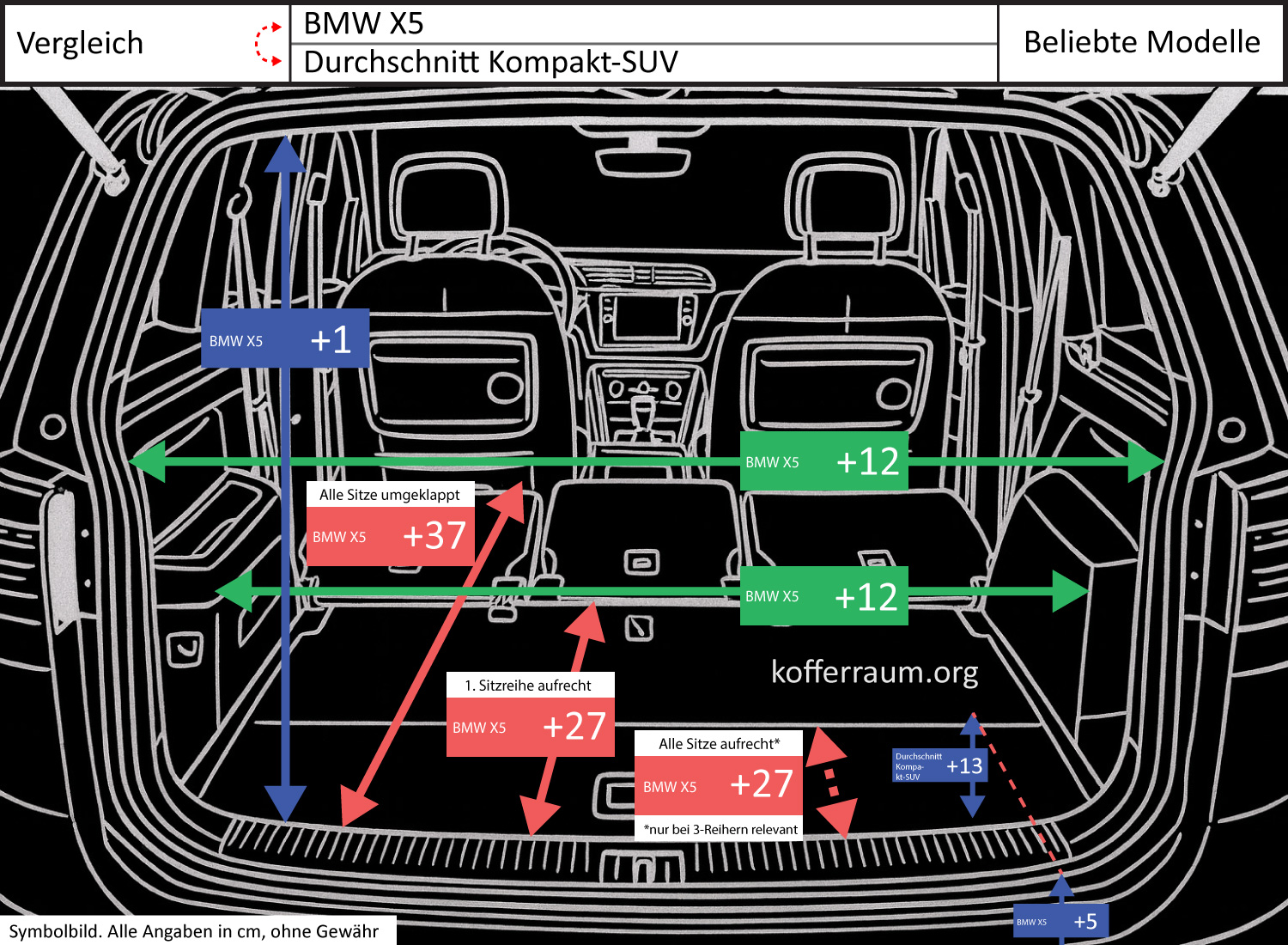
Key Differences (>10%)
The biggest deviations are in loading length and loading width: The BMW X5 offers +14.6 in (+25%) more loading length with folded seats and +10.6 in (+35%) more loading length with the front row upright than the average compact SUV.
At the narrowest point, the trunk of the X5 is +4.7 in (+12%) wider, and the trunk opening is also +4.7 in (+12%) larger. In contrast, the depth of the trunk (loading edge to trunk floor) is +5.1 in (+1300%) greater in the average compact SUV than in the X5.
Smaller differences (not >10%): opening height +0.4 in (1%) and loading edge height +2 in (7%) in favor of the X5.
Impact on Usability
More length and width in the X5 significantly improve usability for long and wide items: furniture panels, skis, bicycles (partially disassembled), or bulky luggage can be more easily accommodated crosswise or lengthwise.
The larger opening simplifies sliding in bulky cargo and reduces restrictions from narrow passages.
The greater depth in the average SUV means that the distance from the loading edge to the trunk floor is larger there. Practically, this can have two effects: smaller, stackable, or deeper-lying items can be better stored in a deeper loading well, and loose goods are less likely to spill over the loading edge.
Conversely, a significantly smaller distance (as in the X5) can mean that heavy loads stand somewhat closer to the loading edge and can therefore be lifted out of the trunk more easily — combined with the slightly higher loading edge in the X5 (+2 in), heavy items may overall be somewhat more strenuous to load.
Conclusion: For transport tasks requiring length and width (long items, wide boxes, flexible use), the BMW X5 is clearly advantageous. However, if a deep loading well or a larger distance below the loading edge is important for storing smaller, deeper, or stackable goods, an average compact SUV offers advantages here.