Trunk comparison: BMW X5 vs Durchschnitt SUV


Key Differences
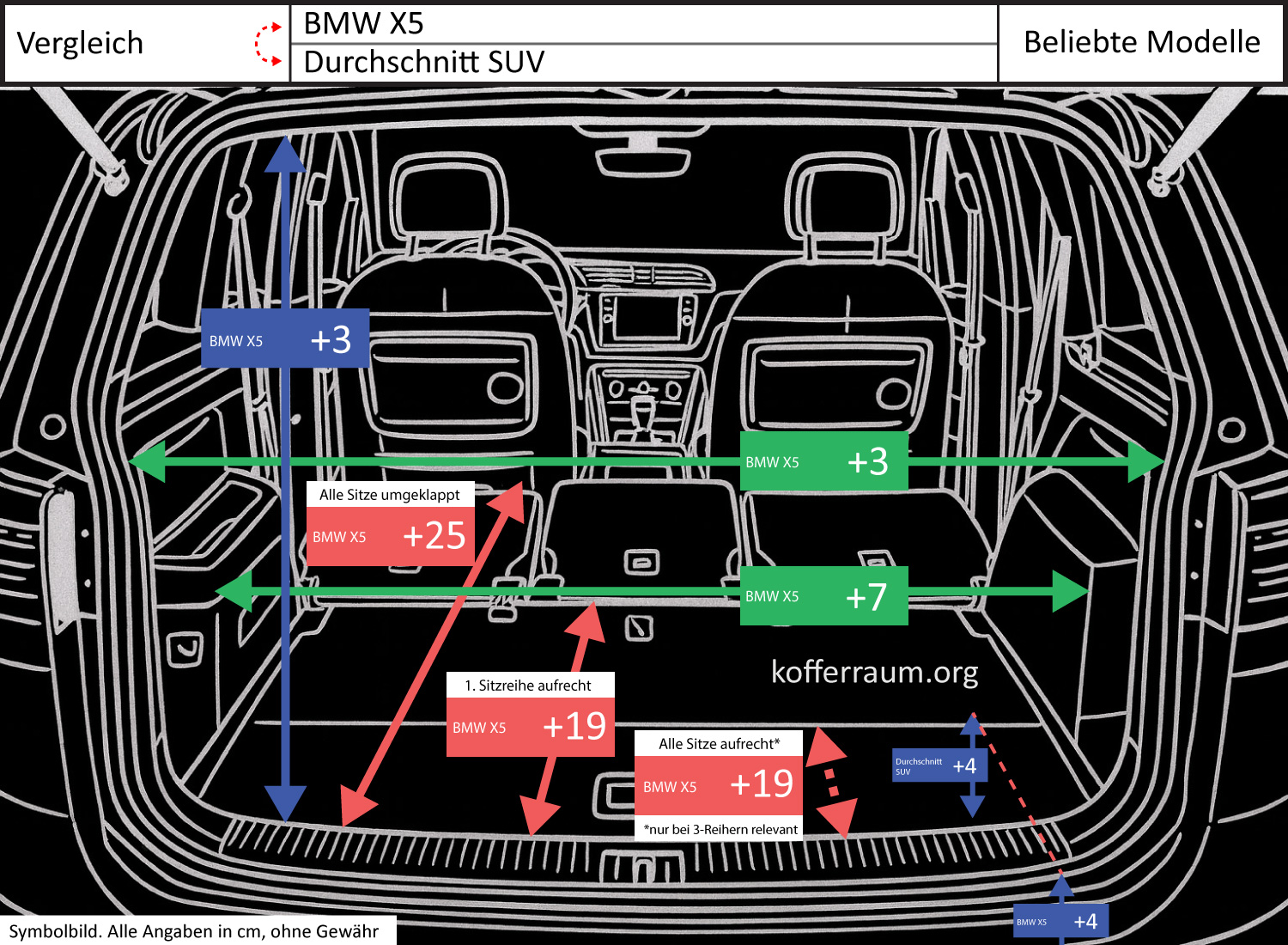
The BMW X5 offers a significantly larger cargo area in the longitudinal direction: with the seats folded down, the trunk of the X5 is 9.8 in (16%) longer, and with the first row of seats upright, it is 7.5 in (22%) longer than the average SUV.
Additionally, the depth between the loading edge and the trunk floor is 1.6 in greater in the average SUV (indicated as 400% relative to the BMW X5 in the data) — this is also a considerable difference.
The other values differ only slightly: height of the trunk opening +1.2 in (4%), loading edge +1.6 in (5%), narrowest trunk width +2.8 in (7%), width of the trunk opening +1.2 in (3%) — these differences are under 10%.
Impact on Usability
The greater loading length of the BMW X5 means practically: longer items (skis, slats, furniture pieces, bulky boxes) can be transported more easily, both with folded seats and with the first row occupied. For users who frequently transport long cargo or longer luggage, the X5 is clearly more flexible in everyday use.
The greater depth (distance loading edge → trunk floor) in the average SUV combined with a slightly lower loading edge means that its cargo area is overall deeper.
In practice, this means heavy or bulky loads tend to have to be lifted a bit higher in the X5, while in the average SUV they can be loaded lower and thus often more easily and transported more stably lying down. Due to the flatter inner tub of the X5, loads lie less deep and can rest more flatly if needed.
Conclusion: The BMW X5 clearly scores in length and thus in transporting long items. The average SUV offers better conditions for easier lifting and more stable, deeper storage of heavy loads due to the deeper cargo area. Smaller differences in width and opening height are usually of little practical relevance.